
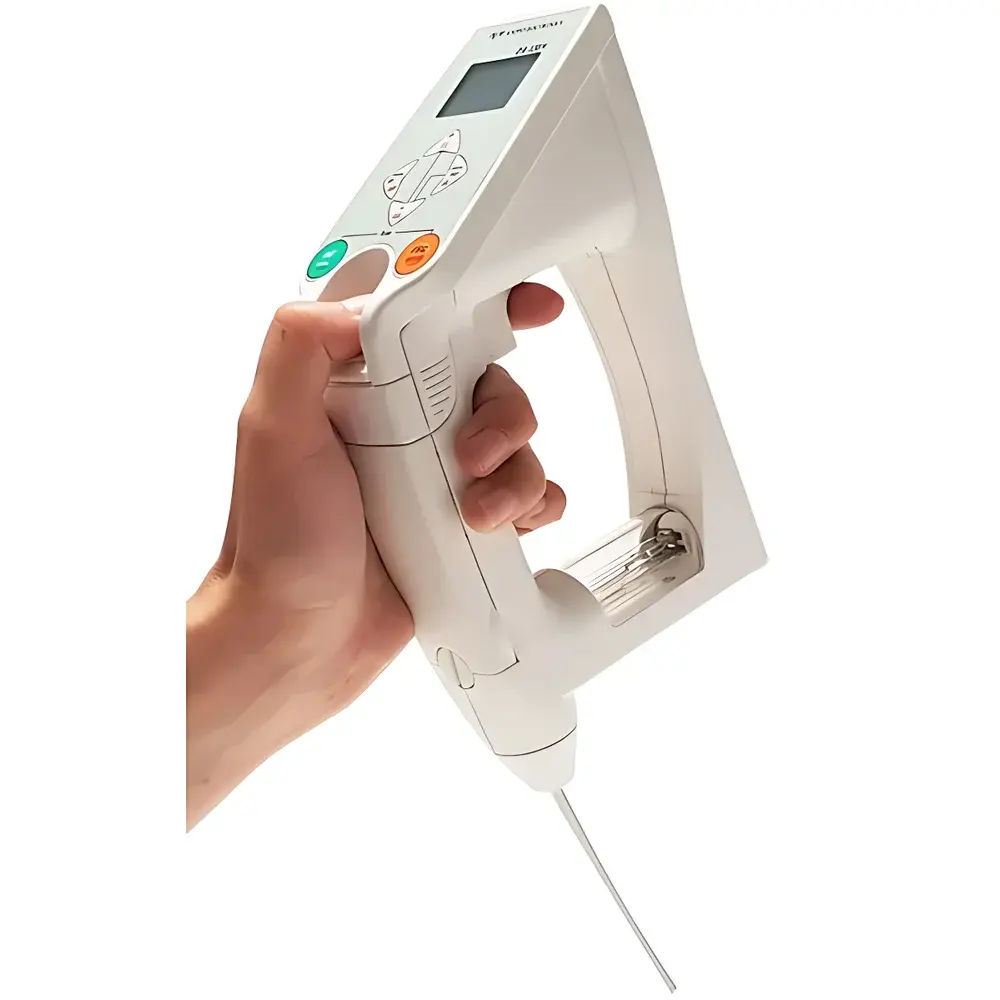
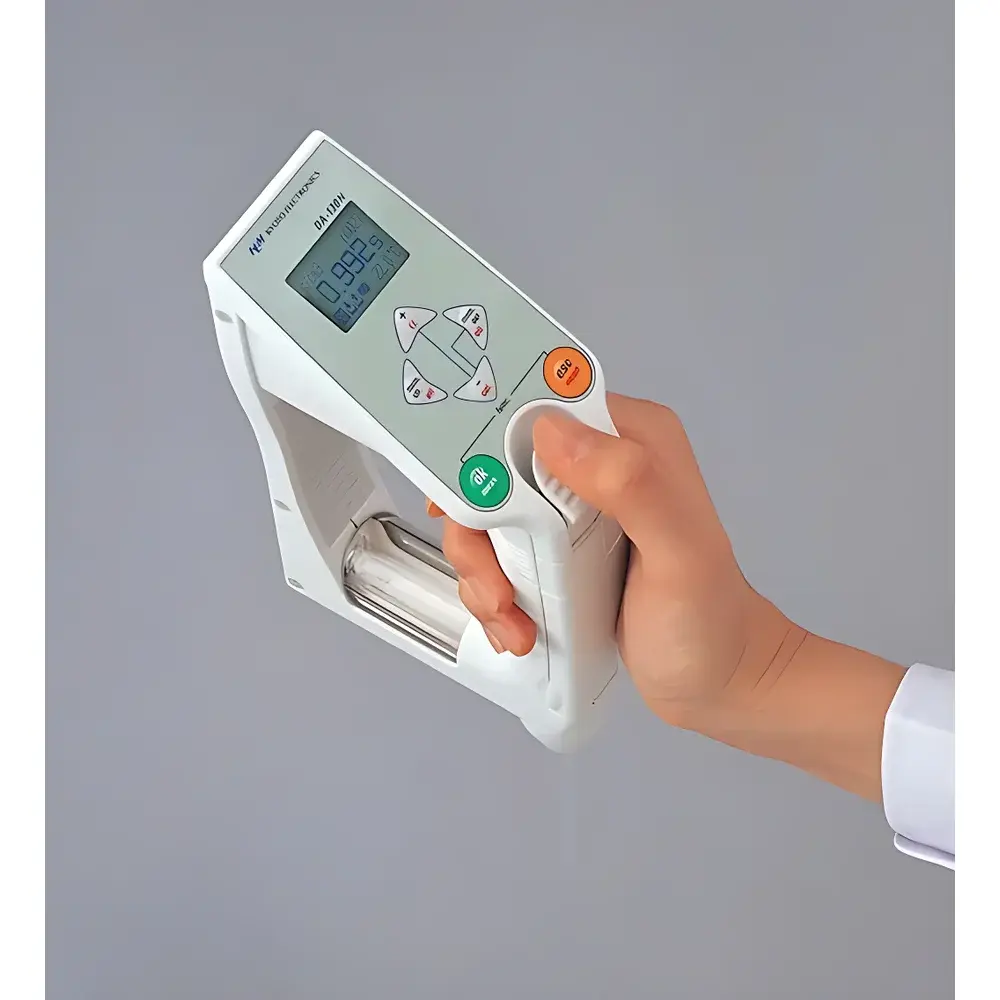
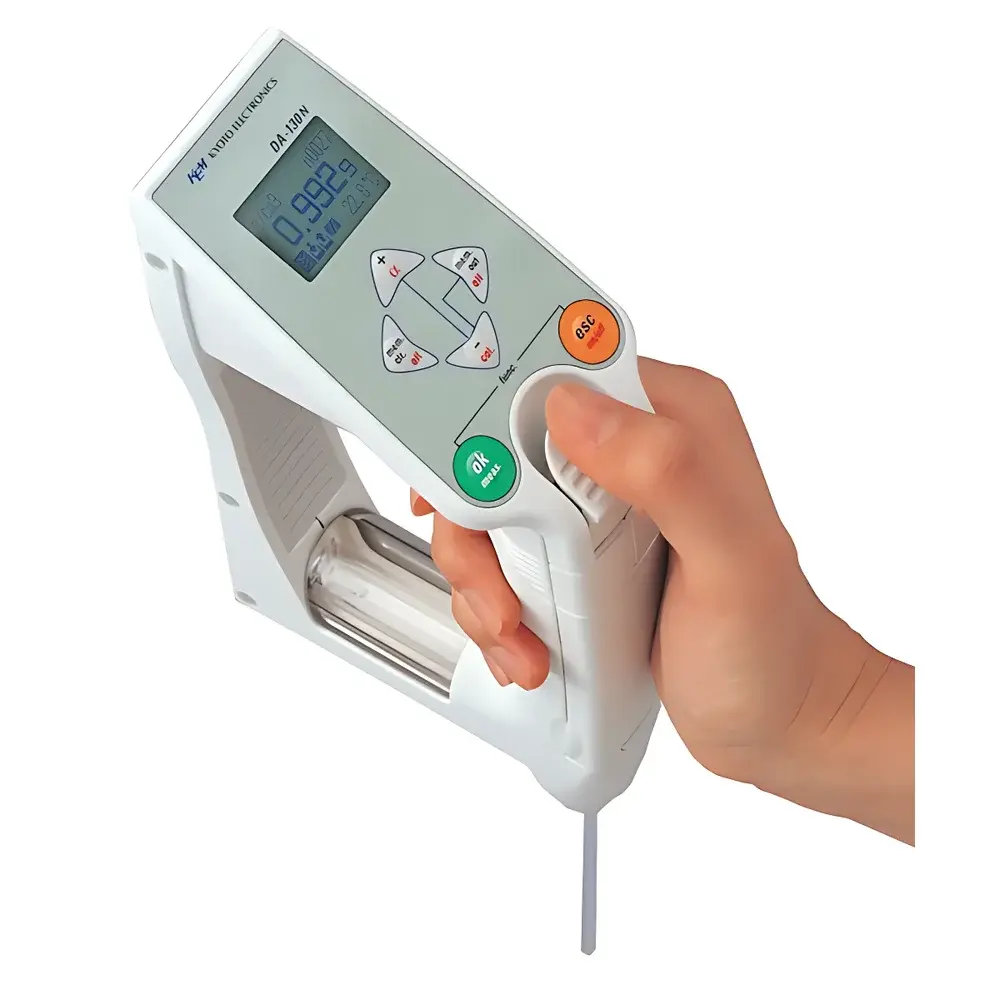
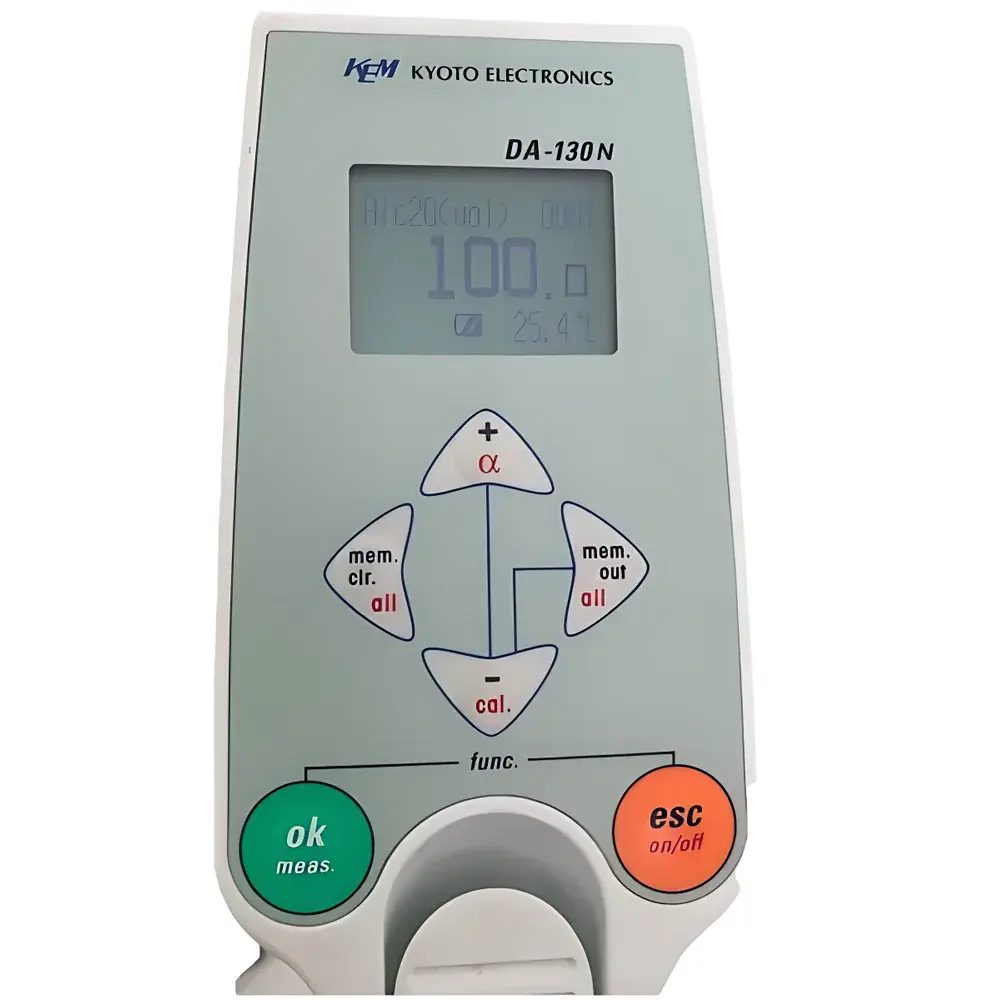
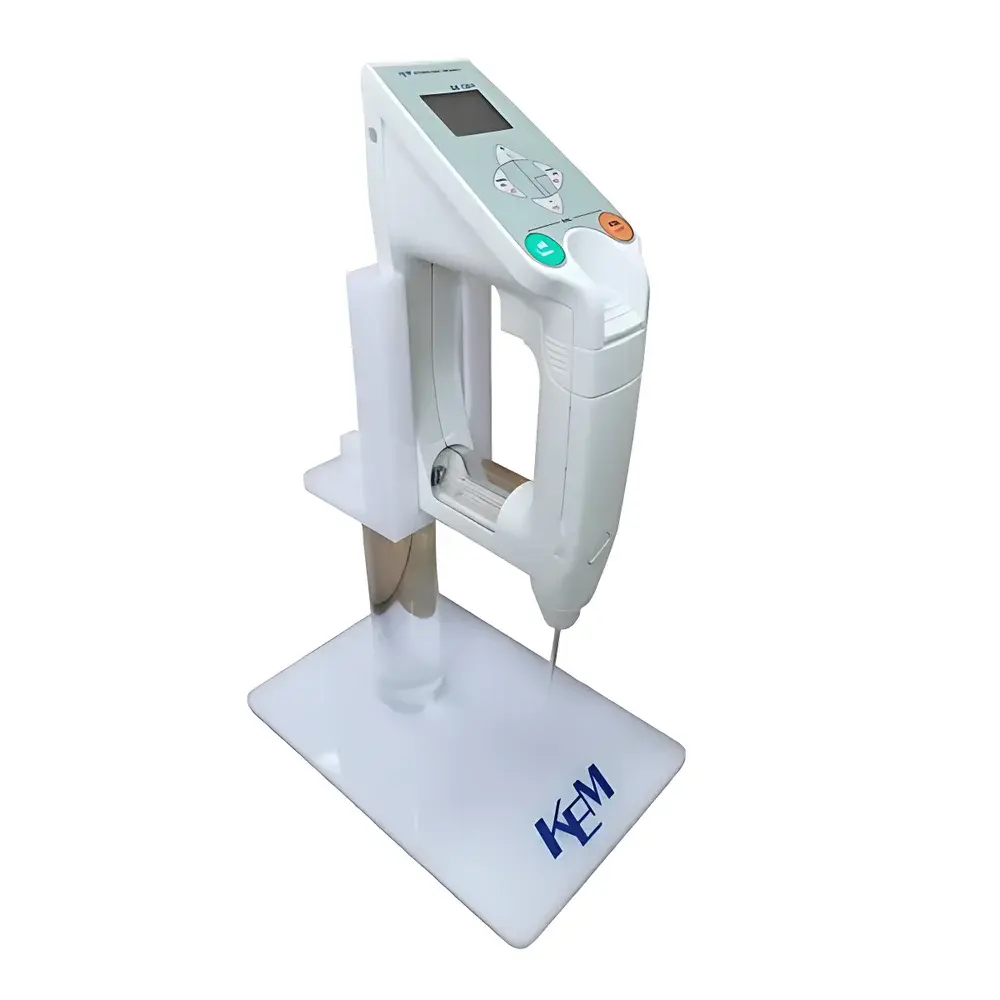
KEM DA-130N Portable Digital Alcohol Meter
| Brand | KEM (Kyoto Electronics Manufacturing) |
|---|---|
| Origin | Japan |
| Manufacturer | Kyoto Electronics Manufacturing Co., Ltd. |
| Model | DA-130N |
| Measurement Principle | U-tube oscillating densimetry |
| Alcohol Content Range | 0.0–100.0 % v/v |
| Density Range | 0.0000–2.0000 g/cm³ |
| Accuracy | ±0.2 % v/v |
| Resolution | 0.1 % v/v |
| Temperature Range | 0–40 °C |
| Dimensions (W×D×H) | 65 × 115 × 235 mm |
| Weight | 360 g |
| Sample Viscosity Limit | ≤2000 mPa·s |
| Data Storage Capacity | 1,100 measurements |
| Interface | Infrared (IR), optional RS-232C |
| Power Supply | Two 1.5 V alkaline batteries (approx. 90 h operation) |
Overview
The KEM DA-130N Portable Digital Alcohol Meter is a precision handheld instrument engineered for rapid, field-deployable determination of ethanol concentration in alcoholic beverages and industrial alcohol solutions. It operates on the internationally recognized U-tube oscillating densimetry principle—where the resonant frequency of a precisely machined U-shaped glass tube filled with sample correlates directly to its density at a defined temperature. By measuring the oscillation period of the tube under controlled thermal conditions, the DA-130N calculates the density of the distilled alcohol-water distillate, then applies KEM’s certified alcohol–water density correlation tables (traceable to NIST-referenced standards) to derive ethanol content as volume percent (% v/v) or mass percent (% w/w) at standardized reference temperatures (15 °C or 20 °C). This method eliminates subjective meniscus reading errors inherent in traditional pycnometers or hydrometric alcoholometers and conforms to core principles outlined in ISO 3696 (Water for analytical laboratory use), AOAC Official Method 982.07 (Alcohol in Alcoholic Beverages), and relevant sections of OIML R 22 (International Recommendation for Alcoholometers). The device is designed for compliance-ready workflows in QC laboratories, production lines, customs inspection points, and third-party testing facilities handling fermented, distilled, and fortified beverages.
Key Features
- Full-range ethanol quantification from 0.0 to 100.0 % v/v with ±0.2 % v/v accuracy and 0.1 % v/v resolution
- Integrated temperature-compensated density calculation using built-in water density reference values per IAPWS-95 formulation
- Onboard calibration support: air zeroing, pure water density validation, and user-defined standard solution calibration
- Dual-mode display: simultaneous readout of density (g/cm³), relative density (d20/20), ethanol concentration (% v/v and % w/w), proof (US/UK), and ambient temperature (°C/°F)
- Motorized micro-pump capable of aspirating samples up to 2000 mPa·s viscosity—enabling direct analysis of unfiltered wine must, liqueurs, and viscous herbal infusions
- Internal memory stores 1,100 complete measurement records with timestamp, sample ID, temperature, and stability flag
- Infrared (IR) wireless data transmission to PC; optional RS-232C interface supports GLP-compliant printer output and CSV export
- Ergonomic handheld design (360 g, 65 × 115 × 235 mm) with tactile controls and low-power LCD for extended battery life (~90 h on two AA alkaline cells)
Sample Compatibility & Compliance
The DA-130N is validated for direct analysis of distilled alcohol–water fractions derived from diverse beverage matrices—including beer, wine, sake, shochu, baijiu, brandy, whisky, rum, gin, and herbal liqueurs—as well as undiluted industrial ethanol, denatured alcohol, pharmaceutical-grade ethanol, and disinfectant formulations. Prior distillation (per ISO 15512 or AOAC 982.07) ensures removal of non-volatile interferents (e.g., sugars, polyphenols, glycerol), enabling measurement traceable to primary density standards. The instrument’s algorithm implements temperature correction based on empirical ethanol–water density surfaces compliant with ISO 5959 and USP , supporting both % v/v labeling requirements (mandatory for all alcoholic beverages under EU Regulation (EU) No 1169/2011 and China GB 2757–2012) and % w/w reporting for technical ethanol specifications (ASTM D4806, ISO 3104). Its compact form factor satisfies mobile lab accreditation criteria under ISO/IEC 17025:2017 Clause 6.4.3 for portable instrumentation used in accredited testing.
Software & Data Management
KEM provides dedicated Windows-compatible data collection software (KEM DA-130N Manager) that enables bidirectional IR communication, batch export of measurement logs (CSV/Excel), customizable report templates, and audit trail generation. All stored entries include automatic time/date stamping, operator ID fields, and pass/fail stability assessment flags based on real-time oscillation damping metrics. When connected via RS-232C to a networked PC, the system supports FDA 21 CFR Part 11–compliant electronic signatures and role-based access control when deployed within validated GxP environments. Raw frequency and temperature data are retained alongside final ethanol results, facilitating retrospective uncertainty budgeting per ISO/IEC Guide 98-3 (GUM).
Applications
- QC release testing of finished alcoholic beverages prior to bottling or labeling
- In-process monitoring during distillation, blending, and fortification operations
- Regulatory compliance verification for alcohol content labeling (EU, USA, China, Japan, ASEAN)
- Raw material screening of food-grade and pharma-grade ethanol solvents
- Customs and border inspection of imported spirits and fermented products
- Research applications in enology, fermentation science, and beverage formulation
- Field audits by certification bodies (e.g., HACCP, BRCGS, ISO 22000 auditors)
FAQ
Does the DA-130N require sample distillation before measurement?
Yes. Per international standard methods (AOAC 982.07, ISO 15512), distillation is mandatory to isolate ethanol from non-volatile matrix components. The DA-130N measures only the density of the distilled fraction.
Can it measure undiluted high-proof spirits directly?
No. Even 95% v/v ethanol requires distillation to remove residual congeners and ensure measurement fidelity against the certified density–ethanol calibration surface.
Is temperature control of the sample required?
The instrument performs automatic internal temperature compensation using its integrated Pt100 sensor, but optimal accuracy is achieved when samples are equilibrated near ambient (0–40 °C); extreme thermal gradients may affect pump aspiration consistency.
How is calibration traceability maintained?
Calibration uses double-point verification: air (density = 0.0012 g/cm³ at 20 °C) and certified water (density = 0.998203 g/cm³ at 20 °C), both traceable to national metrology institutes (NMI-Japan, NIST).
Does it support GLP/GMP documentation requirements?
Yes—when paired with optional RS-232C and KEM software, it generates timestamped, operator-identified records with full metadata, satisfying ALCOA+ data integrity principles for regulated environments.




