
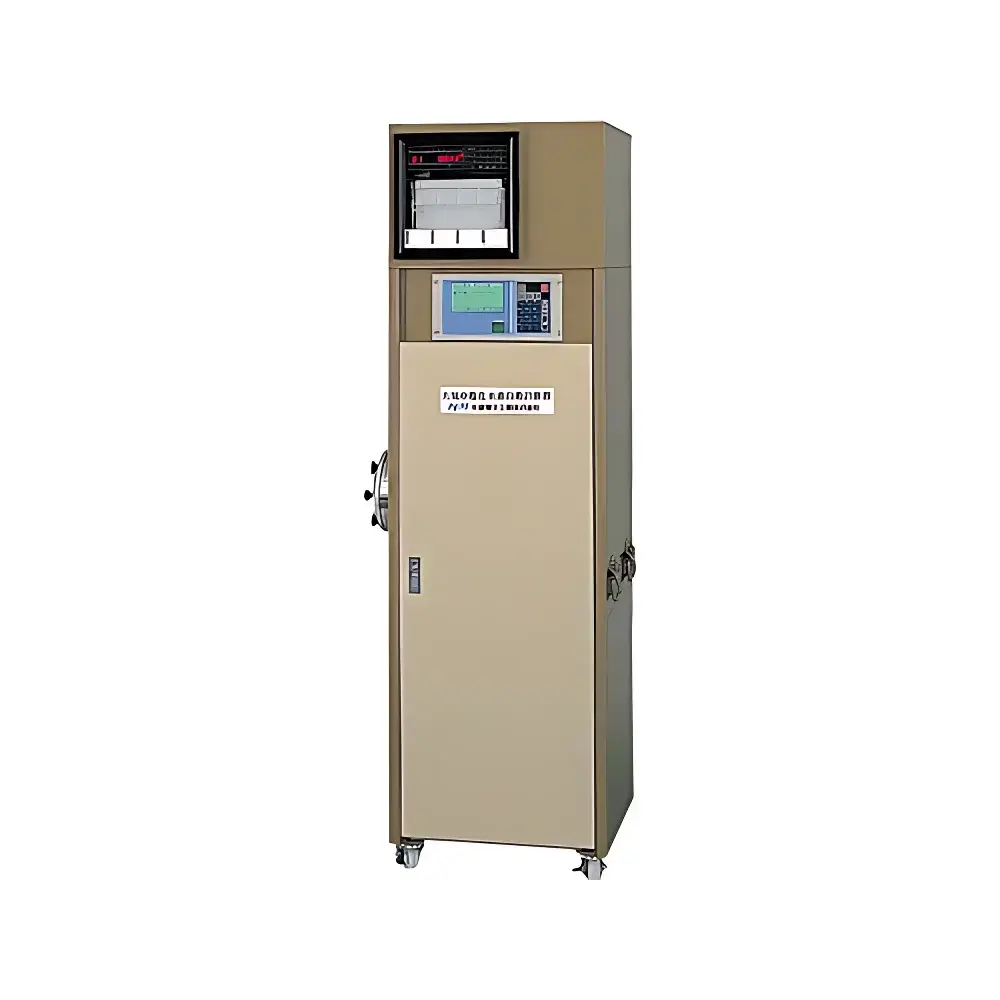
KEM HL-48 Continuous Atmospheric Hydrogen Chloride Analyzer
| Brand | Kyoto Electronics Manufacturing (KEM) |
|---|---|
| Origin | Japan |
| Manufacturer Type | Original Equipment Manufacturer (OEM) |
| Product Origin | Imported |
| Model | HL-48 |
| Pricing | Available upon Request |
Overview
The KEM HL-48 Continuous Atmospheric Hydrogen Chloride Analyzer is a dedicated, laboratory-grade online monitoring system engineered for the precise, real-time quantification of gaseous hydrogen chloride (HCl) in ambient air and stack emissions. It operates on the principle of dual-ion-selective electrode (ISE) potentiometry—a robust, electrochemical measurement technique wherein HCl gas is selectively dissolved into an aqueous electrolyte phase within a temperature-controlled diffusion cell, generating a Nernstian potential response proportional to the logarithm of HCl activity. Unlike optical or chromatographic methods, this approach delivers stable, interference-resistant detection at sub-ppb levels without requiring consumable reagents, calibration gases, or complex optical alignment. The instrument is designed for unattended 24/7 operation in environmental monitoring stations, industrial fence-line applications, and regulatory compliance sites where trace HCl—known for its high toxicity, corrosivity, and role in acid rain formation—must be tracked continuously per national and international air quality directives.
Key Features
- Dual ion-selective electrode configuration ensures enhanced signal stability and suppression of common-mode drift, critical for long-term baseline integrity in low-concentration measurements.
- Heated sample gas line (maintained at 120 °C ± 5 °C) prevents HCl adsorption and condensation on internal surfaces, preserving quantitative transfer efficiency from sampling point to detection cell.
- High-flow sampling system (20 L/min nominal) enables rapid gas exchange in the diffusion chamber, minimizing residence time and supporting measurement cycles with effective temporal resolution of ≤ 2 minutes per data point.
- Integrated thermal management of the measurement cell maintains constant electrolyte temperature (±0.1 °C), reducing thermally induced potential drift and improving reproducibility across ambient temperature fluctuations.
- Modular hardware architecture supports field-replaceable sensor cartridges and sealed electrolyte reservoirs, facilitating maintenance under ISO/IEC 17025-aligned service protocols.
Sample Compatibility & Compliance
The HL-48 is validated for direct analysis of ambient air, diluted stack effluents, and cleanroom exhaust streams containing particulate loadings < 1 mg/m³. It complies with methodological requirements referenced in EPA Method TO-15 (as adapted for ISE-based HCl), JIS K 0311:2021 (Determination of hydrogen chloride in ambient air), and EU Directive 2008/50/EC Annex IX (reference measurement methods for HCl). Its measurement uncertainty profile—characterized by ≤ ±2% RSD (repeatability), ≤ ±3% zero drift, and ≤ ±3% span drift over 24 hours—meets the performance criteria for Class II continuous emission monitoring systems (CEMS) as defined in EN 14181. Data logging and audit trails conform to GLP and FDA 21 CFR Part 11 requirements when operated with optional KEM DataSecure™ software suite.
Software & Data Management
The HL-48 interfaces via RS-232/485 or Ethernet (Modbus TCP) to centralized SCADA or LIMS platforms. Its embedded firmware includes configurable averaging intervals (1–60 min), automatic zero/span verification scheduling, and diagnostic event logging (e.g., heater fault, flow deviation >10%, electrode impedance out-of-range). Optional KEM DataSecure™ software provides electronic signature capability, user-access-level controls, change history tracking, and PDF report generation compliant with ISO 17025 clause 7.7. All raw analog outputs (4–20 mA, 0–10 V) are linearized and temperature-compensated in real time, eliminating post-processing dependencies.
Applications
- Continuous fence-line monitoring around chlor-alkali plants, PVC production facilities, and waste incineration units.
- Regulatory reporting for national ambient air quality standards (e.g., US EPA NAAQS, China GB 3095-2012, Japan Environmental Quality Standards).
- Process safety interlock support in semiconductor fab exhaust handling systems where HCl leaks pose equipment corrosion and personnel exposure risks.
- Research-grade validation of dispersion models and atmospheric chemistry simulations requiring high-temporal-resolution HCl time-series data.
- Calibration reference source for portable HCl sensors used in occupational hygiene surveys.
FAQ
What is the lower detection limit of the HL-48 under standard operating conditions?
The instrument achieves a practical quantitation limit of 0.5 ppb (signal-to-noise ratio ≥ 10) when operated with optimized flow control and thermal stabilization.
Can the HL-48 operate in high-humidity environments without condensation artifacts?
Yes—the heated sampling line and diffusion cell design prevent dew-point-related adsorption or hydrolysis, enabling reliable operation at relative humidity up to 95% RH.
Is routine calibration required, and what standards are recommended?
Zero calibration uses purified nitrogen; span calibration employs certified HCl-permeation tube standards traceable to NIST SRM 2691, with quarterly verification recommended per ISO 17025 Clause 7.6.2.
Does the system support remote diagnostics and firmware updates?
Remote access is supported via secure TLS-enabled web interface; firmware updates require authenticated USB key authorization to maintain data integrity and regulatory compliance.







