
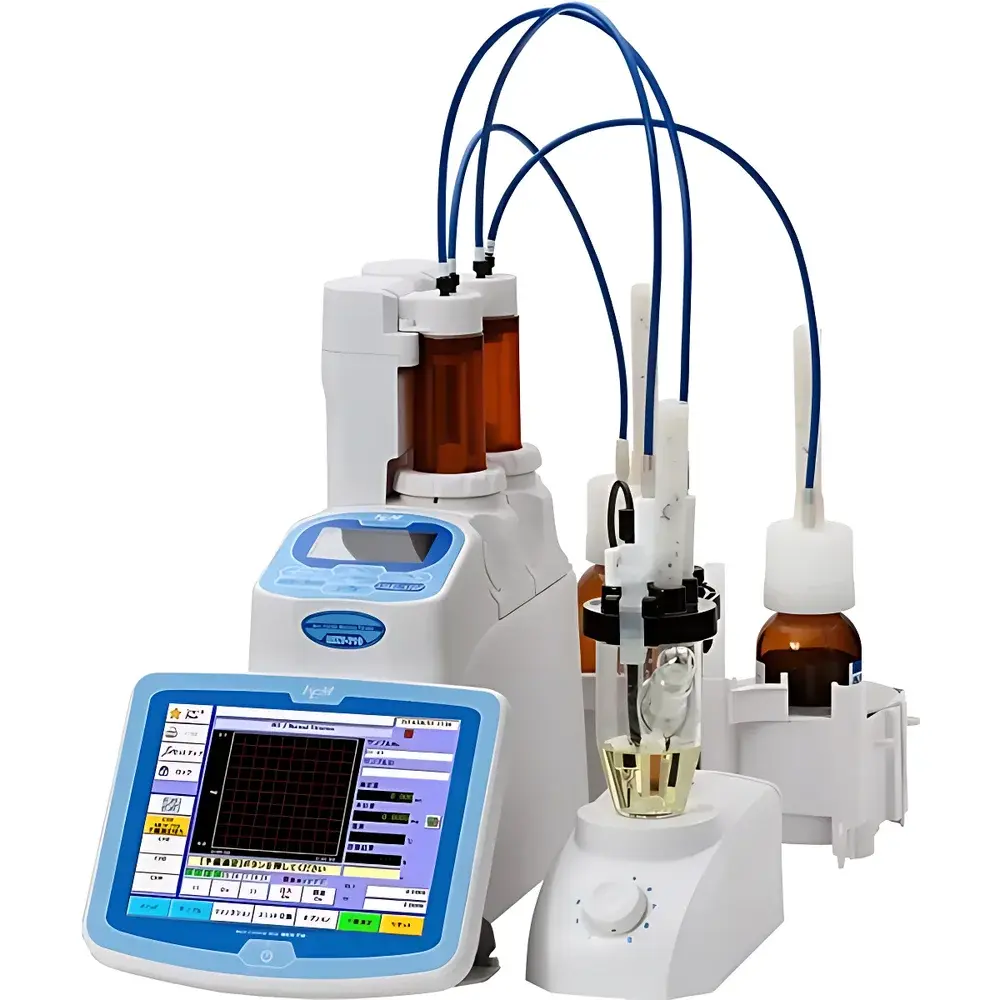
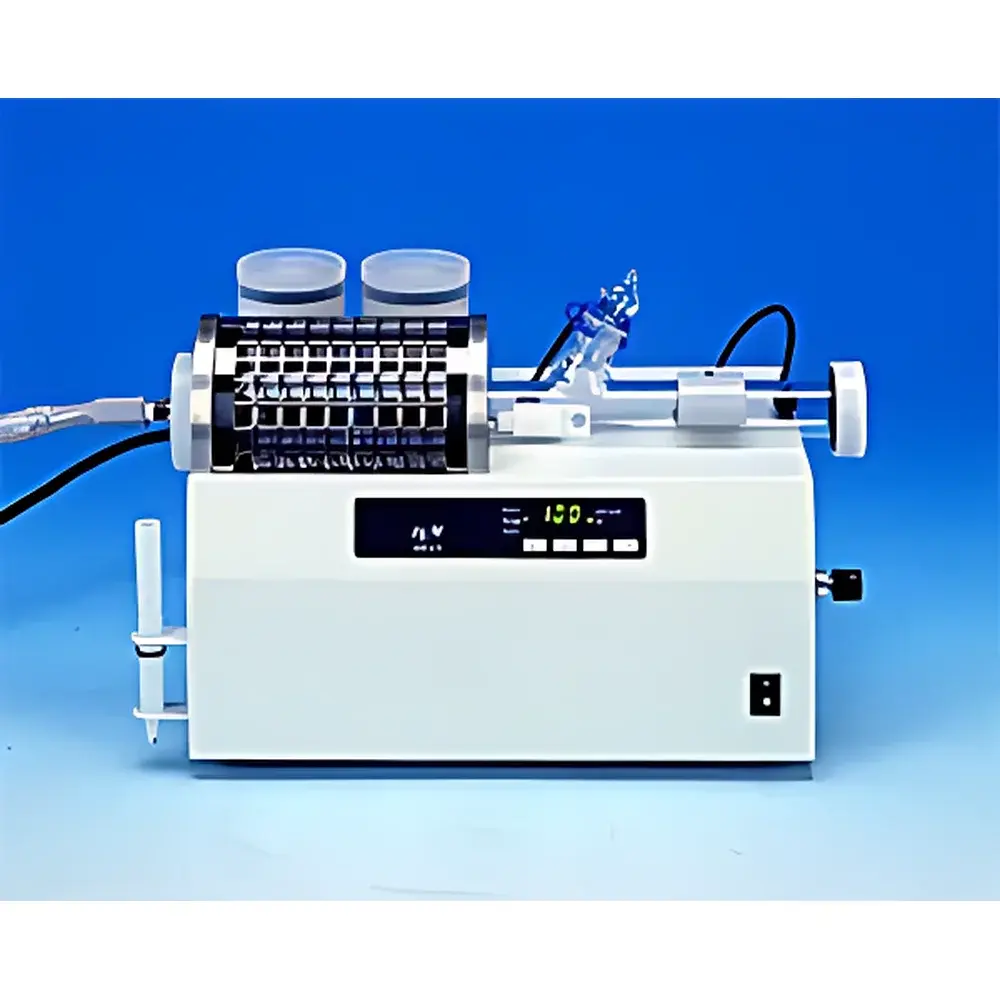
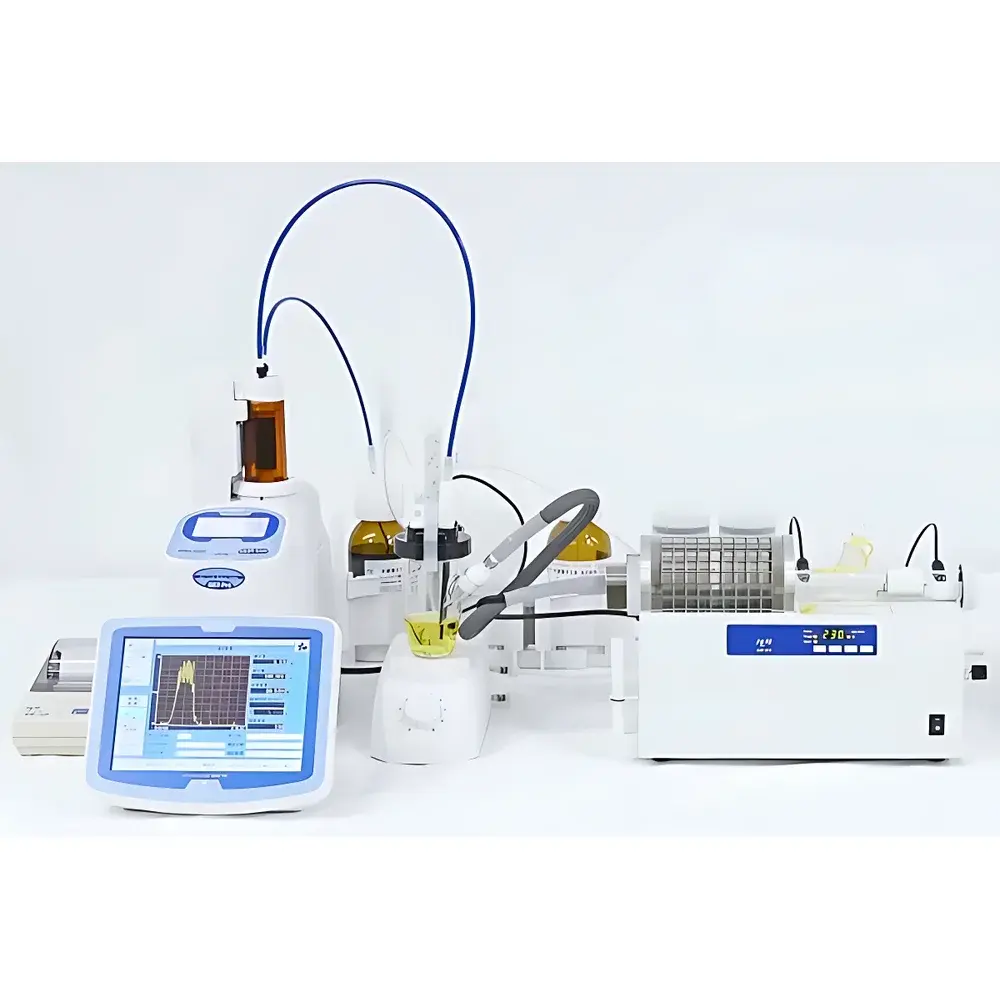
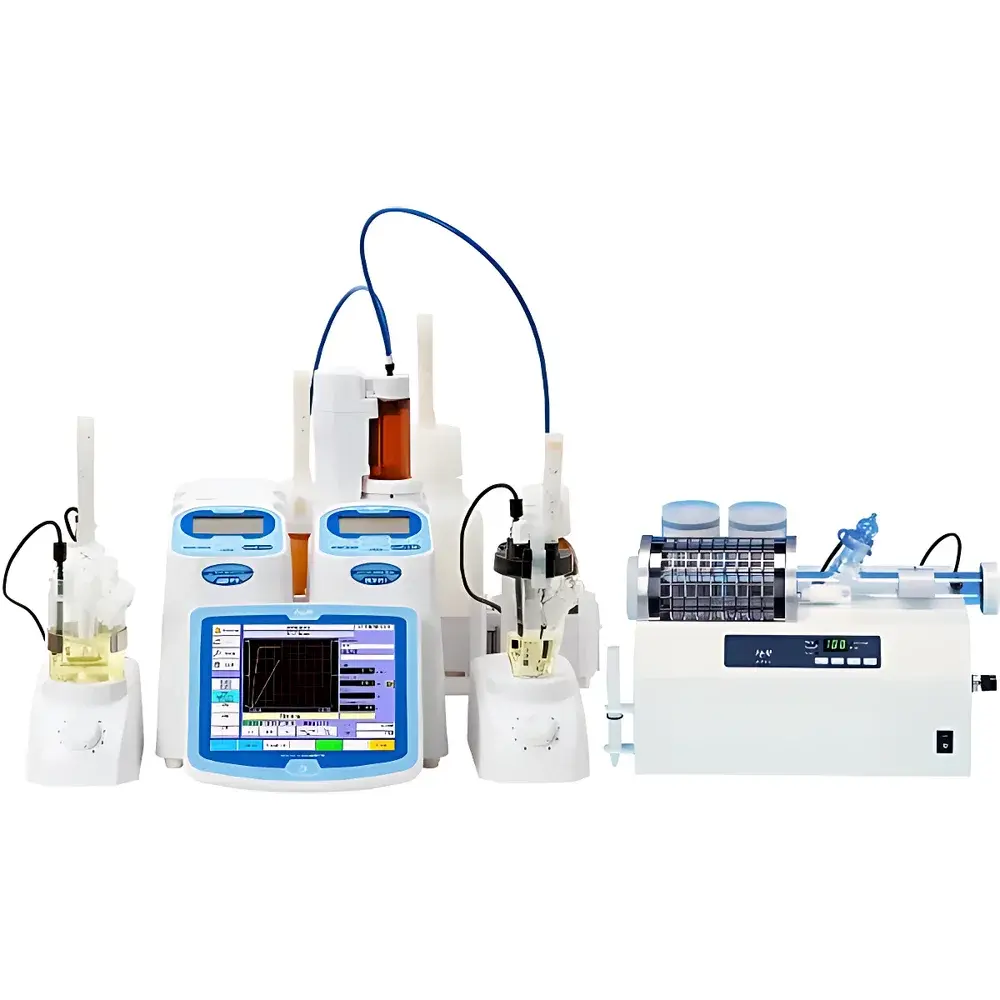
KEM MKV-710S Volumetric Karl Fischer Titrator with ADP-611 Heating Oven (ASTM D6869-25 Compliant)
| Brand | KEM (Kyoto Electronics Manufacturing) |
|---|---|
| Origin | Japan |
| Manufacturer Type | Original Equipment Manufacturer (OEM) |
| Instrument Category | Imported |
| Model | MKV-710S + ADP-611 |
| Price Range | USD 14,000 – 70,000 |
Overview
The KEM MKV-710S volumetric Karl Fischer titrator coupled with the ADP-611 sample heating oven is a fully integrated, GLP-compliant moisture determination system engineered for precise, trace-level water quantification in thermally stable and low-solubility solid polymers—including plastic pellets, engineering resins, polyamide (PA6), polyurethane precursors, and battery separator films. It operates on the stoichiometric Karl Fischer reaction, wherein iodine reacts quantitatively with water in an anhydrous methanol-based electrolyte medium. Unlike coulometric systems, this volumetric configuration delivers high reproducibility across wide moisture concentration ranges (1 ppm to 100% w/w) by precisely dispensing standardized iodine-containing titrant via a calibrated 10 mL burette. The system adheres strictly to ASTM D6869-25, ISO 15512:2019, and multiple Chinese national standards (e.g., GB/T 38138-2019, GB/T 45128-2025), making it suitable for quality control laboratories operating under ISO/IEC 17025, IATF 16949, or FDA-regulated GMP environments.
Key Features
- 8.4-inch full-color TFT-LCD touchscreen interface with eight-language support (English, Chinese, Japanese, Korean, Russian, Spanish, German, French) and modular hardware architecture—touchscreen and titration unit operate independently yet synchronously.
- Dedicated GLP management suite: operator authentication, reagent lot tracking, performance verification logs, and audit-ready time-stamped method execution records.
- Smart burette module with embedded memory chip storing titrant concentration, expiration date, and calibration history—enabling automatic reagent recognition and traceability.
- Reduced dead-volume titration head minimizes reagent consumption and improves endpoint resolution; supports both forward and back-titration modes (second burette optional).
- ADP-611 pyrolytic oven features transparent conductive glass heating elements, K-type thermocouple feedback control (±2 °C accuracy), and automated temperature ramp scanning to determine optimal desorption profiles per sample matrix.
- Magnetic sample boat transport mechanism eliminates manual handling—reducing ambient moisture ingress during transfer—and enables repeatable positioning within the Pyrex evaporation tube (φ30 × 335 mm).
- Integrated gas management: programmable carrier flow (100–300 mL/min N₂ or dried air), dual synthetic zeolite drying columns (100 g each), and real-time digital display of temperature and flow rate.
Sample Compatibility & Compliance
The MKV-710S+ADP-611 system is validated for heterogeneous, hygroscopic, and chemically inert polymer matrices that resist direct dissolution in KF solvent—such as PET, PBT, PC, PA6, PA66, POM, TPU, and ceramic-coated lithium-ion battery separators. Its thermal desorption capability (50–300 °C) ensures complete water release from crystalline lattices and surface-adsorbed moisture without decomposition. Regulatory alignment includes ASTM D6869-25 (primary reference), ISO 15512:2019, USP , and numerous GB/T and FZ/T standards governing moisture in polyamide chips, polyol feedstocks, and specialty films. All measurement data comply with 21 CFR Part 11 requirements when used with KEM’s certified TitraLab® software and external electronic signature modules.
Software & Data Management
Data acquisition, calculation, and reporting are managed via KEM’s embedded firmware and optional TitraLab® PC software. Each analysis stores raw potential curves, endpoint detection parameters (polarization duration: 1–99 s), blank correction values, and titrant titer updates automatically. Up to 500 sample results are retained onboard; export options include USB-stored PDF reports (with embedded spectra and metadata), CSV files for LIMS integration, and direct RS-232 output to balance or printer. The system supports method libraries (120 preloaded protocols), statistical summaries (mean, RSD, confidence intervals), and customizable report templates compliant with internal QA documentation workflows.
Applications
- Quality assurance of hygroscopic engineering plastics prior to injection molding or extrusion—ensuring melt viscosity stability and minimizing hydrolysis-induced degradation.
- Release testing of polyamide (PA6, PA66) chips per GB/T 38138-2019 Method A and FZ/T 51004-2011 specifications.
- Moisture verification of polyurethane polyols (GB/T 22313-2008) and biodegradable polyesters (e.g., PBS, PBST) per GB/T 30294-2013.
- Trace moisture screening of ceramic-coated battery separator films (T/CPPIA 10-2021) where residual H₂O >50 ppm risks LiPF₆ electrolyte decomposition.
- Validation of desiccant performance in insulating glass units (GB/T 11944-2012 Annex D) and moisture uptake kinetics in polymer packaging films.
FAQ
What sample types require the ADP-611 heating oven?
Solid, non-soluble, or thermally stable polymers—including plastic granules, powder resins, fibers, and coated films—that cannot be directly titrated due to poor solubility or slow reaction kinetics.
Is nitrogen gas mandatory for the ADP-611?
Yes—dry nitrogen (dew point ≤ −40 °C) is required as carrier gas to prevent atmospheric moisture contamination during thermal desorption; compressed air may be used only with certified inline desiccation (e.g., dual zeolite columns).
How does the system ensure measurement traceability?
Through embedded reagent chip memory, GLP-mandated operator ID logging, time-stamped method execution, and electronic records compatible with 21 CFR Part 11 when paired with validated software and access controls.
Can the MKV-710S operate without the ADP-611 oven?
Yes—the MKV-710S functions as a standalone volumetric KF titrator for liquids, solutions, and soluble solids; the ADP-611 is an optional but essential module for insoluble polymer matrices.
What maintenance is required for long-term accuracy?
Monthly verification of burette accuracy (±0.005 mL repeatability), annual recalibration of temperature sensors (K-type thermocouple), and routine replacement of drying agents (zeolite columns every 3–6 months depending on usage volume and ambient humidity).




