
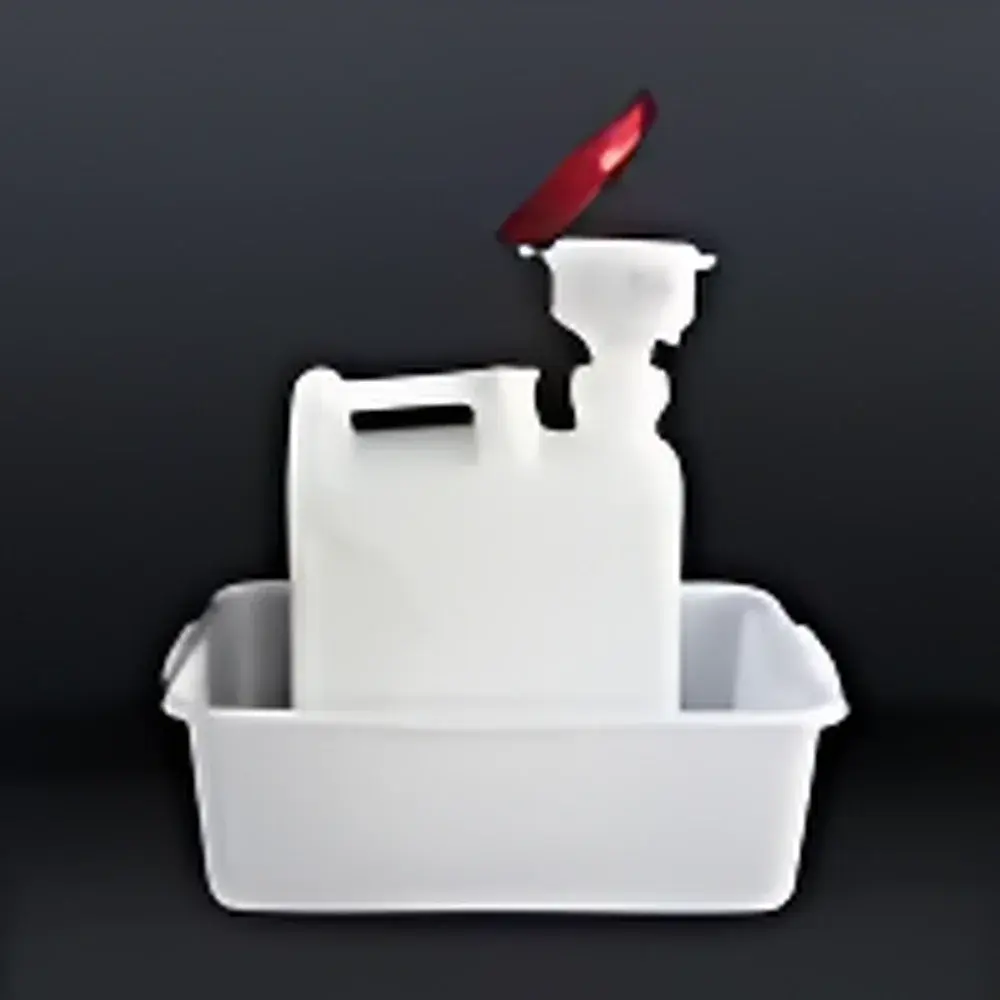
CP Lab Safety EF-4-30020C-SYS 4″ ECO Waste Collection Funnel System
| Brand | CP Lab Safety |
|---|---|
| Origin | USA |
| Manufacturer Type | Authorized Distributor |
| Product Origin | Imported |
| Model | EF-4-30020C-SYS |
| Capacity | 450 mL |
| Funnel Diameter | 4" (101.6 mm) |
| Neck Length | 11" (279 mm) |
| Top Dimensions | 5" × 7" (127 mm × 178 mm) |
| Neck Thread | 38–430 |
| Material | High-Density Polyethylene (HDPE) |
| Filter Included | Yes |
| Max HPLC Fittings | 6 |
| Compatible Container Sizes | 20 L rectangular solvent carboy |
Overview
The CP Lab Safety EF-4-30020C-SYS is a precision-engineered 4-inch ECO waste collection funnel system designed for safe, compliant, and vapor-reduced disposal of hazardous organic solvents in analytical and synthetic laboratories. Unlike conventional open-top waste containers—known sources of volatile organic compound (VOC) emissions, fire hazards, and cross-contamination—the EF-4-30020C-SYS employs a sealed, threaded-neck architecture to physically isolate waste streams while maintaining operational accessibility. Its core function is rooted in passive vapor containment: the extended 11-inch neck creates a high-resistance diffusion path that reduces solvent vapor escape by ≥99% compared to standard funnels (per ASTM D5198-22 methodology for VOC emission estimation). This design directly supports OSHA 29 CFR 1910.1200 (Hazard Communication), NFPA 30 Flammable and Combustible Liquids Code, and EPA 40 CFR Part 262 hazardous waste management requirements. The system is not a filtration device per se but integrates a removable particulate filter to prevent solid residue ingress into downstream containers—critical for protecting pumps, valves, and pressure sensors in integrated HPLC, GC, or peptide synthesis workflows.
Key Features
- Threaded 38–430 neck interface ensures leak-tight, repeatable coupling with certified HDPE, LDPE, and polypropylene waste containers—including 20 L rectangular carboys (model-specific compatibility confirmed via EF-4-30020 designation).
- High-density polyethylene (HDPE) construction provides broad chemical resistance across common laboratory solvents: acetonitrile, methanol, chloroform, ethyl acetate, DMF, DMSO, and dilute acids/bases (per ASTM D543-21 compatibility testing).
- Integrated particulate filter (non-woven polypropylene, nominal 50 µm retention) prevents clogging of narrow-necked carboys and safeguards downstream fluid-handling components.
- Compact footprint (5″ × 7″ top profile) enables stable placement inside fume hoods, sink basins, or on benchtops without obstructing adjacent instrumentation.
- Modular configuration supports up to six standardized HPLC waste line fittings (¼”-28 UNF or M6×1 ports), enabling direct integration with autosamplers, fraction collectors, and preparative chromatography systems.
- Color-coded cap options (e.g., yellow for flammables, red for corrosives) align with ANSI Z535.4 hazard labeling conventions for rapid visual identification.
Sample Compatibility & Compliance
The EF-4-30020C-SYS is validated for use with liquid-phase analytical and synthesis platforms generating Class I (flammable) and Class II (combustible) wastes. It complies with institutional biosafety level (BSL-2) and chemical hygiene plan (CHP) requirements for solvent handling. While not a certified explosion-proof device, its HDPE body and static-dissipative properties (surface resistivity <10¹¹ Ω/sq) mitigate ignition risk when used with grounded metal carboys. The system meets GLP documentation standards for waste stream traceability when paired with barcoded container labels and electronic lab notebook (ELN) entries. It is routinely specified in pharmaceutical QC labs operating under FDA 21 CFR Part 211 (cGMP) and ISO/IEC 17025-accredited testing facilities where VOC exposure monitoring is mandated per ACGIH TLV® guidelines.
Software & Data Management
As a passive mechanical component, the EF-4-30020C-SYS does not incorporate embedded electronics or firmware. However, it interfaces seamlessly with laboratory information management systems (LIMS) and ELNs via standardized container labeling protocols. When deployed with CP Lab Safety’s companion QR-coded carboy labels (sold separately), users can log waste type, volume, date, and responsible analyst directly into LIMS modules supporting 21 CFR Part 11 audit trails. Integration with chromatography data systems (CDS) such as Waters Empower or Thermo Chromeleon is achieved through configurable waste event triggers—e.g., “fraction collection complete” signals initiate automated timestamped entry of waste container ID and solvent class.
Applications
- HPLC and UHPLC waste collection from UV/Vis, fluorescence, and MS detectors—preventing column backpressure fluctuations caused by vapor lock in drain lines.
- DNA synthesizer and peptide synthesizer effluent management, where repeated cycles of acetonitrile and dichloroacetic acid require continuous vapor suppression.
- Preparative LC and flash chromatography systems using large-volume solvent gradients; the 20 L carboy compatibility eliminates frequent container changes.
- GC solvent vent lines and cold trap condensates—reducing ambient benzene/toluene/xylene (BTX) concentrations in shared instrument rooms.
- Academic teaching labs implementing green chemistry principles (ACS GCI metrics), where VOC reduction contributes directly to institutional sustainability reporting.
FAQ
Is the EF-4-30020C-SYS compatible with glass carboys?
No. HDPE funnels are not rated for thermal or mechanical stress associated with glass. Only HDPE, LDPE, and PP containers listed in the EF-4-30020 specification sheet are approved.
Can the filter be autoclaved?
No. The polypropylene filter is not autoclave-stable. Replace after 50–100 L of typical HPLC waste flow or upon visible particulate loading.
Does this system meet NFPA 30 requirements for flammable liquid storage?
Yes—when used with UL-listed, grounded HDPE carboys and installed within a ventilated cabinet or fume hood per NFPA 30 Section 9.6.2.
What is the maximum operating temperature?
Continuous use up to 60°C; short-term exposure (≤30 min) to 70°C is permissible with reduced mechanical load.
How is leak integrity verified during installation?
Perform a positive-pressure test: seal the carboy outlet, apply 2 psi air pressure via the funnel inlet, and monitor for ≥5 min—pressure drop must not exceed 0.1 psi/min.



