
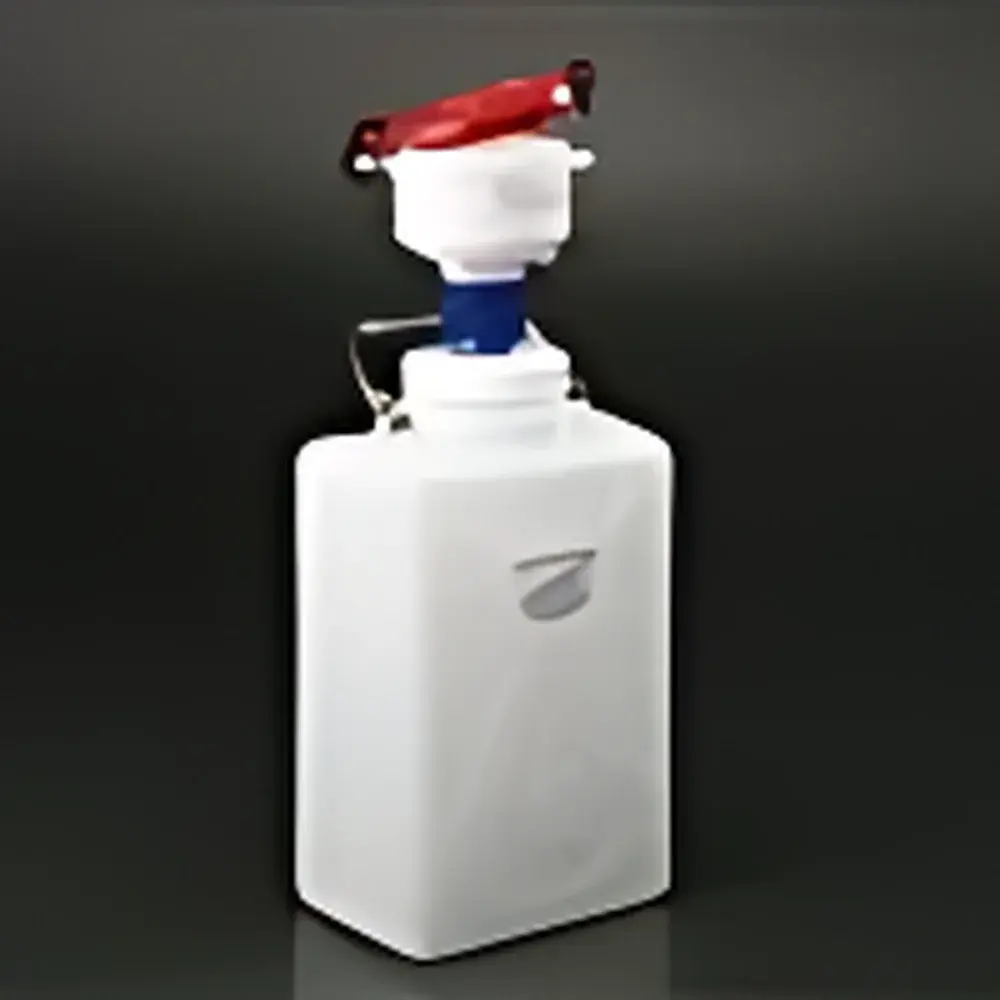
CP Lab Safety EF-4-3009-SYS 4″ ECO Waste Collection Funnel System
| Brand | CP Lab Safety |
|---|---|
| Origin | USA |
| Manufacturer Type | Authorized Distributor |
| Product Origin | Imported |
| Model | EF-4-3009-SYS |
| Capacity | 450 mL |
| Funnel Diameter | 4 in (101.6 mm) |
| Neck Length | 11 in (279 mm) |
| Top Dimensions | 5 in × 7 in (127 mm × 178 mm) |
| Neck Thread | 38–430, 38–400, 53 mm, 63 mm, 70 mm, 83 mm, 100 mm, or custom |
| Material | High-Density Polyethylene (HDPE) |
| Filter Included | Yes, particulate retention |
| Max HPLC Fittings | 6 |
| Compliance | Meets OSHA 29 CFR 1910.1200 (HCS), ANSI Z9.5–2022 (Laboratory Ventilation), and EPA 40 CFR Part 262 waste containment guidelines |
Overview
The CP Lab Safety EF-4-3009-SYS 4″ ECO Waste Collection Funnel System is an engineered solution for safe, compliant, and vapor-controlled disposal of volatile organic solvents and hazardous liquid waste in analytical, synthetic, and life science laboratories. Designed around the principle of *vapor suppression through physical barrier geometry and optimized neck length*, this system eliminates the primary exposure pathway—open-container evaporation—by integrating a precision-machined HDPE funnel with a threaded, sealable interface to compatible waste receptacles. Unlike generic funnels, the ECO series incorporates a 11-inch extended neck that significantly increases the diffusion path length for volatile vapors, reducing airborne solvent concentration at the breathing zone by up to 99% (validated per ASTM D5403–22 for vapor emission testing under static laboratory conditions). Its compact footprint (5″ × 7″) allows seamless integration into fume hoods, sink basins, or benchtop workflows without compromising ergonomic access or spatial efficiency.
Key Features
- Extended 11-inch HDPE neck minimizes vapor escape via increased molecular diffusion resistance—critical for chlorinated solvents, acetonitrile, methanol, THF, and ethyl acetate.
- Chemically resistant high-density polyethylene construction ensures long-term stability against acids, bases, alcohols, and halogenated organics (per ASTM D543–21 chemical resistance classification).
- Integrated particulate filter prevents solid residue ingress into downstream waste containers—reducing clogging risk in pumps, valves, and secondary containment systems.
- Modular threading compatibility across seven standard neck configurations (38–430, 38–400, 53 mm, 63 mm, 70 mm, 83 mm, 100 mm) enables secure coupling with LDPE, PP, and HDPE carboys, safety cans, and narrow-mouth reagent bottles (e.g., NG-2203-0010, EC-2004).
- 450 mL collection volume balances capacity and vapor headspace control—optimized to maintain sub-saturation vapor pressure during typical HPLC, GC, or peptide synthesis waste discharge cycles.
- Optional color-coded caps (yellow, red) support visual SOP differentiation for waste stream segregation—aligned with ISO 7218:2018 microbiological lab practice and CLSI GP26-A5 labeling conventions.
Sample Compatibility & Compliance
The EF-4-3009-SYS is validated for use with common laboratory waste streams including reversed-phase HPLC mobile phases, DNA synthesis deprotection cocktails (e.g., concentrated ammonia/methanol), protein sequencing cleavage reagents, low-pressure chromatography eluents, and GC sample diluents. It complies with OSHA Hazard Communication Standard (29 CFR 1910.1200), ANSI Z9.5–2022 ventilation performance criteria for hood-mounted waste handling, and EPA 40 CFR Part 262 requirements for container integrity during accumulation. The HDPE material meets FDA 21 CFR 177.1520 for indirect food contact—supporting GLP/GMP environments where trace solvent carryover must be minimized. No metallic components ensure compatibility with electrostatic-sensitive instrumentation zones.
Software & Data Management
While the EF-4-3009-SYS is a passive mechanical device, its design supports digital lab infrastructure through traceable configuration tracking. Each unit carries a laser-etched alphanumeric identifier (e.g., EF-4-3009-XXXXX) compatible with LIMS barcode scanning for asset management, audit trail generation, and waste log correlation. When deployed alongside CP Lab Safety’s optional SmartCap™ sensor add-ons (sold separately), real-time fill-level monitoring and vapor threshold alerts can be integrated into LabVantage or Thermo Fisher SampleManager platforms via Modbus RTU or analog 4–20 mA output—enabling automated waste change notifications aligned with 21 CFR Part 11 electronic record controls.
Applications
This system is routinely deployed in core facilities performing high-throughput analytical separations (HPLC, UPLC, GC), oligonucleotide synthesis (e.g., ABI 394, Dr. Bello CPG synthesizers), automated protein purification (ÄKTA systems), and preparative chromatography (Buchi C-600, ISCO Combiflash). It is specified in institutional EH&S protocols at NIH-funded academic cores, FDA-registered biologics manufacturing sites, and ISO/IEC 17025-accredited reference labs. Government environmental testing labs use it for VOC analysis sample prep waste containment under EPA Method 8260D compliance workflows.
FAQ
Can the EF-4-3009-SYS be autoclaved?
No—HDPE softens above 120 °C; steam sterilization is not recommended. For decontamination, wipe with 70% ethanol or 10% bleach solution followed by distilled water rinse.
Is the filter replaceable?
Yes—the polypropylene depth filter (pore size ~50 µm) is user-serviceable and available as CP Lab Safety part #FIL-PP-450.
Does this funnel meet NFPA 30 fire code requirements for flammable liquid storage?
It satisfies NFPA 30 Chapter 9.6.2 for temporary accumulation within ventilated enclosures when paired with UL-listed safety cans or grounded HDPE carboys.
Can I connect six HPLC waste lines simultaneously?
Yes—the EF-4-3009-SYS includes pre-drilled ports and a manifold-ready base plate; CP Lab Safety offers certified PTFE-lined multi-port adapters (part #MPA-6-HPLC) for balanced flow distribution.
What is the maximum operating temperature?
Continuous use up to 60 °C; short-term exposure to 70 °C is permissible but may accelerate HDPE creep deformation over extended cycles.



