
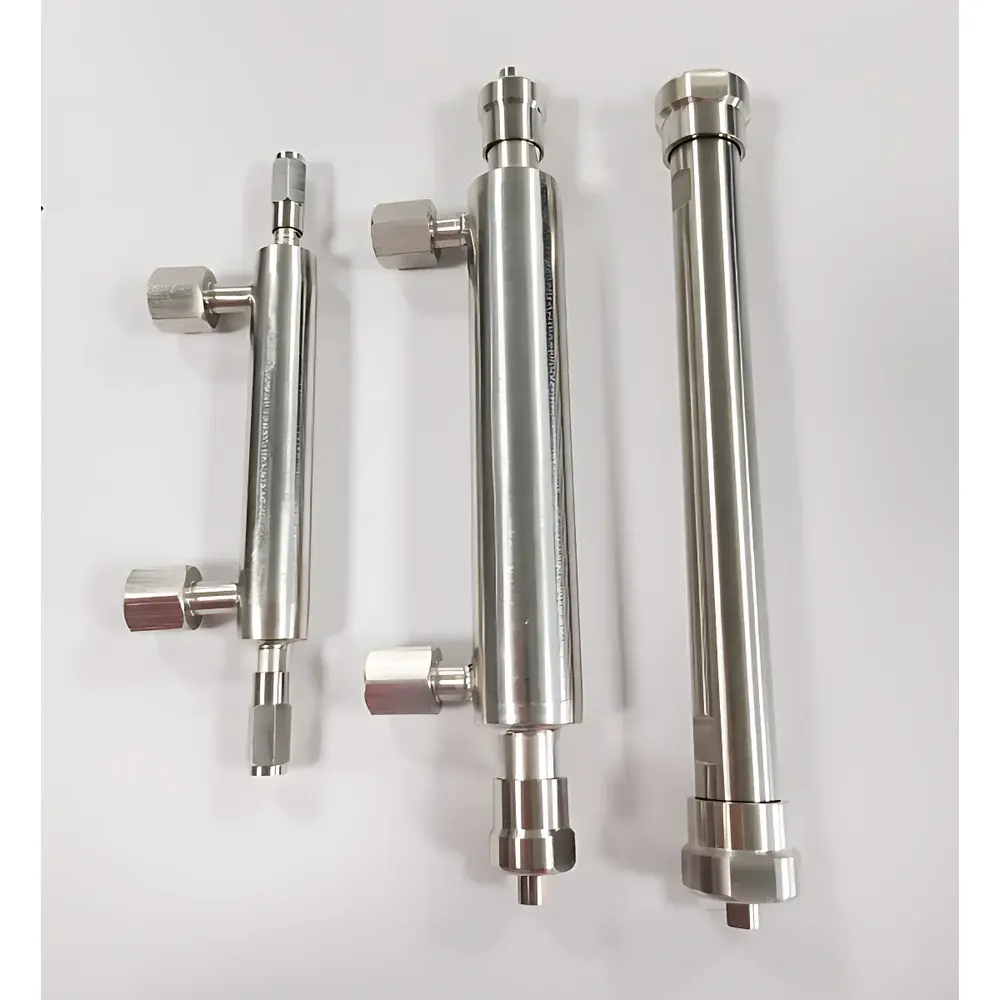
Fixed-Bed Reactor Column by EZONE CHEMIST
| Brand | EZONE CHEMIST |
|---|---|
| Origin | Guangdong, China |
| Manufacturer Type | Authorized Distributor |
| Origin Category | Domestic |
| Model | Customizable Fixed-Bed Column Assembly |
| Quotation | Available Upon Request |
| Body Material | 316L Stainless Steel |
| Seal Material | FFKM (Perfluoroelastomer) |
| Sieve Plate Material | 316L or Titanium Alloy |
| Jacketed Design | Yes |
| Standard Dimensions | 10 mm ID × 200 mm L (15.7 mL), 4.6 mm ID × 150 mm L (2.5 mL) |
| Sieve Pore Size | 20 µm |
| Temperature Range | −20 °C to 200 °C |
| Pressure Rating | 0–100 bar |
| Customization | Available for materials, dimensions, and end fittings |
Overview
The EZONE CHEMIST Fixed-Bed Reactor Column is an engineered component designed for continuous-flow heterogeneous catalysis, gas-phase reactions, and liquid-phase hydrogenation under precisely controlled thermal and pressure conditions. Based on the principle of plug-flow reactor (PFR) hydrodynamics, it enables uniform reactant distribution across a packed catalyst bed while minimizing axial dispersion—critical for kinetic studies, process intensification, and scale-up validation. Its robust construction integrates a double-walled column with integrated thermal jacketing, permitting active temperature control via external circulators or steam/coolant loops. The column is not a standalone instrument but a core modular unit intended for integration into larger flow chemistry systems—including automated synthesis platforms, pilot-scale continuous manufacturing lines, and analytical-grade reaction monitoring setups.
Key Features
- Modular fixed-bed architecture with standardized end fittings (e.g., Swagelok®-compatible 1/4″ or 1/8″ VCR/VCO ports) for seamless integration into existing flow manifolds.
- Double-walled, jacketed column body fabricated from electropolished 316L stainless steel—ensuring high corrosion resistance, low extractables, and compliance with ASME BPE surface finish standards (Ra ≤ 0.4 µm).
- High-integrity sealing system using perfluoroelastomer (FFKM) gaskets rated for aggressive solvents, halogenated media, and elevated temperatures up to 200 °C.
- Precision-machined sintered metal frits (20 µm pore size) made from 316L or titanium alloy—providing mechanical stability, uniform backpressure generation, and minimal catalyst fines entrainment.
- Validated operational envelope: full pressure rating up to 100 bar at 200 °C; cryogenic capability down to −20 °C with appropriate thermal management.
- Configurable geometry: standard inner diameters include 4.6 mm and 10 mm, with lengths up to 300 mm; custom ID/L ratios and aspect ratios available to match residence time requirements and pressure drop constraints.
Sample Compatibility & Compliance
The column accommodates a broad spectrum of solid catalysts—including supported metals (Pd/C, Pt/Al₂O₃), zeolites, metal–organic frameworks (MOFs), and immobilized enzymes—without degradation of structural integrity or leaching risk. Its material set complies with ISO 10993-5 (cytotoxicity) for pharmaceutical process applications and meets ASTM A269/A270 specifications for sanitary tubing. When deployed in GMP environments, the column supports traceable installation records and can be qualified per IQ/OQ protocols. All wetted surfaces are passivated per ASTM A967 and certified with material test reports (MTRs) per EN 10204 3.1. FFKM seals conform to FDA 21 CFR §177.2600 for food-contact and pharmaceutical use.
Software & Data Management
As a hardware module, the column does not include embedded firmware or onboard software. However, it is fully compatible with industry-standard flow control ecosystems—including Syrris Asia, Vapourtec R-Series, and Chemtrix Labtrix platforms—enabling synchronized pressure logging, temperature ramp profiling, and real-time mass flow correlation. When integrated with PLC-based control systems, it supports audit-trail-enabled operation per FDA 21 CFR Part 11 when paired with compliant SCADA or MES layers. Digital twin modeling (e.g., using COMSOL Multiphysics® or Aspen Custom Modeler®) is facilitated by published geometric parameters and validated pressure-drop correlations for common catalyst loadings.
Applications
- Continuous hydrogenation of nitroarenes, alkenes, and heterocycles in API intermediate synthesis.
- CO₂ hydrogenation to methanol or formic acid using Cu/ZnO/Al₂O₃ catalysts under supercritical conditions.
- Enantioselective flow epoxidation with Ti-tartrate immobilized on silica.
- Thermal stability screening of supported catalysts under accelerated aging protocols (e.g., 100 h @ 180 °C, 50 bar H₂).
- In-line FTIR or UV-Vis reaction monitoring via integrated optical windows (optional accessory).
- Process analytical technology (PAT) implementation for Quality-by-Design (QbD) workflows in ICH Q8/Q9-compliant development.
FAQ
Is this column suitable for corrosive reagents such as HF or hot concentrated HCl?
While 316L provides general corrosion resistance, prolonged exposure to hydrofluoric acid or boiling HCl requires alternative construction (e.g., Hastelloy C-276 or titanium grade 7). Consult engineering support for material compatibility assessment.
Can the column be sterilized in place (SIP) using steam?
Yes—FFKM seals and 316L body permit SIP cycles up to 135 °C at 3.5 bar gauge, provided cooling rates comply with ASME BPVC Section VIII Div. 1 thermal stress limits.
Do you provide catalyst loading services or pre-packed columns?
EZONE CHEMIST offers optional catalyst packing under inert atmosphere (N₂/Ar glovebox) with gravimetric loading verification and BET surface area documentation upon request.
What validation documentation is included with shipment?
Each unit ships with a Certificate of Conformance (CoC), dimensional inspection report, MTRs for all wetted materials, and FFKM seal certification per ASTM D1418.
Are explosion-proof variants available for Class I, Division 1 environments?
Jacketed columns may be supplied with ATEX/IECEx-certified external heating mantles and intrinsically safe pressure transducers—subject to full hazardous area classification review.



