
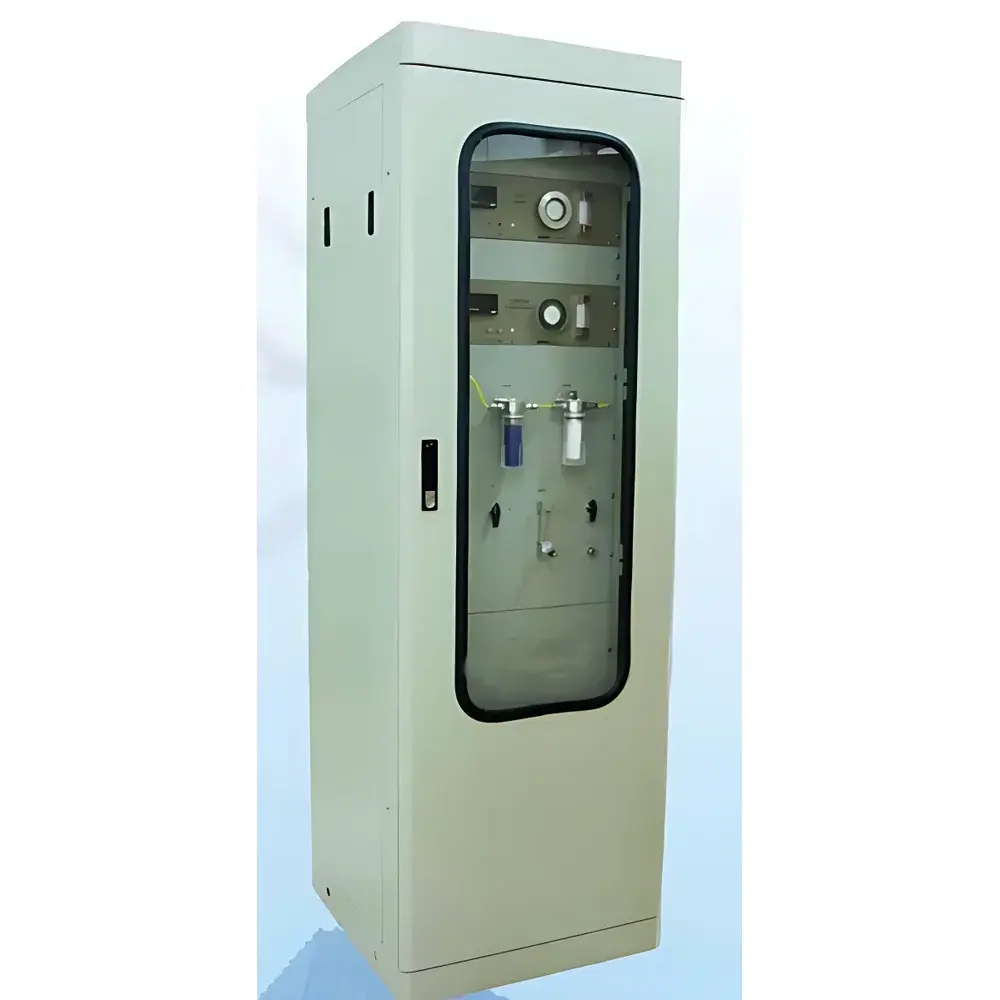
SIELINS XLZ-903 Continuous Emission Monitoring System (CEMS) for Municipal Solid Waste Incineration
| Brand | SIELINS |
|---|---|
| Model | XLZ-903 |
| Origin | Beijing, China |
| Instrument Type | Online CEMS |
| Measured Gases | SO₂, NOₓ, CO, CO₂, CH₄, NH₃, O₂ (configurable multi-component) |
| Measurement Range (min) | 0–50 ppm |
| Repeatability | ±1% FS |
| Resolution | 0.1 ppm |
| Response Time | ≤25 s |
| Zero Drift | ±5% FS / 24 h |
| Span Drift | ±1% FS / 24 h |
| Linearity Error | ±2% FS |
| Compliance | Designed for EN 15267-3, EN 14181, and GB/T 16157–2018 referenced operation |
Overview
The SIELINS XLZ-903 Continuous Emission Monitoring System (CEMS) is an integrated, rack-mounted online gas analysis platform engineered for regulatory-grade compliance monitoring of flue gases from municipal solid waste (MSW) incineration facilities. It operates on a multi-analyte optical and electrochemical detection architecture: UV/Vis differential optical absorption spectroscopy (DOAS) for SO₂ and NOₓ; non-dispersive infrared (NDIR) for CO, CO₂, and CH₄; tunable diode laser absorption spectroscopy (TDLAS) or chemiluminescence (CLD) for NH₃ (configurable); and paramagnetic or zirconia-based sensing for O₂. The system meets the functional requirements of continuous stack emission reporting under national and international environmental standards—including China’s HJ 75–2017 and HJ 76–2017 technical specifications for CEMS, as well as European reference methods EN 15267-3 (performance certification) and EN 14181 (quality assurance). Its design prioritizes long-term stability in high-dust, high-moisture, and thermally variable flue gas environments typical of grate-fired and fluidized-bed MSW incinerators.
Key Features
- Multi-component real-time measurement of up to seven regulated gases—SO₂, NO, NO₂ (as NOₓ), CO, CO₂, CH₄, NH₃, and O₂—with independent sensor modules and auto-compensated cross-interference correction.
- Robust sample conditioning system including heated sampling probe (180 °C), PTFE-lined extractive line, chiller-based moisture removal (<5 °C dew point), and particle filtration down to 0.3 µm to ensure representative gas delivery to analyzers.
- Embedded microprocessor with dual-redundant data logging: local SD card storage (≥1 year at 1-min intervals) plus RS-485/Modbus RTU and Ethernet TCP/IP interfaces for integration with DCS, SCADA, or central environmental information platforms.
- Automatic zero/span calibration capability using certified standard gases (NIST-traceable), with scheduled calibration cycles configurable per regulatory schedule (e.g., every 24 h for zero, every 168 h for span).
- Self-diagnostic firmware with real-time status reporting for critical subsystems—including flow rate, temperature, pressure, filter clogging, and optical path integrity—enabling predictive maintenance and minimizing unscheduled downtime.
- IP65-rated field enclosure with internal temperature stabilization (15–35 °C operating range), suitable for outdoor installation adjacent to stack or in equipment shelters without HVAC dependency.
Sample Compatibility & Compliance
The XLZ-903 is validated for use with flue gas streams containing particulate mass concentrations up to 50 g/Nm³, moisture content up to 25% v/v, and acid gas concentrations typical of MSW combustion (e.g., HCl ≤ 200 ppm, HF ≤ 10 ppm). All wet-bench components are constructed from corrosion-resistant materials: Hastelloy C-276 for probe tips, PFA-lined tubing, and quartz optical cells. The system complies with GB/T 16157–2018 for manual reference method equivalence and supports QA/QC protocols aligned with ISO/IEC 17025 laboratory accreditation requirements. Data integrity features include electronic audit trails, user-level access control (admin/operator/guest), and time-stamped event logs compliant with GLP principles for regulatory submission.
Software & Data Management
The embedded CEMS Manager software provides a browser-accessible interface (HTTPS) for configuration, diagnostics, and report generation. It supports automated generation of mandatory reports per China’s “Pollutant Discharge Permit Regulation”—including hourly average concentration, daily maximum, 30-day rolling averages, and exceedance alerts. Raw data export is available in CSV and XML formats, with optional OPC UA server integration for enterprise-level data lakes. All data modifications are logged with user ID, timestamp, and reason code. The system implements secure authentication (SHA-256 hashing), TLS 1.2 encryption for remote access, and optional 21 CFR Part 11-compliant electronic signature modules for auditable record retention.
Applications
- Regulatory compliance monitoring for MSW incineration plants subject to China’s “Emission Standards for Pollution Control of Municipal Solid Waste Incineration” (GB 18485–2014) and EU Directive 2010/75/EU (IED).
- Process optimization support via real-time O₂ feedback for combustion efficiency tuning and NH₃ slip monitoring in SNCR/SCR denitrification systems.
- Carbon accounting workflows: simultaneous CO₂ and CH₄ quantification enables facility-level GHG inventory reporting aligned with ISO 14064-1 and national carbon market requirements.
- Stack testing validation: serves as a reference system during periodic performance audits and relative accuracy test audits (RATA) per HJ 76–2017 Annex B.
- Research applications in thermal treatment R&D facilities evaluating novel waste-to-energy configurations and post-combustion capture integration.
FAQ
What regulatory standards does the XLZ-903 meet for Chinese incineration facilities?
It conforms to HJ 75–2017 (technical specification for CEMS installation and acceptance) and HJ 76–2017 (technical specification for CEMS operation and quality assurance), as well as GB 18485–2014 emission limits.
Can the system be configured for fewer than seven gas components?
Yes—users select required analytes at order stage; base configuration includes SO₂, NOₓ, CO, O₂, and CO₂; optional modules add NH₃, CH₄, or HCl upon request.
Is third-party certification available for this CEMS?
SIELINS supports EN 15267-3 type approval through authorized EU Notified Bodies; factory acceptance testing (FAT) and site acceptance testing (SAT) documentation are provided.
How is data security ensured during remote access?
All web-based access uses TLS 1.2 encryption, role-based authentication, and immutable audit logs; no cloud storage is enabled by default—data resides locally unless explicitly configured for secure enterprise transfer.
What maintenance intervals are recommended for routine operation?
Filter replacement every 3 months, chiller desiccant every 6 months, and full optical path cleaning every 12 months; automated diagnostics reduce need for manual intervention.







