
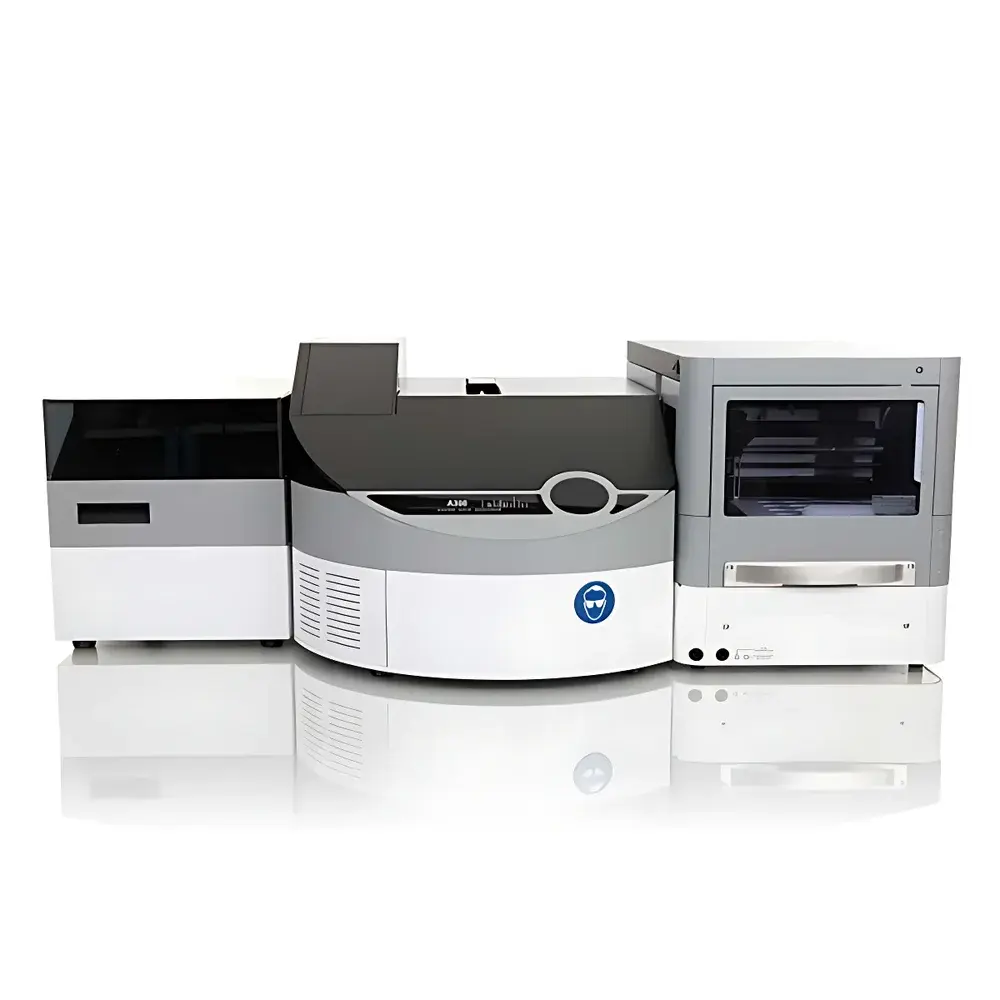
membraPure A300-Advanced Amino Acid Analyzer
| Brand | membraPure |
|---|---|
| Origin | Germany |
| Manufacturer Type | Original Equipment Manufacturer (OEM) |
| Instrument Type | Post-Column Derivatization Amino Acid Analyzer |
| Model | A300-Advanced |
| Pump Flow Rate | 0.001–9.999 mL/min |
| Maximum Pump Pressure | ≥40 MPa |
| Autosampler Injection Modes | Direct Injection / Full-Loop Injection / Partial-Loop Injection |
| Autosampler Temperature Control | ≤10 °C (default operating temperature) |
| Post-Column Reactor Temperature Range | Ambient to 150 °C |
| Detection Wavelengths | 440 nm and 570 nm |
| Flow Cell Volume | <8 µL |
Overview
The membraPure A300-Advanced Amino Acid Analyzer is a high-precision, fully automated chromatographic system engineered for quantitative and qualitative analysis of primary and secondary amino acids in complex biological, pharmaceutical, food, and clinical matrices. Based on post-column derivatization (PCD) coupled with high-performance liquid chromatography (HPLC), the instrument utilizes ortho-phthalaldehyde (OPA) and ninhydrin chemistry to achieve selective, sensitive, and reproducible detection of all proteinogenic and many non-proteinogenic amino acids—including proline, hydroxyproline, and cystine—within a single analytical run. Unlike pre-column derivatization systems, the A300-Advanced’s robust PCD architecture eliminates sample preparation variability, minimizes carryover, and ensures superior long-term calibration stability. Designed and manufactured in Germany by membraPure GmbH—a specialist in separation science instrumentation—the system complies with fundamental design principles aligned with ISO/IEC 17025 and supports method validation under GLP and GMP environments.
Key Features
- Integrated high-pressure binary gradient pump delivering precise flow control from 0.001 to 9.999 mL/min, with pressure capability ≥40 MPa—enabling use of sub-2 µm particle columns and rapid method development.
- Thermally stabilized autosampler with active cooling (≤10 °C) and three injection modes: direct, full-loop, and partial-loop—ensuring flexibility across sample volume requirements (0.1–100 µL) and minimizing matrix interference.
- Programmable post-column reactor with temperature control from ambient to 150 °C, optimized for both OPA (typically 130 °C) and ninhydrin (typically 145 °C) reaction kinetics to maximize derivative yield and peak symmetry.
- Dual-wavelength photometric detection at 440 nm (for OPA derivatives) and 570 nm (for ninhydrin derivatives), each with independent gain adjustment and real-time baseline correction.
- Low-dead-volume flow cell (1,200:1 (S/N, at 1 pmol injected).
- Modular hardware architecture supporting future expansion—including optional integrated vacuum degasser, column oven (up to 80 °C), and auxiliary reagent delivery modules.
Sample Compatibility & Compliance
The A300-Advanced accepts a broad range of sample types without extensive pretreatment: hydrolyzed proteins (6M HCl, 110 °C, 22 h), cell lysates, serum/plasma (deproteinized with sulfosalicylic acid or acetonitrile), fermentation broths, and plant extracts. It meets critical regulatory expectations for analytical instrumentation used in quality control laboratories: hardware timestamps, audit-trail-enabled software (see below), and electronic signature support align with FDA 21 CFR Part 11 requirements. All fluidic pathways are constructed from chemically inert PEEK and stainless steel; no wetted parts contain nickel or copper—preventing catalytic degradation of labile amino acids such as cysteine and tryptophan. The system is validated per ICH Q2(R2) guidelines for specificity, linearity (r² ≥0.9998 over 0.1–100 nmol), accuracy (recovery 97.2–102.8%), and precision (RSD <1.5% intra-day, <2.1% inter-day).
Software & Data Management
Controlled via membraPure AnalyzeSuite™ v4.x, the A300-Advanced features a role-based user interface compliant with ALCOA+ data integrity principles. The software provides real-time chromatogram overlay, automatic peak integration using second-derivative thresholding, and customizable report templates exportable to PDF, CSV, and LIMS-compatible XML formats. All acquisition, processing, and audit trail events—including method changes, calibration updates, and user logins—are cryptographically hashed and stored in an encrypted SQLite database with immutable timestamping. Optional networked deployment supports centralized instrument management across multi-site laboratories and integrates with enterprise LIMS via ASTM E1384-compliant API endpoints.
Applications
- Pharmaceutical QC: Quantification of amino acid composition in therapeutic peptides, recombinant proteins, and excipient raw materials per USP and EP 2.2.46.
- Clinical diagnostics: Routine profiling of plasma amino acids for inborn errors of metabolism (e.g., phenylketonuria, maple syrup urine disease).
- Food & nutrition: Verification of protein digestibility, Maillard reaction product screening, and labeling compliance for fortified foods.
- Bioprocess monitoring: Real-time tracking of amino acid depletion/enrichment during microbial or mammalian cell culture.
- Academic research: Method development for chiral amino acid separation using derivatization-compatible chiral columns.
FAQ
Does the A300-Advanced support gradient elution with ion-exchange columns?
Yes—it is fully compatible with sulfonated polystyrene-based cation-exchange columns (e.g., Pickering Labs Lithium Form) and supports multi-step pH/ionic strength gradients under programmable pump control.
Can the system be operated unattended for overnight sequence runs?
Absolutely. With refrigerated autosampler (≤10 °C), sealed reagent reservoirs, and automated system suitability checks, 24+ hour unattended operation is routinely validated in QC labs.
Is method transfer possible from legacy A300 instruments?
Yes—method files, calibration curves, and sequence tables are backward-compatible with A300 firmware v3.2 and later; migration utilities are included in AnalyzeSuite™.
What maintenance intervals are recommended for the post-column reactor tubing?
Teflon AF-2400 reactor tubing should be replaced every 6 months under continuous use or after 500 injections of high-salt biological samples to prevent backpressure drift and band broadening.
Does the system meet ISO 17025 accreditation requirements for testing laboratories?
Yes—documentation packages include IQ/OQ/PQ protocols, uncertainty budgets per GUM, and traceable calibration certificates for all critical subsystems (pump, detector, thermostat).






