
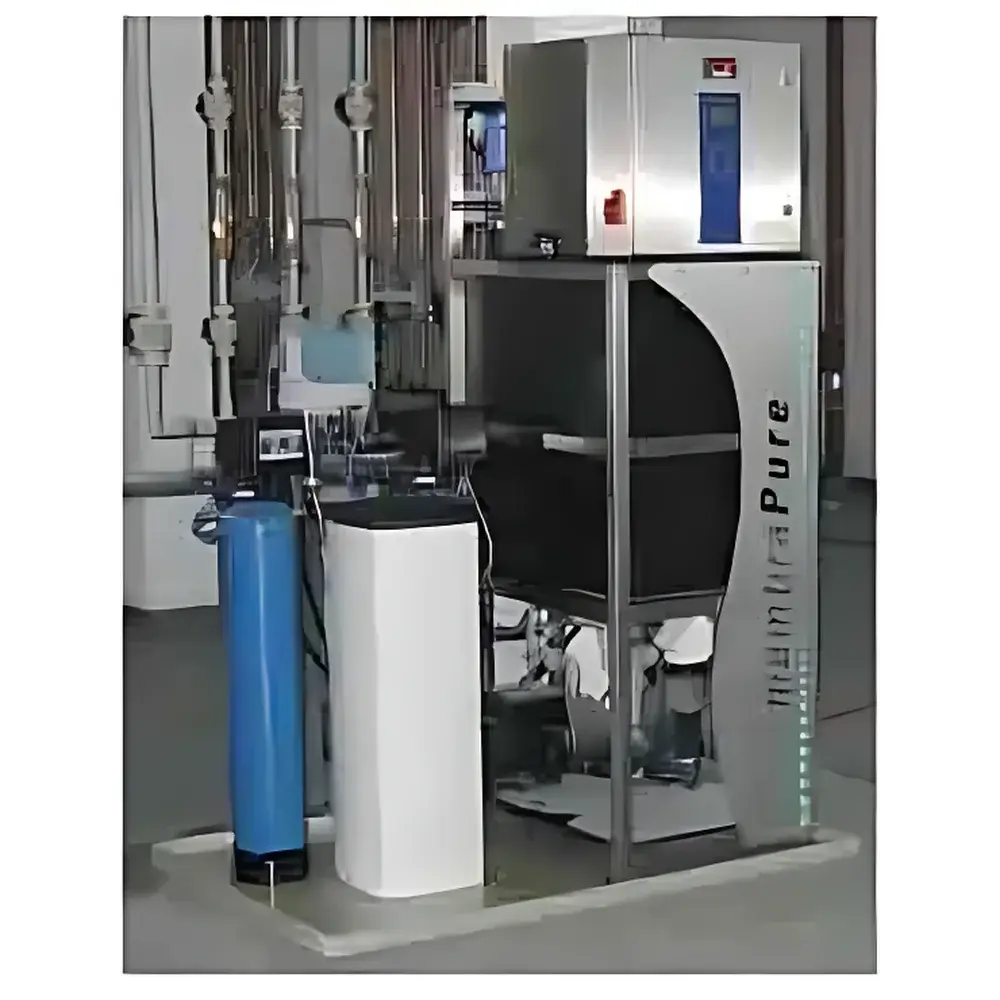
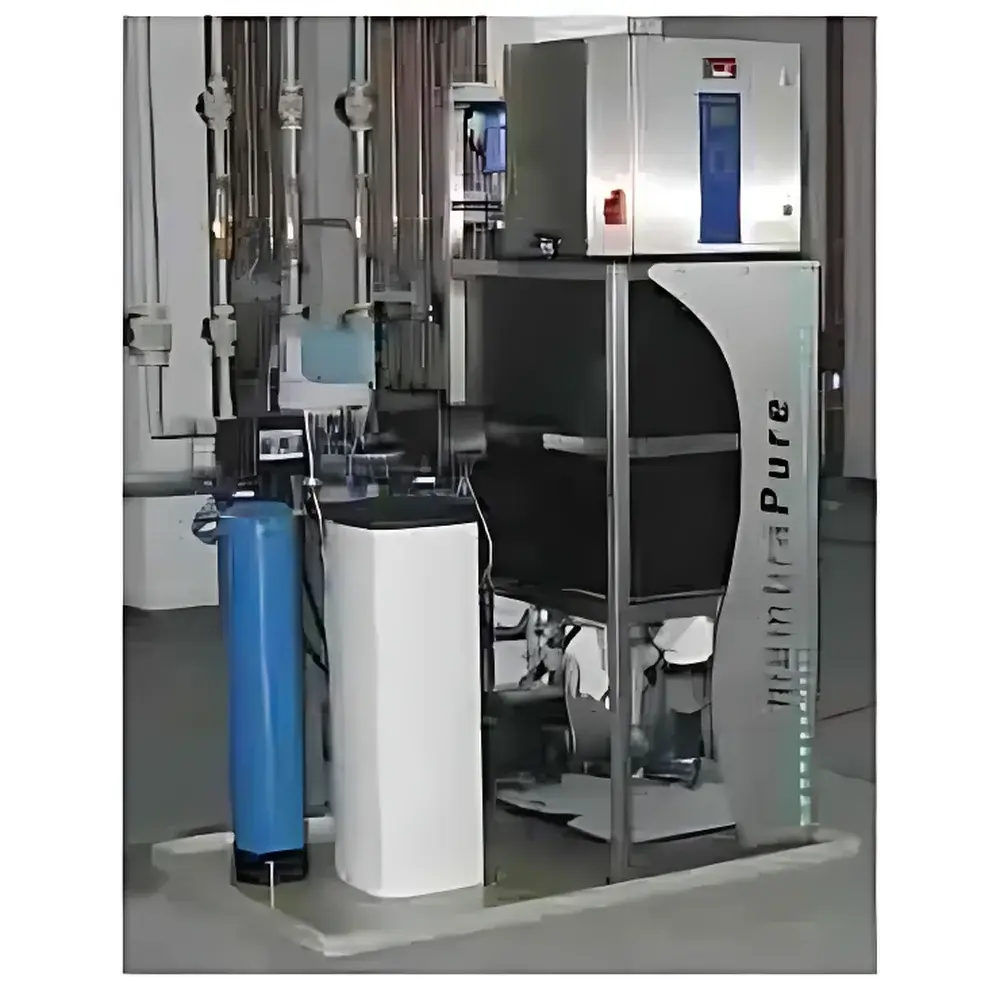
membraPure EDI Compact Ultra-Pure Water System
| Brand | membraPure |
|---|---|
| Origin | Germany |
| Manufacturer | membraPure GmbH |
| Product Type | Imported Laboratory Ultra-Pure Water System |
| Model | EDI Compact |
| Pure Water Grade | ASTM Type II |
| Resistivity | 18.2 MΩ·cm at 25 °C |
| Heavy Metals & Soluble Silica | < 0.1 ppb |
| Total Organic Carbon (TOC) | < 3 ppb |
| Microbial Count | < 10 CFU/mL |
| Endotoxin | < 0.001 EU/mL |
| Particles (>0.1 µm) | < 1 particle/mL |
| Conductivity | < 1.0 µS/cm |
| Flow Rate Range | 5–330 L/h |
Overview
The membraPure EDI Compact Ultra-Pure Water System is an integrated, continuously regenerating electrodeionization (EDI) platform engineered for laboratories requiring consistent, on-demand production of ASTM Type II and ISO 3696 Grade 2 water—serving as both a primary purification unit and a polishing stage following reverse osmosis (RO) pretreatment. Unlike batch-mode deionization systems, the EDI Compact employs stacked ion-exchange membranes and electrically driven ion migration to achieve continuous removal of residual ionic contaminants without chemical regeneration. Its compact footprint (typically < 0.4 m² floor space) and modular design enable seamless integration into single-laboratory environments or centralized distribution networks serving multiple adjacent workspaces. The system operates under fully automated control with real-time monitoring of key water quality parameters—including resistivity, TOC, and flow rate—ensuring traceability and compliance with ISO/IEC 17025 laboratory quality management requirements.
Key Features
- Continuous electrodeionization (EDI) technology with integrated RO pre-treatment compatibility, eliminating need for acid/base regeneration cycles
- Real-time resistivity monitoring at point-of-use (18.2 MΩ·cm @ 25 °C), validated per ASTM D1193 and ISO 3696
- Integrated UV oxidation (185/254 nm dual-wavelength lamp) and 0.1 µm final filtration to suppress microbial regrowth and reduce TOC to < 3 ppb
- Automated sanitization protocol with hot water (80 °C) or ozone-based recirculation, supporting GLP/GMP-aligned maintenance logs
- Touchscreen HMI with configurable alarm thresholds, event logging, and password-protected user access levels (operator, technician, administrator)
- Modular flow architecture supporting scalable output from 5 L/h to 330 L/h, with optional distribution loop pressure regulation and loop circulation pump
Sample Compatibility & Compliance
The EDI Compact is designed for use with municipal or pre-treated feed water meeting ASTM D1193 Type III specifications (conductivity ≤ 50 µS/cm, TOC ≤ 200 ppb). It complies with international standards governing analytical water quality, including ISO 3696:2017 (Water for analytical laboratory use), ASTM D1193-20 (Standard Specification for Reagent Water), and CLSI EP22-A (Evaluation of Water Purity for Clinical Laboratories). All wetted components—including PVDF housings, PTFE-sealed diaphragms, and electroplated stainless-steel electrodes—meet USP Class VI biocompatibility requirements. System validation documentation supports IQ/OQ protocols aligned with FDA 21 CFR Part 11 for electronic records and signatures.
Software & Data Management
The embedded control firmware supports audit-trail-enabled data capture compliant with 21 CFR Part 11 Annex 11 requirements. All critical events—including conductivity excursions, UV lamp status, filter saturation alerts, and sanitization cycle timestamps—are time-stamped, digitally signed, and exportable in CSV or PDF format. Optional Ethernet/IP or Modbus TCP connectivity enables integration into centralized laboratory information management systems (LIMS) or building automation platforms. Remote diagnostics via secure TLS 1.2 encrypted channel allow authorized service engineers to perform firmware updates and calibration verification without physical site access.
Applications
- HPLC mobile phase preparation and column equilibration where low ionic background and sub-ppb silica content prevent baseline drift and column fouling
- ICP-MS and ICP-OES sample dilution and standard preparation, where <0.1 ppb heavy metal carryover ensures detection limits below 0.01 pg/mL
- Cell culture media formulation requiring endotoxin-free water (<0.001 EU/mL) and minimal organic leachables
- Trace elemental analysis by GF-AAS and CV-AAS, where TOC < 3 ppb minimizes carbon-based spectral interference
- Calibration of conductivity and pH meters using certified reference waters traceable to NIST SRM 3194
- Supporting ISO/IEC 17025-accredited testing laboratories requiring documented water quality history per test batch
FAQ
What feed water quality is required for optimal EDI Compact performance?
Feed water must meet ASTM D1193 Type III specifications: conductivity ≤ 50 µS/cm, TOC ≤ 200 ppb, and silica ≤ 0.5 mg/L. A dedicated RO pretreatment unit is strongly recommended.
Can the system be validated for GMP-regulated environments?
Yes—the EDI Compact supports full IQ/OQ/PQ execution with vendor-supplied protocols, and its audit trail functionality satisfies FDA 21 CFR Part 11 and EU Annex 11 requirements.
How often do consumables require replacement?
UV lamps are rated for 12,000 hours; 0.1 µm final filters typically last 6–12 months depending on usage and feed water quality; EDI stack lifetime exceeds 5 years under specified operating conditions.
Is remote monitoring supported out of the box?
Standard Ethernet interface enables local network visibility; optional cloud-based telemetry module provides secure remote access, predictive maintenance alerts, and firmware update scheduling.
Does the system comply with environmental regulations for wastewater discharge?
No waste stream is generated during normal operation; the EDI process produces no chemical regenerant effluent, aligning with ISO 14001 environmental management principles.



