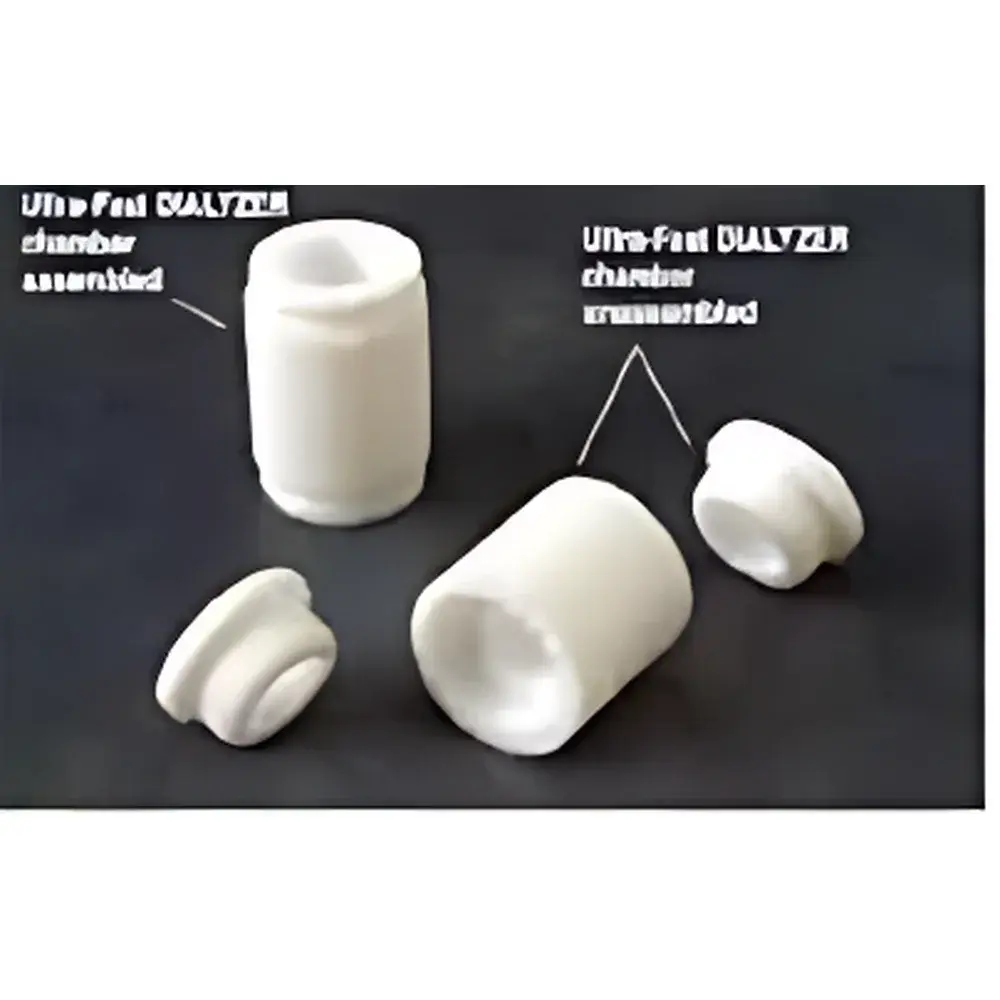
Ultra Fast DIALYZERTM
| Origin | USA |
|---|---|
| Manufacturer Type | Authorized Distributor |
| Origin Category | Imported |
| Model | Ultra Fast DIALYZERTM |
| Pricing | Available Upon Request |
Overview
The Ultra Fast DIALYZERTM is a high-efficiency, benchtop electrodialysis system engineered for rapid and controlled molecular separation, purification, and concentration of biological macromolecules—including nucleic acids and proteins—under precisely regulated electric field conditions. Unlike conventional passive dialysis devices relying solely on diffusion across semi-permeable membranes, the Ultra Fast DIALYZERTM integrates bidirectional electrode-driven ion migration to accelerate mass transfer kinetics. Its dual-membrane architecture—featuring one membrane at each end of the sample chamber—establishes a symmetric electrochemical gradient that enhances transmembrane flux while minimizing sample polarization and Joule heating effects. Designed for reproducible operation in clinical laboratory and translational research environments, the system supports both continuous and pulsed DC voltage modes, enabling fine-tuned control over desalting efficiency, buffer exchange rates, and analyte recovery.
Key Features
- Bidirectional membrane configuration: Two identical, low-binding, molecular-weight-cutoff (MWCO) membranes mounted at opposing ends of the sample chamber to enable simultaneous electrophoretic transport from both directions.
- Integrated DC power supply with adjustable voltage (0–100 V) and current limiting (0–50 mA), supporting programmable ramping and stepwise protocols.
- Compact, modular design with chemically resistant PEEK and borosilicate glass components compatible with common biological buffers (e.g., Tris-HCl, HEPES, PBS) and low-conductivity solvents.
- Real-time monitoring of current draw and temperature via front-panel LED indicators; optional external data logging via analog output (0–5 V).
- No moving parts or pumps—operation is silent, maintenance-free, and suitable for Class II biosafety cabinets and GMP-compliant cleanroom workflows.
Sample Compatibility & Compliance
The Ultra Fast DIALYZERTM accommodates aqueous samples ranging from 50 µL to 2 mL per run, with demonstrated compatibility across plasmid DNA (0.5–10 kbp), siRNA, monoclonal antibodies (IgG, ~150 kDa), and recombinant enzymes. Membrane selection (available in 3.5, 10, and 50 kDa MWCO) allows optimization for target molecule retention versus small-molecule removal (e.g., salts, detergents, imidazole). The device complies with IEC 61010-1:2012 for electrical safety in laboratory equipment and meets essential requirements of ISO 13485:2016 for in vitro diagnostic-related instrumentation when used in validated clinical assay development. It supports GLP documentation practices through traceable protocol execution and operator-defined metadata tagging.
Software & Data Management
While the base Ultra Fast DIALYZERTM operates without proprietary software, it is fully compatible with third-party lab information management systems (LIMS) and electronic lab notebooks (ELN) via its analog output interface. For advanced users, optional firmware upgrade enables USB-C connectivity and integration with open-source Python-based control scripts (provided under MIT license). All operational parameters—including applied voltage, elapsed time, and measured current—are logged locally on non-volatile memory for audit-ready record retention. When deployed in regulated environments, the system supports 21 CFR Part 11–compliant workflows through external validation of user access controls, electronic signatures, and change history tracking within connected LIMS platforms.
Applications
- Rapid desalting and buffer exchange of enzymatically digested peptides prior to LC-MS/MS analysis.
- Concentration of dilute protein samples (e.g., affinity-purified kinases) without centrifugal stress or surface adsorption losses.
- Electro-purification of CRISPR-Cas9 ribonucleoprotein (RNP) complexes to remove free sgRNA and uncomplexed Cas9.
- Removal of endotoxins from therapeutic antibody preparations using charge-selective anion-exchange membranes.
- Preparative-scale nucleic acid cleanup following in vitro transcription or PCR amplification.
FAQ
What types of membranes are supported?
Standard configurations include regenerated cellulose (RC) and polyethersulfone (PES) membranes with MWCO options of 3.5, 10, and 50 kDa. Custom membranes with asymmetric pore structures or surface modifications (e.g., hydrophilic coating) are available upon request.
Can the system be used for sterile processing?
Yes—the sample chamber and membrane holders are autoclavable (121°C, 20 min), and all wetted surfaces meet USP Class VI biocompatibility standards. Sterile assembly kits and pre-sterilized membrane cassettes are offered as accessories.
Is method validation support provided?
Comprehensive IQ/OQ documentation templates, including performance qualification tests for current stability, temperature drift, and membrane integrity verification, are included with each unit.
How does this differ from traditional dialysis or spin columns?
Electrophoretic enhancement reduces typical 4–24 hour passive dialysis cycles to 15–90 minutes, with higher recovery (>92% for IgG) and lower aggregation incidence due to absence of shear forces or vacuum-induced denaturation.