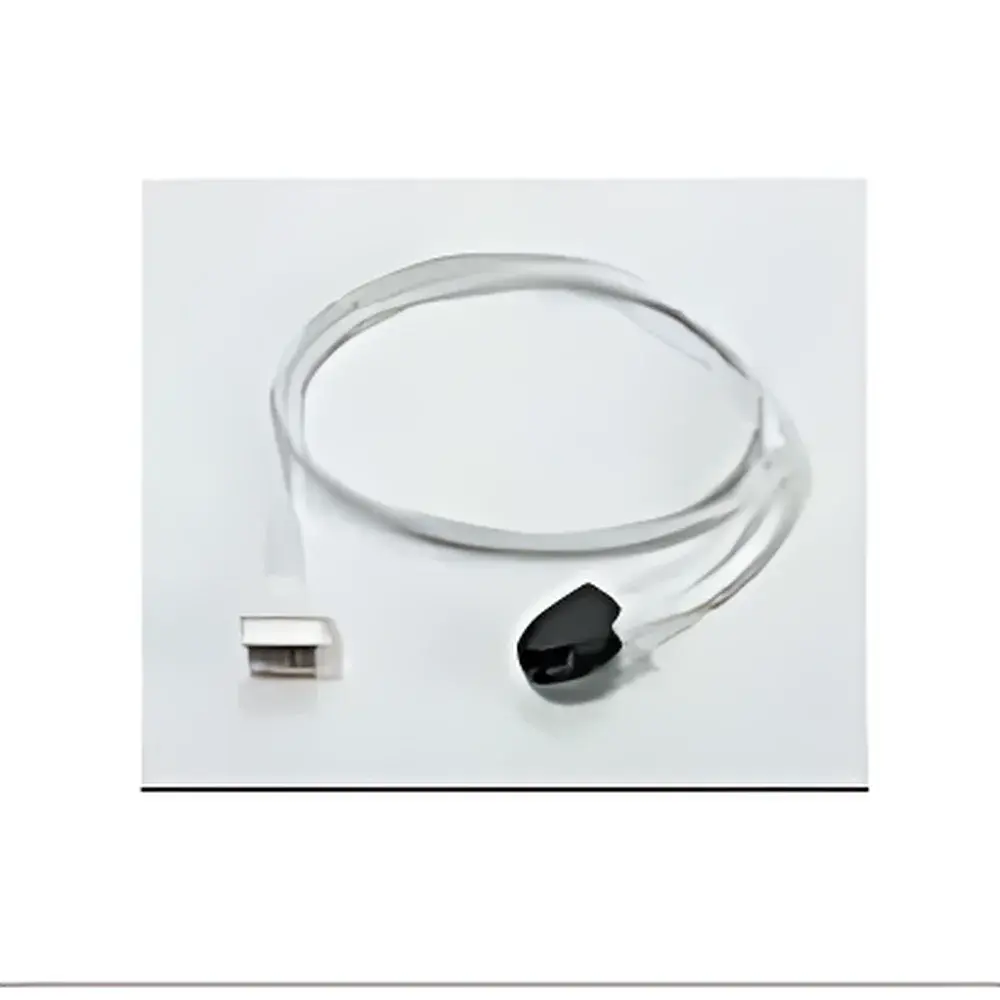
Oximetry Sensor for Animal Patient Monitors
| Origin | USA |
|---|---|
| Manufacturer Type | Distributor |
| Origin Category | Imported |
| Model | Monitor-Compatible Oximetry Sensor |
| Pricing | Upon Request |
Overview
This oximetry sensor is a clinical-grade, non-invasive optical transducer designed exclusively for integration with veterinary and preclinical animal patient monitors. It operates on the principle of dual-wavelength photoplethysmography (PPG), utilizing red (660 nm) and infrared (940 nm) light-emitting diodes to quantify arterial oxygen saturation (SpO₂) and pulse rate in conscious or anesthetized small to medium-sized laboratory animals—including mice, rats, rabbits, guinea pigs, and juvenile canines or felines. The sensor employs reflectance or transmission geometry depending on anatomical placement, enabling reliable signal acquisition under dynamic physiological conditions common in acute or chronic in vivo studies. Its design conforms to the fundamental optical path requirements specified in ISO 80601-2-61 (Medical electrical equipment — Part 2-61: Particular requirements for basic safety and essential performance of pulse oximeter equipment) for veterinary use contexts.
Key Features
- Optimized optical coupling for low-perfusion sites: engineered lens geometry and spectral filtering minimize motion artifact and ambient light interference during unrestrained or lightly restrained animal monitoring.
- Biocompatible, hypoallergenic housing: medical-grade thermoplastic elastomer (TPE) shell ensures prolonged skin contact without thermal stress or pressure necrosis—critical for longitudinal studies exceeding 72 hours.
- Universal interface compatibility: standard 3.5 mm analog output or digital I²C/SPI variants available per monitor OEM specification; supports plug-and-play integration with major animal-specific monitor platforms (e.g., Nonin LifeSense, Kent Scientific PhysioSuite, Harvard Apparatus Rodent Monitor).
- Calibration traceability: factory-calibrated against NIST-traceable hemoglobin oxygenation standards; calibration coefficients embedded in sensor EEPROM for automatic recognition by host monitor firmware.
- Reusable and sterilizable: withstands repeated cold chemical disinfection (e.g., 2% glutaraldehyde, 70% ethanol); not autoclavable—consistent with ISO 15883-1 guidelines for reusable biomedical sensors.
Sample Compatibility & Compliance
The sensor is validated for use across multiple anatomical attachment sites in rodents and lagomorphs: lingual surface (tongue), pinna (ear), abdominal flank, and tail base—each selected based on local perfusion density and tissue thickness to ensure signal fidelity. Placement protocol adheres to AVMA Guidelines for the Euthanasia of Animals and NIH Office of Laboratory Animal Welfare (OLAW) standards for minimally disruptive physiological monitoring. Device labeling complies with FDA 21 CFR Part 809 (In Vitro Diagnostic Products for Animal Use) and carries CE marking under EU Regulation (EU) 2017/746 (IVDR) for Class A non-invasive devices. Intended for research use only (RUO); not cleared for diagnostic use in human subjects.
Software & Data Management
When paired with compliant animal monitor systems, the sensor feeds real-time SpO₂ (%), pulse rate (bpm), and plethysmographic waveform data into vendor-specific acquisition software (e.g., LabChart for Life Science, AcqKnowledge v5.0+). All acquired parameters are timestamped and stored in HDF5 or TDMS formats, supporting audit-ready export for GLP-compliant study reporting. Firmware-level data integrity safeguards include cyclic redundancy check (CRC) validation on each data packet and configurable sampling rates (10–100 Hz) to balance temporal resolution with storage efficiency. Optional integration with electronic lab notebooks (ELNs) such as LabArchives or Benchling enables automated metadata tagging (animal ID, protocol step, anesthesia status) per measurement event.
Applications
- Pharmacokinetic/pharmacodynamic (PK/PD) studies requiring continuous oxygenation assessment during compound administration.
- Anesthesia depth monitoring in rodent surgical models, correlating SpO₂ trends with end-tidal CO₂ and blood pressure.
- Hypoxia-reoxygenation injury models (e.g., ischemic stroke, pulmonary hypertension) where transient desaturation events must be quantified with sub-second latency.
- Longitudinal wellness tracking in genetically modified mouse cohorts, particularly those exhibiting cardiopulmonary phenotypes.
- Validation of novel oxygen delivery systems (e.g., nanocarriers, hyperoxic gas blends) in large-animal translational models.
FAQ
Is this sensor compatible with human patient monitors?
No. This device is specifically calibrated and validated for animal tissue optical properties (e.g., melanin distribution, capillary density, skin thickness) and is not intended for human use.
Can it be used on neonatal or pediatric animals?
Yes—miniaturized clip and adhesive variants are available for pups (<100 g) and neonatal rabbits; contact technical support for size-specific part numbers.
Does the sensor require recalibration after repeated use?
No. Factory calibration remains stable over ≥500 attachment cycles when handled per IFU; periodic verification against reference pulse oximeters is recommended every 6 months per ISO 80601-2-61 Annex D.
What is the maximum permissible cable length between sensor and monitor?
For analog output: ≤2.5 m to maintain signal-to-noise ratio >60 dB; for digital variants: up to 5 m with shielded twisted-pair cabling meeting IEC 61000-4-3 immunity requirements.
Is firmware update capability supported?
Yes—via USB-connected programming dongle and vendor-provided configuration utility; updates preserve calibration EEPROM contents and comply with IEC 62304 Class B software lifecycle requirements.