
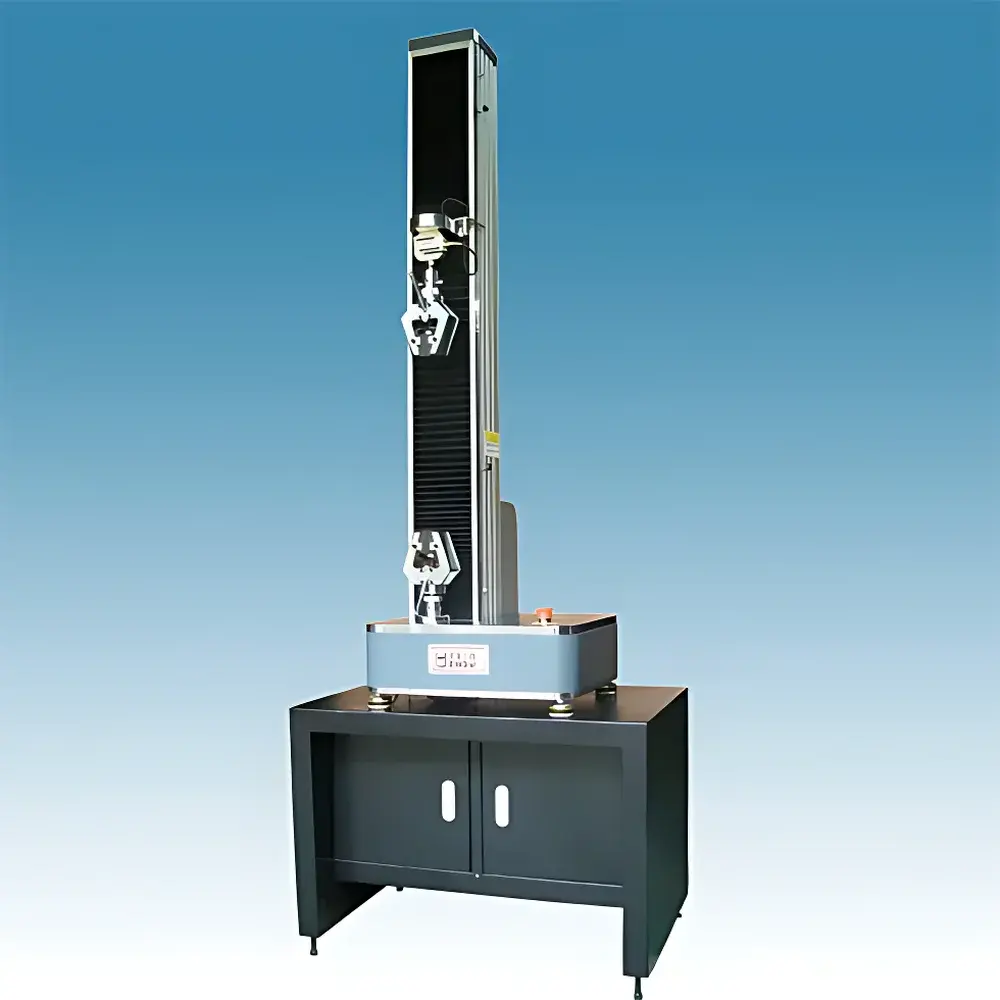
Hengyi HY-0580 Universal Testing Machine for Hydrogel Mechanical Characterization
| Brand | Hengyi |
|---|---|
| Origin | Shanghai, China |
| Manufacturer Type | Direct Manufacturer |
| Country of Origin | China |
| Model | HY-0580 |
| Instrument Type | Electromechanical Universal Testing Machine |
| Load Capacity Options | 1 N to 5000 N (interchangeable load cells) |
| Force Accuracy | ≤ ±0.5% of reading |
| Effective Test Width | 120 mm |
| Effective Vertical Travel | 800 mm |
| Speed Range | 0.001–500 mm/min |
| Speed Accuracy | ±0.5% of set value |
| Displacement Accuracy | ±0.5% of reading |
| Strain Measurement Accuracy | ±0.5% of reading |
| Stress/Strain Control Rate Range | 0.002–6% FS/s |
| Control Mode | Full-digital triple-closed-loop (force, displacement, strain) |
| Safety Protections | Electronic limit switches, overload protection (110% FS), emergency stop, auto-return, programmable stop conditions (load/strain/time) |
| Power Supply | 220 V AC, 750 W |
| Dimensions (W×D×H) | 470 × 400 × 1510 mm |
| Weight | 95 kg |
Overview
The Hengyi HY-0580 Universal Testing Machine is a high-precision electromechanical system engineered for the mechanical characterization of soft biomaterials—particularly hydrogels—under uniaxial tensile, compressive, cyclic, and relaxation loading conditions. Designed in accordance with ISO 527, ASTM D638, ASTM D3574, and ISO 6892-1 standards, the HY-0580 integrates a modular load frame, high-fidelity transduction architecture, and real-time closed-loop control to deliver repeatable, traceable, and compliant test data for R&D laboratories, quality control units, and regulatory submission workflows. Its core measurement principle relies on precision load cell transduction (with selectable capacities from 1 N to 5000 N), linear motion actuation via servo-controlled ball screw drive, and synchronized acquisition of force, displacement, and extensometer-derived strain signals at up to 10 kHz sampling rate. The system is optimized for low-force, high-deformation regimes typical of hydrogel testing—where compliance, hysteresis, preconditioning behavior, and time-dependent viscoelastic response must be resolved with sub-micron displacement resolution and <0.5% force linearity.
Key Features
- Full-digital triple-closed-loop control architecture based on adaptive neural network algorithms—enabling seamless, zero-transition switching between force, displacement, and strain control modes without overshoot or settling delay.
- High-integration test platform with integrated 24-bit A/D conversion, real-time data streaming, and deterministic timing synchronization across all sensor channels.
- Modular load cell configuration: interchangeable sensors covering 1 N to 5000 N ranges—each calibrated to ISO 7500-1 Class 0.5 accuracy, with full-scale resolution of ±500,000 counts and no internal range switching.
- Programmable multi-step test protocols—including tension-compression cycling, stress relaxation, creep, ramp-hold-ramp, and staircase loading—with user-defined trigger conditions (e.g., stop at 50% strain, hold for 300 s, then unload at 0.1 mm/min).
- Comprehensive safety system: dual-channel electronic limit detection, hardware-based emergency stop circuitry, over-load cutoff at 110% of selected capacity, automatic return-to-start, and real-time diagnostic monitoring of drive voltage, current, and thermal status.
- Intuitive Windows-native HYtest software with multi-axis plotting engine—supporting simultaneous display of load vs. displacement, true stress vs. true strain, stress vs. time, and strain vs. time curves—with overlay, zoom, annotation, and point-wise comparative analysis tools.
Sample Compatibility & Compliance
The HY-0580 accommodates a broad spectrum of specimen geometries and mechanical behaviors, including but not limited to synthetic and natural hydrogels (e.g., PAAm, alginate, gelatin-methacryloyl, hyaluronic acid derivatives), soft elastomers, tissue-engineered constructs, hydrophilic films, and bioadhesives. Standard fixtures include pneumatic wedge grips, compression platens, and custom-designed hydrogel-compatible clamping systems with low-slip surface treatment and adjustable preload. Optional accessories include video extensometers (for non-contact strain measurement), environmental chambers (−20 °C to +80 °C), and solvent-resistant fluid baths for in-situ hydration control. All test methods and reporting outputs comply with GLP documentation requirements, support 21 CFR Part 11 audit trails (when configured with electronic signature module), and generate export-ready datasets conforming to ASTM E122-22 (sampling precision), ISO 1798 (flexible cellular materials), and USP <1043> (mechanical testing of hydrogel-based medical devices).
Software & Data Management
HYtest software operates as a validated Windows application supporting both English and Chinese UI localization. It provides full lifecycle data management—from test definition and parameter validation through raw signal acquisition, post-processing, statistical summarization (ReH, ReL, Rp0.2, Rm, E, fracture energy, hysteresis area), and report generation. Curve analysis includes automatic yield point detection (0.2% offset method), tangent modulus calculation, plateau identification, and failure mode classification. All test sessions are timestamped, user-logged, and stored in encrypted SQLite databases with configurable backup policies. Export formats include CSV, XML, PDF (with embedded vector graphics), and HDF5 for integration with MATLAB, Python (SciPy/Pandas), or LIMS platforms. Software validation documentation (IQ/OQ/PQ templates) and electronic signature capability are available upon request for regulated environments.
Applications
- Mechanical profiling of injectable hydrogels during syringe extrusion and post-gelation swelling.
- Cyclic fatigue assessment of wound dressings and contact lens materials under physiological strain amplitudes (5–300% elongation).
- Stress relaxation quantification for cartilage-mimetic scaffolds under constant-strain loading (0.1–100 s time scales).
- Adhesion strength evaluation of hydrogel-tissue interfaces using peel and lap-shear configurations.
- Temperature- and pH-dependent modulus mapping for stimuli-responsive polymer networks.
- Validation of finite element models against experimental load-displacement trajectories.
FAQ
What hydrogel sample dimensions are recommended for optimal accuracy?
Standard dog-bone specimens per ISO 527-2 Type 1BA (10 mm gauge length, 4 mm width) or ASTM D638 Type V are recommended; custom geometries down to 2 mm width and 1 mm thickness are supported with micro-grip kits.
Does the system support real-time modulus calculation during dynamic loading?
Yes—tangent, secant, and instantaneous Young’s modulus are computed continuously at user-defined intervals and overlaid on the stress–strain curve in real time.
Can test data be exported directly into statistical analysis packages like JMP or Minitab?
All raw and processed data export to CSV with header metadata, enabling direct import into JMP, Minitab, R, or Python for ANOVA, Weibull fitting, or multivariate regression.
Is the HY-0580 compatible with third-party environmental chambers?
Yes—the system features analog I/O ports and Modbus TCP interface for synchronized chamber temperature/humidity control and feedback integration.
How is calibration traceability maintained across multiple load cells?
Each load cell ships with NIST-traceable calibration certificate (ISO/IEC 17025 accredited lab); HYtest software enforces mandatory calibration date tracking and alerts users prior to expiry.



