
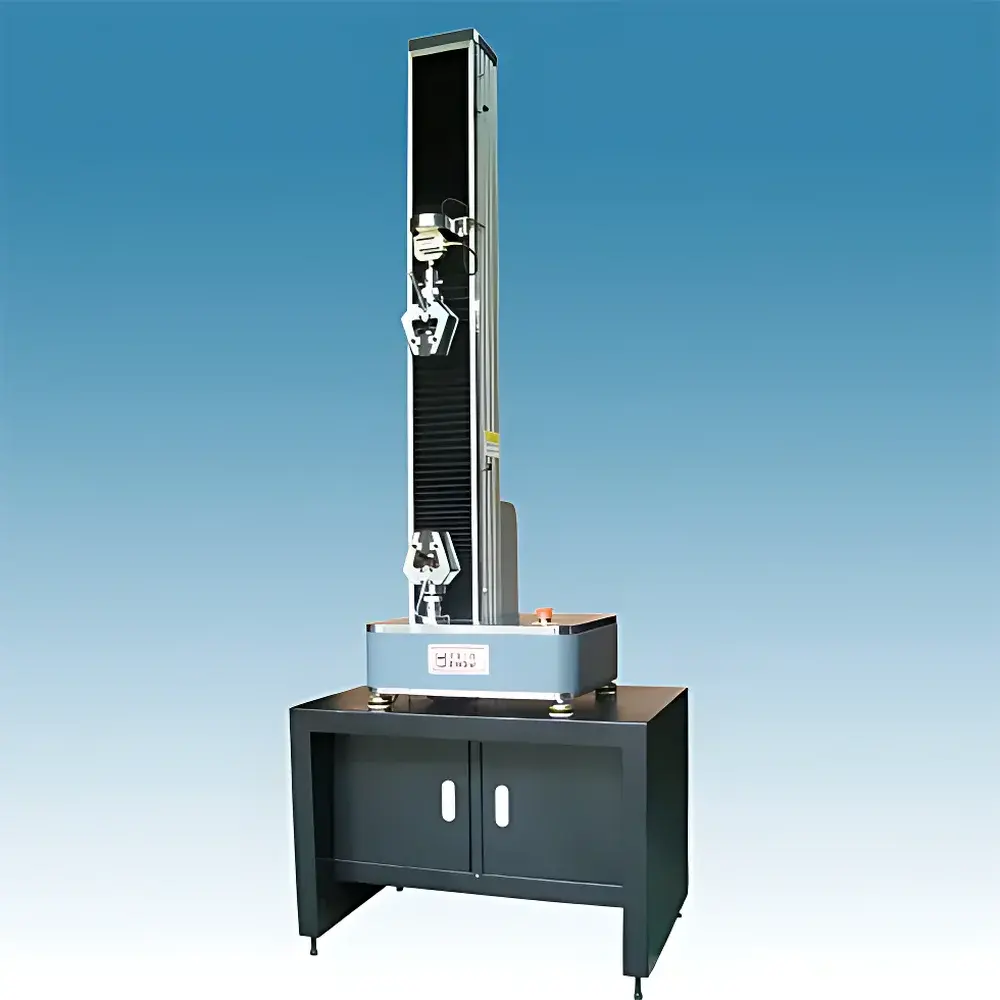
Hengyi HY-0580 Single-Column Electronic Universal Testing Machine
| Origin | Shanghai, China |
|---|---|
| Manufacturer Type | Authorized Distributor |
| Country of Origin | China |
| Model | HY-0580 |
| Instrument Type | Electronic Universal Testing Machine |
| Maximum Load Capacity | 5000 N |
| Load Cell Accuracy | ±0.01% of full scale |
| Measurement Accuracy | < ±1% |
| Test Speed Range | 0.001–500 mm/min |
| Speed Accuracy | ±0.5% |
| Displacement Accuracy | ±0.5% |
| Effective Width | 150 mm |
| Stroke | 800 mm (extendable) |
| Power Supply | 220 V AC |
| Unit Weight | ~85 kg |
| Dimensions (W×D×H) | 590 × 355 × 1640 mm |
Overview
The Hengyi HY-0580 is a single-column electronic universal testing machine engineered for precision mechanical property evaluation of metallic and non-metallic materials under tension, compression, bending, peel, puncture, and yield conditions. It operates on a closed-loop servo-controlled electromechanical principle: a high-torque DC motor—coupled via a precision gearbox to a ground滚珠 screw—drives the crosshead vertically with nanometer-level positional repeatability. Force is measured via a calibrated S-type load cell; displacement is tracked by a high-resolution optical encoder integrated into the lead screw assembly. The system complies with fundamental metrological traceability requirements defined in ISO/IEC 17025 and supports method validation per ASTM E4, ASTM E8/E8M, ISO 6892-1, ISO 178, ISO 148-1, and GB/T 228.1–2021. Designed for laboratory, QC, and R&D environments, it delivers stable, repeatable data acquisition at sampling rates up to 1 kHz, enabling accurate capture of transient mechanical events such as yield point onset or fracture initiation.
Key Features
- High-performance DSP-based control platform delivering real-time signal processing, deterministic loop response (<1 ms), and multi-channel synchronous acquisition (force, displacement, extensometer input).
- USB 1.1 full-speed interface (12 Mbps) supporting hot-plug operation and dynamic configuration of I/O parameters via software—eliminating hardware jumper settings.
- Four-layer PCB architecture with optimized grounding, differential routing, and ferrite-filtered power domains to suppress EMI from switching power supplies and motor drivers.
- Comprehensive safety architecture: dual-channel hardware limit switches, software-configurable overload thresholds, emergency stop circuitry meeting IEC 60204-1 Category 3 requirements, and automatic return-to-home upon test completion or fault detection.
- Modular mechanical design with preloaded ball screws, low-backlash gear reduction, and linear motion guides ensuring <0.02 mm axial runout over full stroke.
- Global-ready firmware supporting nine UI languages and unit systems—including SI (N, kN), imperial (lbf), and metric mass equivalents (kgf, tonf)—with seamless conversion during live testing.
Sample Compatibility & Compliance
The HY-0580 accommodates standardized tensile specimens (e.g., ASTM E8 dog-bone, ISO 6892-1 Type 2), compression blocks (ASTM C39), flexural beams (ASTM D790), peel strips (ASTM D903), and puncture discs (ASTM F1306). Grip options include pneumatic wedge grips, vise-type clamps, and custom fixtures for films, fibers, and biomedical sutures. All calibration and verification procedures align with ISO 7500-1 (static force measurement) and ISO 9513 (extensometer verification). Data integrity meets GLP/GMP documentation standards, with audit-trail-capable software logging user actions, parameter changes, and calibration events. Optional integration with LIMS via CSV/XML export satisfies FDA 21 CFR Part 11 requirements when paired with electronic signature modules.
Software & Data Management
HYtest V7.0 is a Windows-native application (compatible with Windows XP through Windows 11) built on VB.NET and SQL Server Compact Edition. It provides real-time plotting with auto-scaling axes, XY overlays, derivative computation (dF/dx), and customizable pass/fail criteria based on slope, plateau duration, or absolute threshold. Users define reusable test methods—including ramp-hold-relax cycles, cyclic loading, and multi-step protocols—with embedded logic for conditional branching (e.g., “if force > 95% FS, trigger video capture”). Raw data exports include ASCII-delimited files with metadata headers (timestamp, operator ID, environmental conditions), while processed reports generate PDFs compliant with ISO/IEC 17025 clause 7.8. Database schema supports relational querying across batches, materials, and operators—enabling trend analysis and SPC charting.
Applications
This system serves cross-industry mechanical characterization needs: polymer tensile modulus and elongation-at-break per ISO 527; wire bond pull strength in semiconductor packaging (JEDEC JESD22-B109); peel adhesion of medical device laminates (ISO 10993-17); compressive yield of orthopedic foam (ASTM F136); tensile strength of carbon fiber prepreg (ASTM D3039); and rubber hardness correlation via stress–strain hysteresis loops. Academic labs utilize its open API for MATLAB or Python automation; automotive Tier-1 suppliers deploy it for PPAP submission testing against OEM-specific material specs (e.g., GMW14872, Ford WSS-M99P1111-A).
FAQ
What standards does the HY-0580 support out-of-the-box?
Preconfigured test methods cover ASTM E8/E8M, ISO 6892-1, ISO 178, GB/T 228.1, and JIS Z2241. Custom method templates can be authored to match proprietary or emerging standards.
Can the system integrate with existing lab infrastructure?
Yes—via USB virtual COM port emulation for SCADA linkage, OPC UA gateway compatibility (optional), and scheduled automated report generation to network shares or email endpoints.
Is third-party calibration certification available?
Factory calibration includes NIST-traceable load cell and displacement verification. Accredited external calibration per ISO/IEC 17025 is offered through Hengyi’s global partner network.
What maintenance intervals are recommended?
Lubrication of ball screws every 500 hours; visual inspection of grip jaws and alignment fixtures before each shift; annual verification of load cell linearity and zero stability.
Does the software support multi-user role-based access control?
Yes—administrator, technician, and viewer roles enforce parameter lockdown, report editing permissions, and audit trail visibility per user group.



