
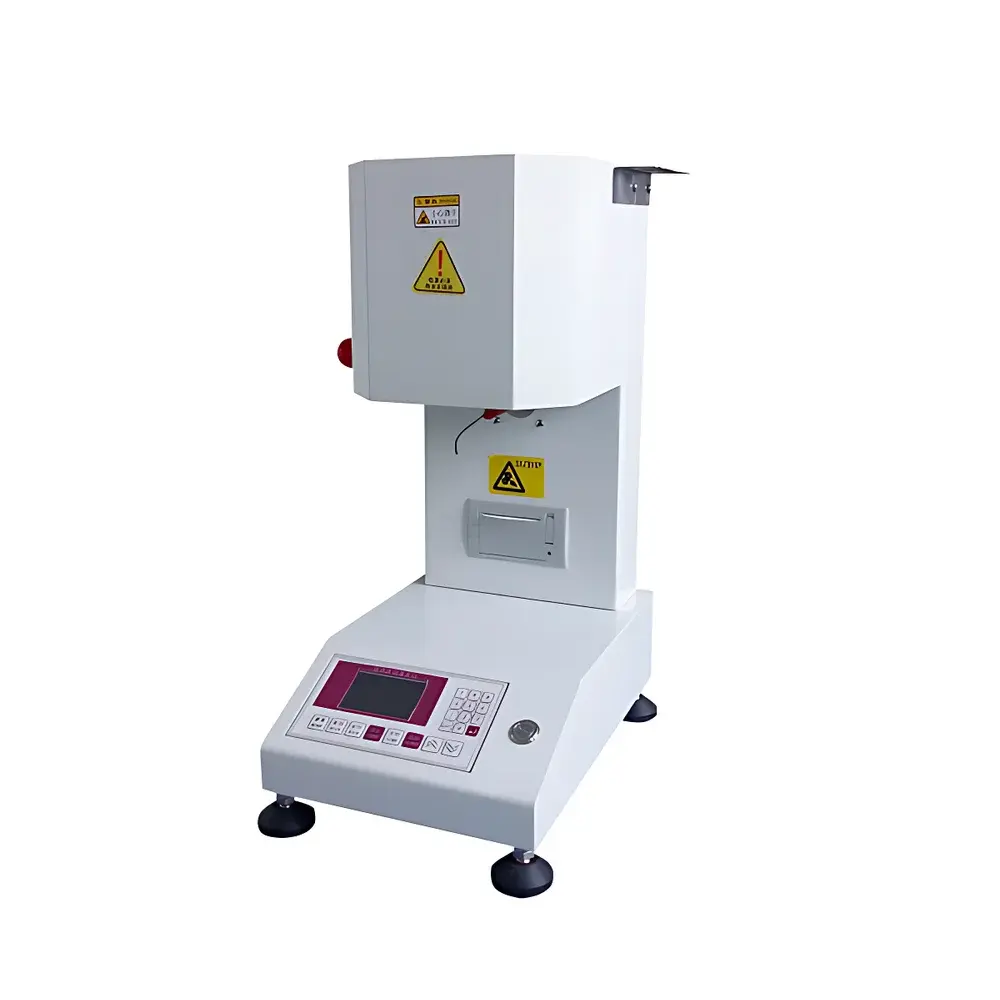
Hengyi HY(RZ) Plastic Pellet Melt Flow Rate Tester
| Brand | Hengyi |
|---|---|
| Origin | Shanghai, China |
| Manufacturer Type | Manufacturer |
| Product Category | Domestic |
| Model | HY(RZ) |
| Pricing | Upon Request |
| Standards Compliance | GB/T 3682–2018, JB/T 5456–2005 |
| Max Operating Temperature | ≥400 °C |
| Temperature Control Accuracy | ±0.2 °C |
| Temp Stabilization Time (to max temp) | ≤30 min |
| Thermal Recovery Time (post-filling) | 2–4 min |
| Timing Resolution | ≥0.1 s |
| Piston Displacement Resolution | ≥0.01 mm |
| Load Sets | 8 standard weights (0.325–21.600 kg |
| Die Dimensions | Ø2.095±0.005 mm × 8.000±0.025 mm |
| Barrel ID | Ø9.550±0.025 mm, L=152±0.1 mm |
| Piston Head | Ø9.475±0.015 mm × 6.350±0.100 mm |
| Test Methods | Mass Flow Rate (MFR) and Volume Flow Rate (MVR) |
| User Interface | Full-color PLC touchscreen |
| Safety | Insulated high-temp components, anti-scald design |
| Packaging/Transport | Compliant with GB/T 13384, GB/T 191, GB/T 6388 |
Overview
The Hengyi HY(RZ) Plastic Pellet Melt Flow Rate Tester is a precision instrument engineered for the standardized determination of melt mass flow rate (MFR) and melt volume flow rate (MVR) of thermoplastic polymers under controlled temperature and load conditions. Based on the principle of extrusion rheometry—where molten polymer is forced through a standardized capillary die under defined gravitational or applied loads—the HY(RZ) delivers repeatable, traceable flow data essential for raw material qualification, process validation, and quality control in polymer manufacturing and R&D laboratories. Designed in strict accordance with GB/T 3682–2018 (equivalent to ISO 1133–1:2011 and ASTM D1238–22) and JB/T 5456–2005, the system supports both gravimetric (MFR) and volumetric (MVR) measurement protocols, enabling direct correlation with international specification sheets and regulatory documentation.
Key Features
- High-temperature operation up to 400 °C with ±0.2 °C thermal stability, achieved via PID-controlled dual-zone heating and optimized thermal mass distribution;
- Eight calibrated weight sets (0.325–21.600 kg), covering the full range of standard test loads per ISO 1133 and ASTM D1238—including 3.187 N (0.325 kg), 21.18 N (2.160 kg), 98.07 N (10.000 kg), and 211.82 N (21.600 kg);
- Precision-machined capillary die (Ø2.095 ± 0.005 mm × 8.000 ± 0.025 mm) and barrel assembly (Ø9.550 ± 0.025 mm × 152 ± 0.1 mm) manufactured to metrological tolerances aligned with ISO 1133 Annex A;
- Automated, programmable cut-off mechanism synchronized with real-time piston displacement tracking (resolution: 0.01 mm) and high-accuracy timing (0.1 s resolution);
- Full-color PLC-based touchscreen interface supporting intuitive parameter configuration, live temperature profiling, MFR/MVR calculation, calibration logging, and multi-step test sequencing;
- Thermally insulated housing with anti-scald guards and modular component layout—facilitating rapid replacement of wear-prone parts (e.g., die, barrel liner, piston head) without specialized tools;
- Robust mechanical architecture compliant with GB/T 13384 (packaging) and GB/T 191/GB/T 6388 (transportation), ensuring integrity during global shipment and installation.
Sample Compatibility & Compliance
The HY(RZ) is validated for use with a broad spectrum of thermoplastic resins, including polyethylene (PE), polypropylene (PP), polystyrene (PS), polyoxymethylene (POM), acrylonitrile-butadiene-styrene (ABS), polycarbonate (PC), nylon (PA6, PA66), and fluoropolymers (e.g., PTFE, PVDF). All measurements adhere to the dimensional, thermal, and procedural requirements of GB/T 3682–2018, which references ISO 1133–1 for method equivalence and ISO 1133–2 for reference materials. While not inherently 21 CFR Part 11–compliant, the system’s deterministic control logic, timestamped event logs, and non-volatile parameter storage support integration into GLP- and GMP-aligned workflows when paired with validated laboratory information management systems (LIMS).
Software & Data Management
The embedded PLC firmware provides real-time display of chamber temperature, piston position, elapsed time, and calculated MFR/MVR values. Users may configure test sequences—including preheat duration, load application delay, cut-off interval, and replicate count—via the touchscreen interface. All operational parameters and results are stored locally with date/time stamps and user-defined sample IDs. Export functionality supports CSV output for external analysis. For audit readiness, the system maintains an immutable log of temperature deviations, manual interventions, and calibration events—enabling retrospective verification consistent with ISO/IEC 17025 clause 7.7 and internal QA procedures.
Applications
- Raw material acceptance testing against supplier specifications (e.g., PE MFR 0.3–40 g/10 min at 190 °C/2.16 kg);
- Batch-to-batch consistency evaluation during polymer compounding and pelletization;
- Correlation studies between MFR and mechanical properties (e.g., tensile strength, impact resistance);
- Process optimization of extrusion, injection molding, and blow molding parameters;
- Stability assessment of polymer degradation during thermal aging or recycling cycles;
- Supporting technical documentation for ISO 9001, IATF 16949, and AS9100-certified production facilities.
FAQ
What standards does the HY(RZ) comply with?
It fully implements GB/T 3682–2018 and JB/T 5456–2005, and its geometry and methodology are technically equivalent to ISO 1133–1:2011 and ASTM D1238–22.
Can the instrument perform both MFR and MVR measurements?
Yes—automated switching between mass-based (g/10 min) and volume-based (cm³/10 min) calculations is supported via integrated density input or optional pycnometry linkage.
Is the temperature stabilization time verified per standard requirements?
Yes—thermal recovery after sample loading is consistently ≤4 minutes, meeting the ≤5-minute requirement specified in ISO 1133 Annex B.
How is traceability maintained for weight calibration?
Each of the eight weight sets is supplied with individual calibration certificates traceable to national metrology institutes (e.g., NIM China), and the system supports user-initiated recalibration logging with operator ID and timestamp.
Does the HY(RZ) support automated reporting for regulatory submissions?
While native PDF report generation is not included, structured CSV exports enable seamless integration with validated reporting tools used in FDA-submitted dossiers and CE technical files.



