
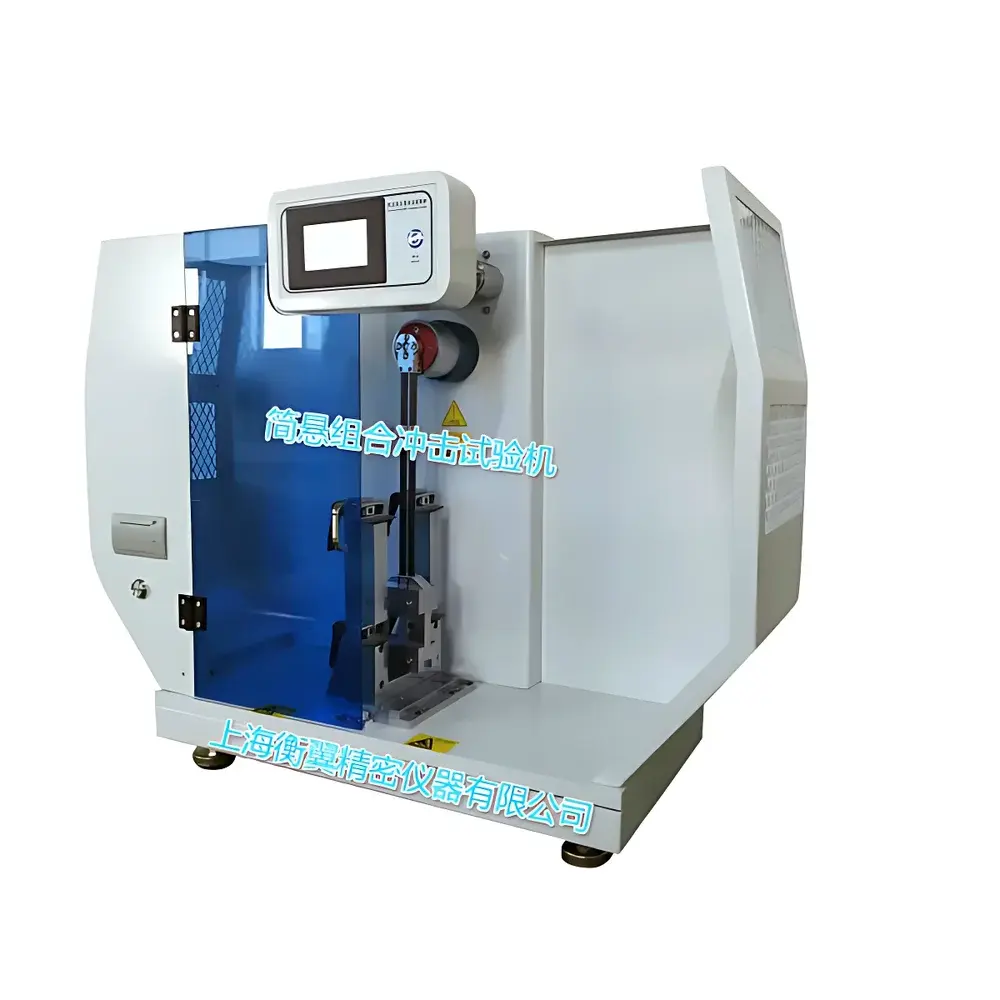
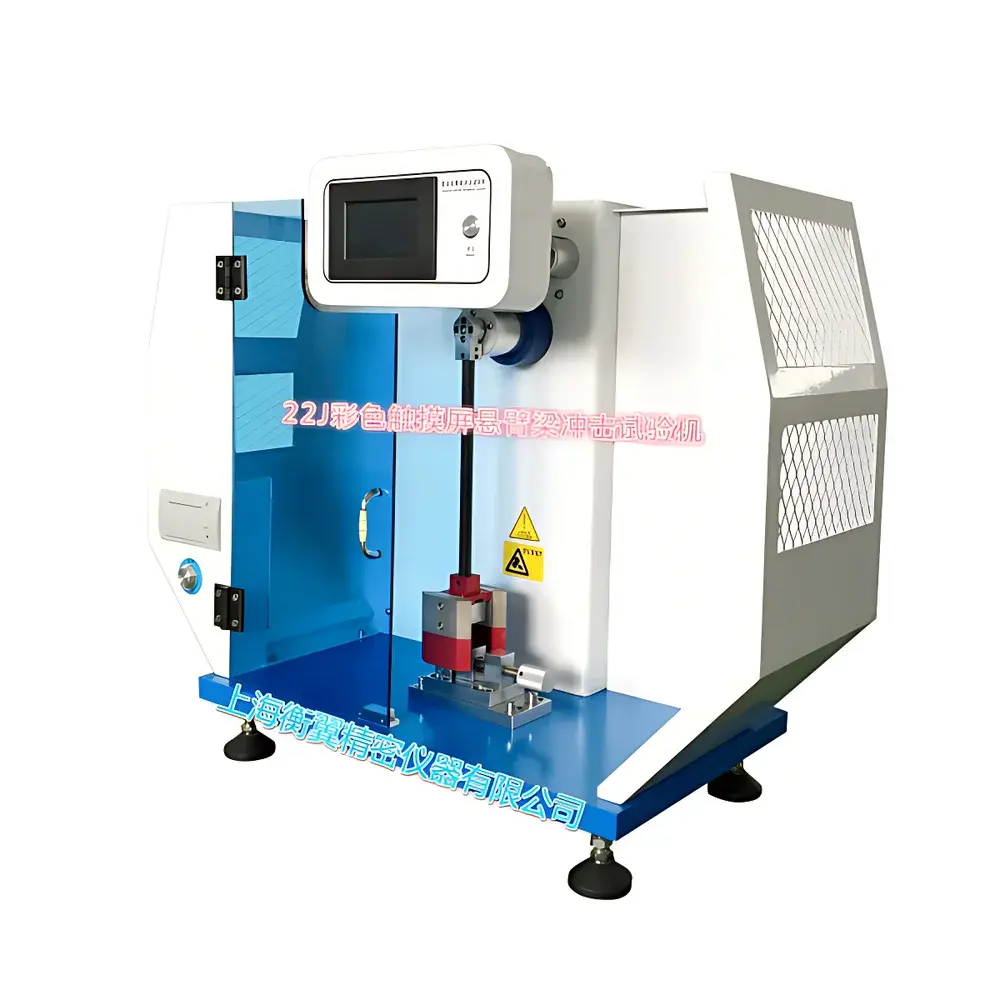
Hengyi HY(JX) Digital Display Simply-Supported & Cantilever Impact Testing Machine
| Brand | Hengyi |
|---|---|
| Origin | Shanghai, China |
| Manufacturer Type | Direct Manufacturer |
| Country of Origin | China |
| Model | HY(JX)-SFCV |
| Instrument Type | Pendulum Impact Tester |
| Impact Energy (Simply-Supported) | 1.0 J, 2.0 J, 4.0 J, 5.0 J |
| Impact Energy (Cantilever) | 2.75 J, 5.5 J, 11 J, 22 J |
| Impact Velocity (Simply-Supported) | 2.9 m/s |
| Impact Velocity (Cantilever) | 3.5 m/s |
| Pendulum Pre-lift Angle | 150° |
| Hammer Center Distance (Simply-Supported) | 230 mm |
| Hammer Center Distance (Cantilever) | 335 mm |
| Notch Radius (Simply-Supported) | R0.5 mm |
| Notch Radius (Cantilever) | R0.8 ± 0.2 mm |
| Distance from Blade Edge to Clamp Top (Cantilever) | 22 ± 0.2 mm |
| Pendulum Torque Constants | 0.53590 N·m (2.75 J), 1.47372 N·m (5.5 J), 2.94744 N·m (11 J), 5.8949 N·m (22 J), 11.7898 N·m (44 J equiv.) |
| Clamp Span Options (Simply-Supported) | 40 mm, 60 mm, 62 mm, 70 mm |
| Encoder | Panasonic Optical Rotary Encoder |
| Display System | Integrated LCD Control & Measurement Unit |
Overview
The Hengyi HY(JX)-SFCV Digital Display Simply-Supported & Cantilever Impact Testing Machine is a dual-mode pendulum impact tester engineered for precise determination of Charpy and Izod impact toughness in non-metallic materials. It operates on the classical principle of gravitational potential energy conversion: a calibrated pendulum is raised to a fixed angular position (150°), released, and allowed to strike a notched specimen clamped in either simply-supported (Charpy-type) or cantilever (Izod-type) configuration. The residual kinetic energy—measured via high-resolution optical encoder feedback and torque-based calibration—is subtracted from the initial potential energy to compute absorbed impact energy with traceable repeatability. Designed for routine quality control and R&D validation, this instrument delivers stable, low-drift performance across its full energy range without requiring external calibration weights or manual energy recalibration between test modes.
Key Features
- Dual-test capability: Switch seamlessly between ISO/GB-compliant simply-supported (Charpy) and cantilever (Izod) configurations using dedicated fixtures and calibrated pendulum assemblies.
- Precision optical measurement: Panasonic high-resolution rotary encoder captures real-time angular displacement and velocity profiles, enabling direct calculation of energy absorption with sub-mJ resolution.
- Modular pendulum system: Interchangeable hammer assemblies pre-calibrated for discrete energy levels—1.0 J, 2.0 J, 4.0 J, and 5.0 J for simply-supported mode; 2.75 J, 5.5 J, 11 J, and 22 J for cantilever mode—each with documented torque constants traceable to NIST-equivalent reference standards.
- Fixed-geometry compliance: Strict adherence to standardized specimen support dimensions—including 230 mm hammer center distance (simply-supported) and 335 mm (cantilever), 22 ± 0.2 mm blade-to-clamp distance (cantilever), and controlled notch radii (R0.5 mm and R0.8 ± 0.2 mm)—ensures inter-laboratory comparability.
- Integrated LCD control unit: Localized real-time display of impact energy, velocity, and pendulum angle; no PC dependency for basic operation; supports manual start/stop and emergency brake activation.
- Rugged cast-iron base and hardened steel anvil assembly ensure long-term dimensional stability and resistance to vibration-induced measurement drift during high-cycle testing.
Sample Compatibility & Compliance
The HY(JX)-SFCV is validated for standardized impact testing of rigid and semi-rigid polymeric materials including thermoplastics (e.g., ABS, PC, PP), reinforced composites (glass-fiber-reinforced nylon, carbon-fiber epoxy laminates), ceramics, cast stone, and electrical insulating materials. Specimen geometry conforms strictly to ISO 179-1 (Izod), ISO 180 (Charpy), GB/T 1043.1 (Chinese national standard for simply-supported beam impact), GB/T 1843 (Izod), ASTM D256 (Izod & Charpy), DIN 53453, and DIN 8078. All mechanical tolerances—including clamp span options (40 mm, 60 mm, 62 mm, 70 mm), anvil flatness (≤ 0.02 mm/m), and blade hardness (≥ 60 HRC)—are verified per ISO/IEC 17025-aligned internal procedures. The system supports GLP-compliant data recording when paired with optional audit-trail-enabled software (see Software & Data Management).
Software & Data Management
While the embedded LCD interface enables stand-alone operation, optional PC-based software provides expanded functionality: automated test sequence programming, statistical analysis (mean, SD, CV%, confidence intervals), PDF report generation with embedded digital signatures, and export to CSV/Excel for LIMS integration. The software architecture supports 21 CFR Part 11-compliant user access controls, electronic signature workflows, and immutable audit trails—including timestamped records of operator ID, parameter changes, calibration events, and raw encoder data logs. All firmware and software updates are delivered via signed package files with SHA-256 verification to maintain integrity throughout the instrument lifecycle.
Applications
- Quality assurance of injection-molded plastic components in automotive and consumer electronics supply chains.
- Comparative evaluation of polymer formulations during material development—e.g., impact modifier efficacy, filler dispersion effects, or thermal aging degradation.
- Regulatory submission testing for medical device housing materials under ISO 10993-4 biocompatibility requirements.
- Failure analysis labs assessing brittle-to-ductile transition behavior in composite laminates exposed to environmental conditioning (humidity, UV, thermal cycling).
- Academic research on structure–property relationships in bio-based polymers and recycled plastic blends.
- Third-party certification laboratories performing accredited testing to ISO/IEC 17025 scope requirements.
FAQ
What standards does the HY(JX)-SFCV fully comply with?
It meets the mechanical and procedural requirements of GB/T 1043.1, GB/T 1843, ISO 179-1, ISO 180, ASTM D256, DIN 53453, and DIN 8078—including dimensional tolerances, energy calibration methodology, and specimen preparation guidelines.
Can the same pendulum be used for both simply-supported and cantilever tests?
No—each configuration requires a dedicated pendulum assembly with distinct torque constants, center-of-gravity positioning, and blade geometry optimized for the respective loading mode.
Is third-party calibration certification available?
Yes; Hengyi offers factory calibration certificates traceable to CNAS-accredited metrology institutes, including uncertainty budgets per ISO/IEC 17025 Annex A.3.
Does the system support automatic specimen ejection or robotic handling?
Not natively—the HY(JX)-SFCV is designed as a manually loaded benchtop instrument. However, its mechanical interface and digital I/O ports allow integration with custom automation modules upon request.
What maintenance intervals are recommended for long-term accuracy?
Biannual verification of pendulum pivot friction, anvil surface flatness, and encoder alignment is advised; annual recalibration of torque constants and energy scale against certified reference specimens is required for ISO/IEC 17025 compliance.



