
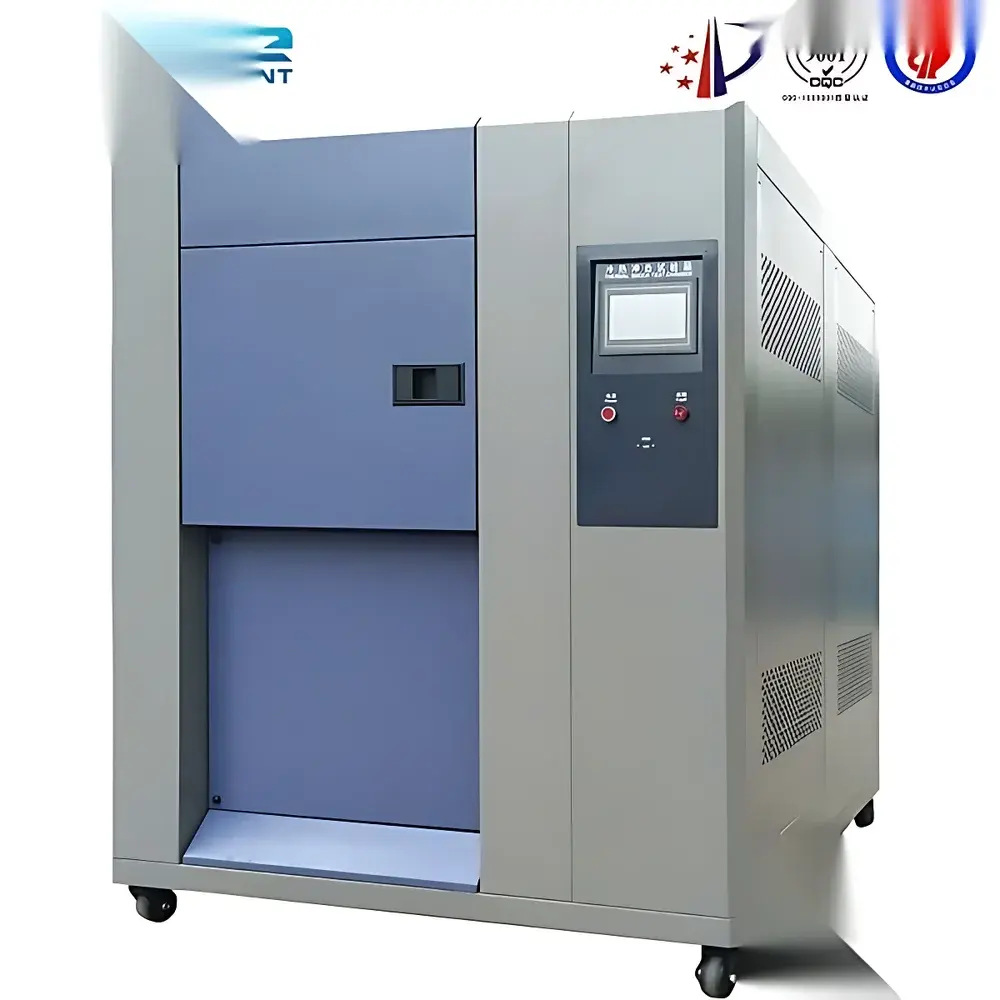
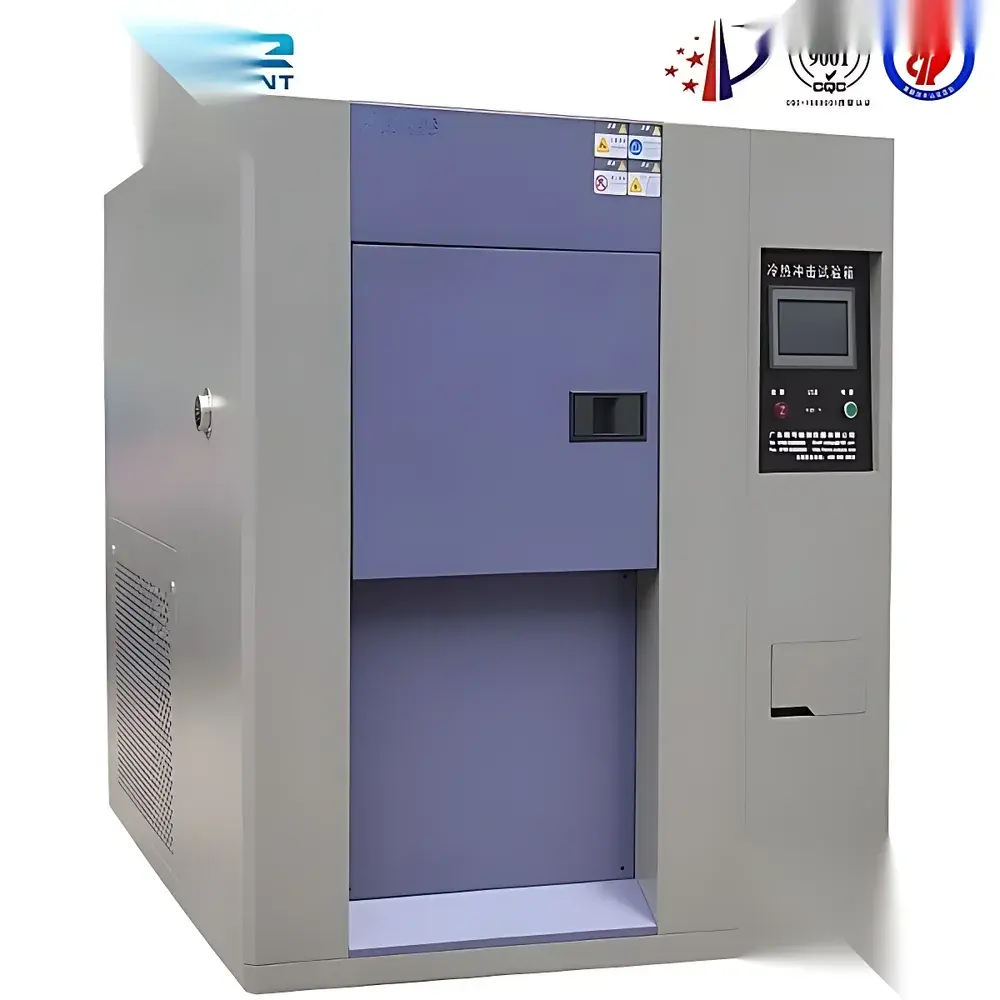
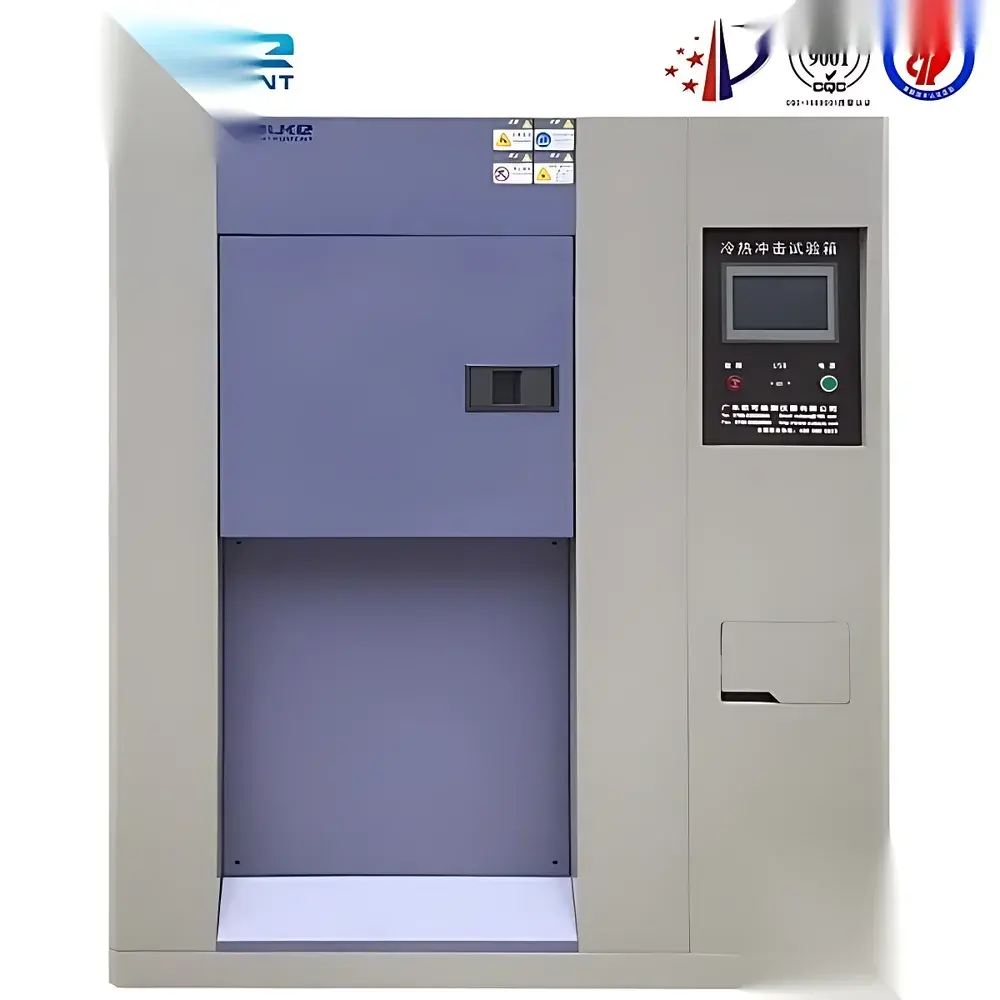
OK-TS Series Thermal Shock Test Chamber
| Brand | OK Instruments |
|---|---|
| Model | OK-TS-100A / OK-TS-225A / OK-TS-500A / OK-TS-010A |
| Internal Chamber Dimensions (W×H×D) | 450×450×500 mm / 600×600×600 mm / 800×800×800 mm / 1000×1000×1000 mm |
| External Dimensions (W×H×D) | 1560×870×1545 mm / 1710×1020×1845 mm / 1910×1220×2265 mm / 2110×1420×2665 mm |
| Temperature Range | −65 °C to +150 °C (typical dual-zone configuration) |
| Transition Time (typical) | ≤15 s between chambers |
| Temperature Uniformity | ±0.5 °C (at steady state, per IEC 60068-3-5) |
| Control Resolution | 0.1 °C |
| Data Logging | USB 2.0 & RS-232C interfaces |
| Sampling Interval | 3 s to 3600 s (configurable) |
| Storage Capacity | ≥120 days of timestamped temperature data at 60 s interval |
| Compliance | IEC 60068-2-14, MIL-STD-810G Method 503.5, JIS Z 8702, GB/T 2423.22 |
Overview
The OK-TS Series Thermal Shock Test Chambers are engineered for high-fidelity evaluation of material and component reliability under rapid, repeated thermal transitions. Utilizing a dual-chamber (hot/cold) or tri-zone (hot/ambient/cold) architecture with independent refrigeration and heating circuits, these systems subject test specimens to controlled, accelerated thermal cycling—mimicking real-world operational stresses encountered in aerospace, automotive electronics, semiconductor packaging, and medical device manufacturing. The core principle relies on mechanical transfer of samples between thermally isolated zones via pneumatic or servo-driven baskets, enabling precise dwell times and transition rates compliant with international environmental stress screening (ESS) protocols. Designed for laboratory and production-line validation, the OK-TS platform delivers reproducible thermal shock profiles essential for failure mode analysis, solder joint integrity assessment, and qualification testing per IPC-J-STD-020 and JEDEC JESD22-A104.
Key Features
- Dual independent refrigeration circuits with optimized compressor staging: large-capacity scroll compressors for rapid cooling; low-power units for fine-tuned temperature maintenance—reducing energy consumption by ≥30% versus conventional single-stage designs.
- Intelligent refrigerant demand algorithm dynamically modulates expansion valve opening and condenser fan speed to minimize thermal cross-talk and eliminate unnecessary cold/hot air mixing during transitions.
- High-efficiency air circulation system featuring stainless-steel extended-shaft motors and corrosion-resistant aluminum alloy multi-blade centrifugal impellers—rated for continuous operation from −65 °C to +150 °C.
- Positive-pressure airflow design with strategically positioned outlets ensures uniform temperature distribution (±0.5 °C) across full chamber volume, validated per IEC 60068-3-5.
- Advanced PID+PWM+SSR temperature control architecture with auto-tuning capability, delivering stable setpoint tracking and minimal overshoot during ramp-and-soak cycles.
- Integrated data acquisition system with dual communication interfaces: USB 2.0 for local data export (CSV/Excel-compatible), and RS-232C for bidirectional SCPI command-based remote control and integration into factory MES or LIMS platforms.
Sample Compatibility & Compliance
The OK-TS Series accommodates a broad range of sample geometries—from printed circuit board assemblies (PCBAs) and MEMS sensors to molded plastic housings and hermetically sealed connectors. Standard chamber volumes (100 L to 1000 L) support fixtures compliant with MIL-STD-810G Figure 503.5-1 mounting configurations. All models meet mandatory safety and electromagnetic compatibility requirements per IEC 61000-6-2/6-4 and carry CE marking. Calibration traceability follows ISO/IEC 17025 guidelines, with optional NIST-traceable certificate available upon request. The system architecture supports audit-ready data integrity features—including user-access logging, electronic signatures, and immutable timestamped records—aligning with FDA 21 CFR Part 11 and GLP/GMP documentation standards when configured with validated software modules.
Software & Data Management
Built-in controller firmware supports configurable sampling intervals (3 seconds to 1 hour), enabling granular resolution for transient analysis or long-term stability monitoring. Onboard memory stores ≥120 days of temperature history (at 60-second intervals) with automatic time-stamped curve generation. Data export via USB yields standardized CSV files compatible with MATLAB, Python pandas, or JMP for statistical process control (SPC) and Weibull reliability modeling. Optional Ethernet interface enables secure remote access through HTTPS-based web UI or Modbus TCP integration, facilitating centralized fleet monitoring in multi-chamber test labs. Firmware updates are delivered via signed package files to ensure cryptographic integrity and version-controlled deployment.
Applications
- Qualification testing of avionics components per RTCA DO-160 Section 24 (Temperature Shock).
- Accelerated life testing of battery modules and power electronics under extreme thermal gradients.
- Validation of conformal coating adhesion and delamination resistance in automotive ECUs.
- Reliability screening of wafer-level chip-scale packages (WLCSP) and flip-chip interconnects.
- Material compatibility assessment for cryogenic sealants, optical adhesives, and composite laminates.
- Process development support for reflow soldering profile optimization and post-molding stress relief.
FAQ
What is the typical thermal transition time between chambers?
Transition time from hot to cold (or vice versa) is ≤15 seconds for standard configurations, verified using Class A PT100 sensors per IEC 60751.
Does the system support custom test profiles with variable dwell times and ramp rates?
Yes—the controller supports up to 99 programmable steps per cycle, including non-linear ramps, hold durations, and loop nesting, all definable via front-panel interface or remote SCPI commands.
Is calibration documentation included with shipment?
Each unit ships with a factory calibration report covering temperature uniformity, transition accuracy, and sensor linearity across the full operating range; ISO/IEC 17025-accredited calibration services are available as an add-on.
Can the chamber be integrated into an automated test cell with PLC coordination?
Absolutely—RS-232C and optional digital I/O terminals enable seamless handshake signaling (e.g., door status, cycle completion, fault alerts) for synchronization with robotic handlers or conveyor systems.
What maintenance intervals are recommended for the refrigeration system?
Compressor oil and filter replacement is scheduled every 8,000 operating hours; annual verification of refrigerant charge and heat exchanger cleanliness is advised per manufacturer’s preventive maintenance checklist.



