
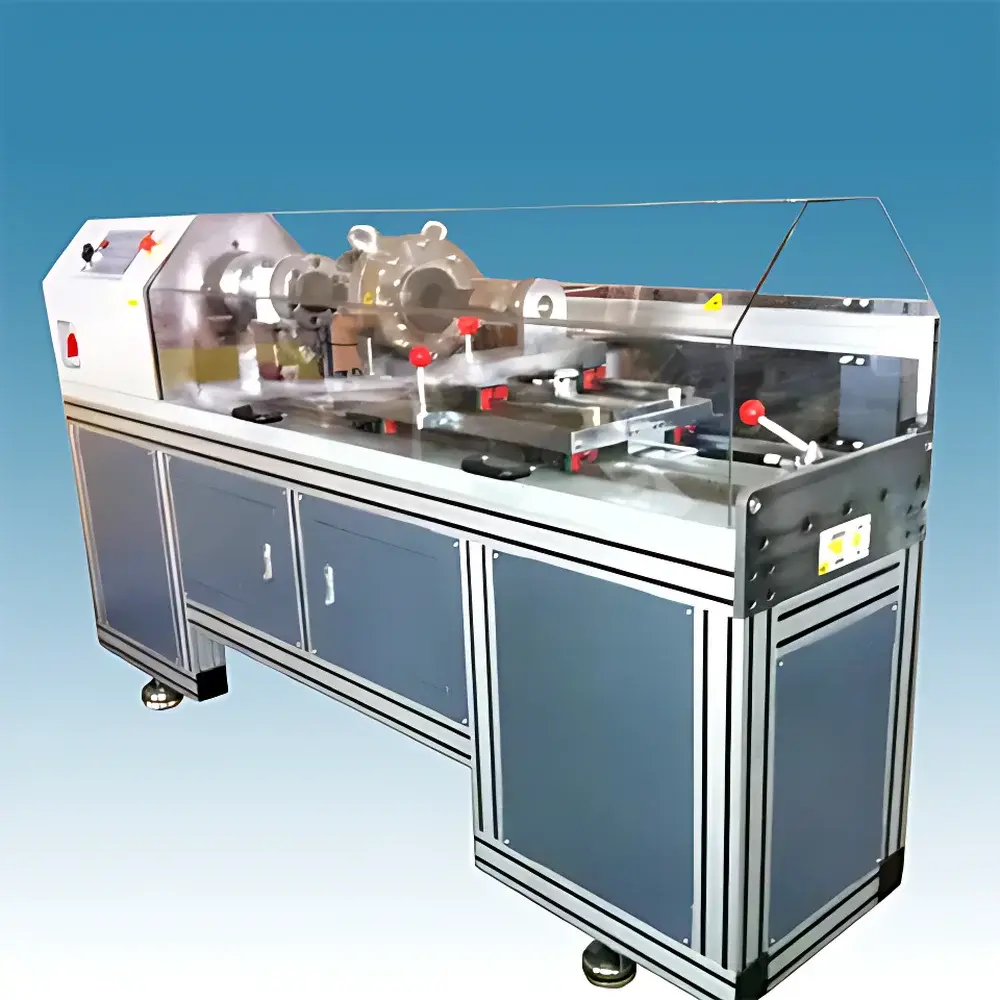
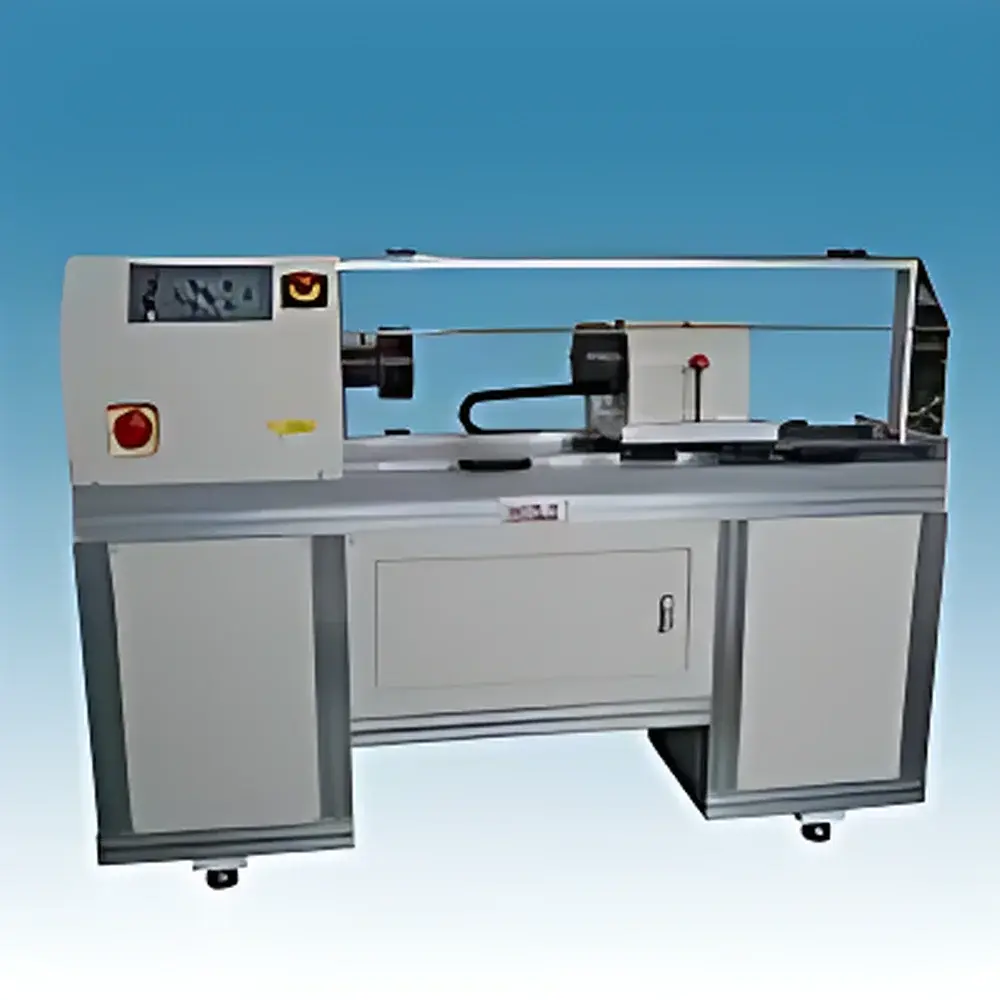
Hengyi HY-2000N·m Fastener Friction Coefficient Testing Machine
| Brand | Hengyi |
|---|---|
| Origin | Shanghai, China |
| Manufacturer Type | Direct Manufacturer |
| Product Category | Domestic |
| Model | HY-2000N·m |
| Max Torque | 2000 N·m |
| Torque Measurement Range | 2–2000 N·m |
| Torque Resolution | 1/50000 |
| Torsion Angle Range | 0–100000° |
| Motor Power | 5 kW |
Overview
The Hengyi HY-2000N·m Fastener Friction Coefficient Testing Machine is a high-precision torsion testing system engineered for the quantitative mechanical characterization of threaded fasteners—including bolts, screws, studs, and nuts—under controlled tightening conditions. It operates on the principle of simultaneous multi-axis force-torque-angle acquisition, utilizing dual-sensor architecture: a calibrated axial load cell (5–500 kN) and coaxial torque transducers (total torque up to 2000 N·m; thread torque up to 1000 N·m) integrated into a rigid C-frame torsion head. This configuration enables real-time, synchronized measurement of clamping force (preload), total applied torque, thread torque, bearing surface torque, and angular displacement during ramped or stepwise tightening protocols. The system is fundamentally designed to comply with internationally recognized fastener performance evaluation standards, including ISO 16047:2015, ISO 2320:2019, GB/T 3098.9–2010, GB/T 16823.3–2010, EN 14399-1:2005, and EN 14399-3–6:2006. Its core purpose is to extract critical frictional and mechanical parameters essential for bolted joint integrity assessment in safety-critical engineering domains.
Key Features
- High-resolution torque measurement with ±0.5% accuracy across full range (2–2000 N·m), supported by 1/50,000 digital resolution for precise detection of torque inflection points during yield and failure events.
- Dual-torque sensing architecture: independent measurement of total torque and thread torque enables direct calculation of thread friction coefficient (µthread) and bearing surface friction coefficient (µbearing), as defined in ISO 16047 Annex A.
- Integrated axial force measurement (5–500 kN) with ±0.5% linearity and repeatability, enabling accurate determination of K-factor (torque coefficient), yield preload, ultimate preload, and torque–angle curves.
- Wide torsion angle range: 0–100,000° (or continuous rotation mode), with angular position resolution <0.01° and ±0.5% measurement uncertainty per ISO 16047 Clause 7.3.
- Programmable torsion speed from 5–40 rpm (extendable to 200 rpm), with closed-loop servo control ensuring stable low-speed operation (<1 rpm) without stick-slip behavior—critical for capturing elastic–plastic transition during tightening.
- Modular clamping system accommodating fasteners from M10 to M30 (customizable up to M42), with adjustable jaw spacing (max. 1000 mm) and self-aligning fixtures to minimize bending moments.
- Robust mechanical architecture: 1800 kg reinforced steel frame, vibration-damped base, and low-noise 5 kW AC servo motor delivering consistent torque output across operational envelope.
Sample Compatibility & Compliance
The HY-2000N·m system is validated for testing metallic threaded fasteners conforming to ISO 898-1, ISO 4014, ISO 4016, ASTM F568M, and DIN 933/931 specifications. It supports both bolt–nut assemblies and screw–tapped hole configurations under static and quasi-static loading. All test procedures adhere strictly to the calibration, verification, and reporting requirements outlined in ISO 16047:2015 (Clause 8: Calibration of Test Equipment) and GB/T 16823.3–2010 (Section 6: Uncertainty Evaluation). The machine’s traceable metrology chain includes factory-calibrated load cells and torque transducers certified to ISO/IEC 17025-accredited laboratories. Data outputs meet GLP and GMP documentation prerequisites, supporting audit-ready records for aerospace (AS9100), automotive (IATF 16949), and energy sector (API RP 2A-WSD) quality systems.
Software & Data Management
The HYtest v5.2 modular software suite provides ISO 16047-compliant test sequencing, real-time parameter visualization, and automated coefficient derivation. It supports user-defined test profiles (e.g., constant-rate torque ramp, torque-controlled step, angle-controlled dwell), automatic yield point detection via 0.2% offset method, and dynamic calculation of µtotal, µthread, µbearing, K-value, and torque–angle hysteresis loops. All raw data—including time-stamped force, torque, angle, and speed vectors—are stored in binary .hdt format with embedded metadata (operator ID, sample ID, standard reference, environmental conditions). Export options include CSV, PDF reports (with configurable headers, logos, and signature fields), and XML for LIMS integration. Software complies with FDA 21 CFR Part 11 requirements for electronic records and signatures, featuring role-based access control, audit trail logging, and password-protected method locking.
Applications
- Quantitative validation of lubricant efficacy on fastener surfaces in automotive powertrain and chassis assembly lines.
- Development and qualification of high-strength bolting systems for wind turbine tower flange joints per IEC 61400-1.
- Root-cause analysis of bolt loosening in rail vehicle suspension components under vibrational fatigue.
- Calibration and verification of torque tools used in nuclear plant maintenance per ASME BPVC Section III.
- Research on thread geometry effects (pitch, flank angle, surface roughness) on friction distribution using parametric test matrices.
- Third-party certification testing for ISO 898-2 compliant fasteners in metallurgical R&D labs.
FAQ
Does the system support automated compliance reporting per ISO 16047?
Yes—HYtest software generates fully compliant test reports with mandatory fields: test date, operator, standard reference, fastener grade/specification, measured coefficients, uncertainty statements, and pass/fail verdicts against specified limits.
Can the machine test non-standard fasteners larger than M30?
Yes—custom tooling kits and extended-length torque arms are available upon request; maximum clamping length is configurable up to 1200 mm with structural reinforcement.
Is traceable calibration documentation included with delivery?
Each unit ships with a factory calibration certificate issued by an ISO/IEC 17025-accredited laboratory, covering axial load, total torque, and angular position channels, valid for 12 months.
How is data integrity ensured during long-duration tests (e.g., 72-hour relaxation studies)?
The HYtest controller employs non-volatile memory buffering and periodic auto-save intervals (configurable down to 100 ms), preventing data loss during power interruption or software restart.
What maintenance schedule is recommended for sustained metrological accuracy?
Biannual verification of sensor linearity and zero drift is advised; annual full recalibration is required for ISO 17025 traceability—service can be performed on-site or at Hengyi’s Shanghai calibration center.



