
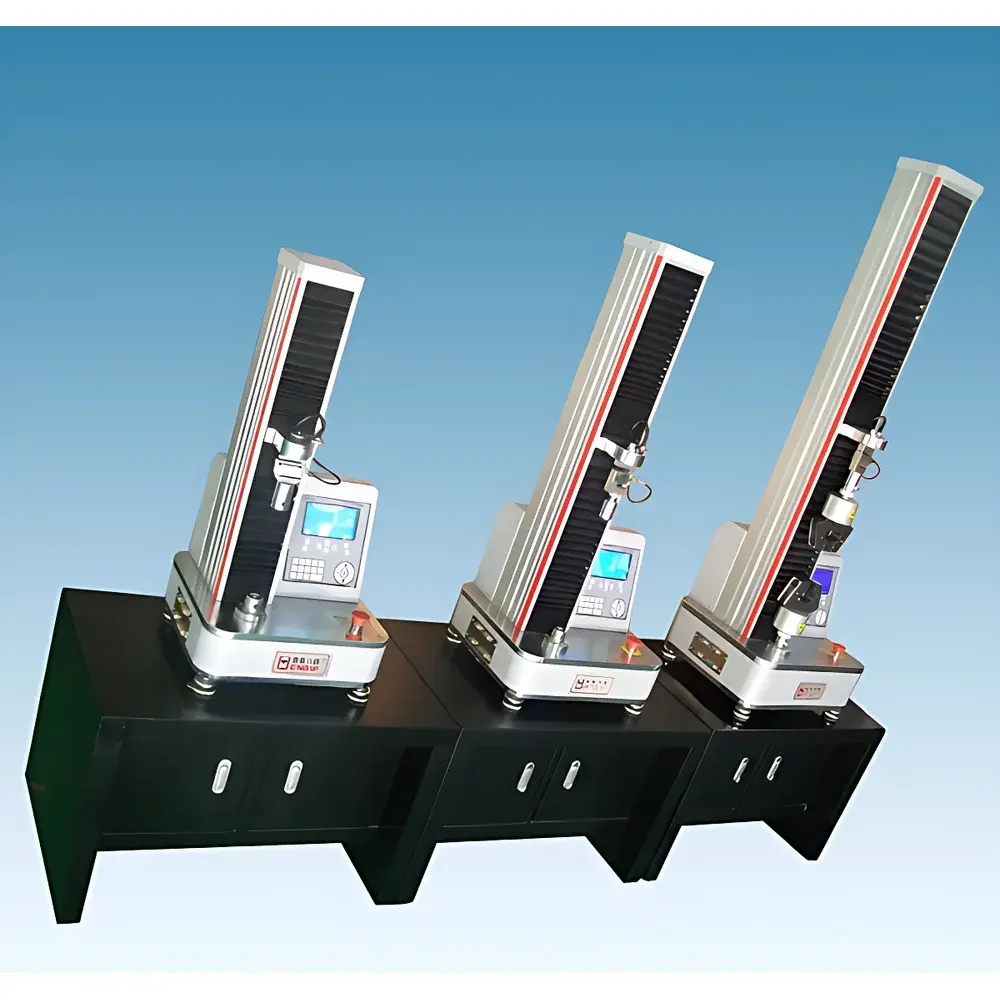
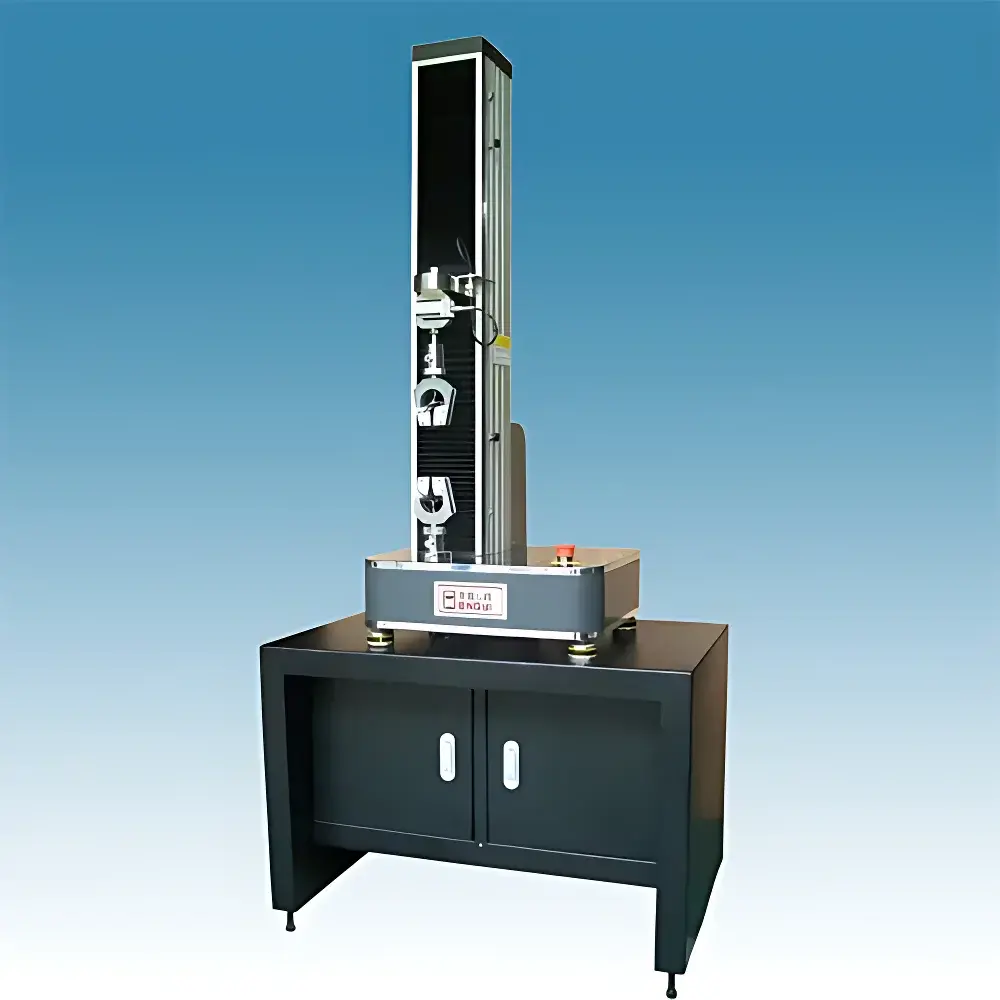
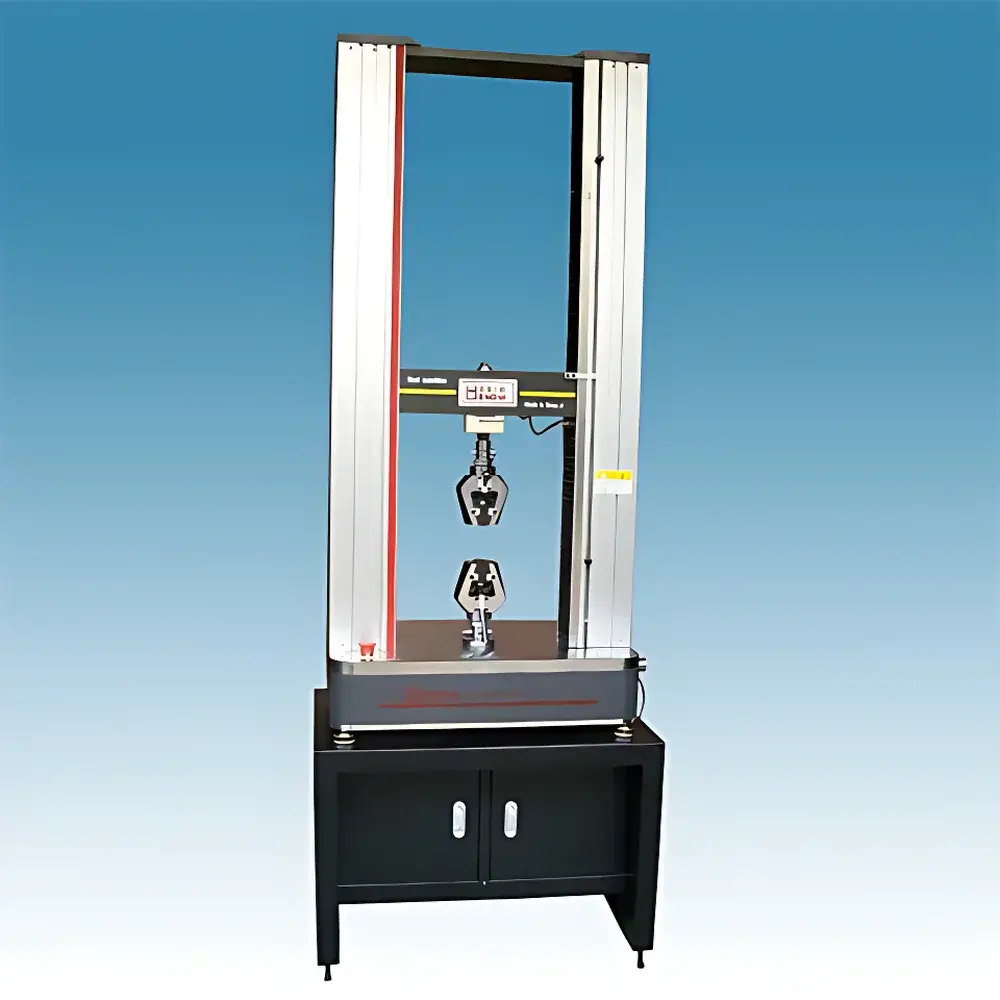
Hengyi HY-0580RTT Carbon Fiber Composite Tensile Testing Machine
| Brand | Hengyi |
|---|---|
| Origin | Shanghai, China |
| Manufacturer Type | Direct Manufacturer |
| Product Category | Domestic |
| Model | HY-0580RTT |
| Instrument Type | Electromechanical Tensile Testing Machine |
| Maximum Test Load | 5 kN |
| Load Measurement Range | 0.001–100% of Full Scale |
| Load Accuracy | ±0.5% of reading |
| Travel Distance | 800 mm |
| Displacement Resolution | 0.001 mm |
| Speed Range | 0.001–500 mm/min (optional up to 1000 mm/min) |
| Speed Accuracy | ±0.5% |
| Displacement Accuracy | ±0.5% of reading |
| Effective Width | 150 mm |
| Frame Weight | ~100 kg |
| Power Supply | 220 V AC |
| Dimensions (W×D×H) | 590 × 355 × 1640 mm |
| Safety Features | Electronic travel limit protection, emergency stop button |
| Control Interface | Full PC-based control with LCD panel backup |
| Software | Windows-based, bilingual (Chinese/English), optional 8-language version |
| Compliance | Meets ISO 527, ASTM D3039, ASTM D638, ISO 6892-1, and GB/T 228.1 requirements for static mechanical testing |
Overview
The Hengyi HY-0580RTT Carbon Fiber Composite Tensile Testing Machine is a precision-engineered electromechanical universal tester designed specifically for the static mechanical characterization of advanced fiber-reinforced polymer (FRP) composites—including carbon fiber, glass fiber, aramid, and hybrid laminates—as well as metals, plastics, elastomers, adhesives, textiles, and thin films. Built upon a high-rigidity single-column frame architecture with hardened ground steel columns and preloaded ball screws, the system delivers exceptional dimensional stability and minimal deflection under load. Its force measurement subsystem employs a calibrated load cell traceable to national standards, supporting closed-loop control via stress, strain, or displacement feedback—enabling full compliance with standardized test protocols for tensile, compression, flexural, peel, tear, and shear evaluation. The machine satisfies the structural and metrological requirements defined in ISO 527-4 (plastics – tensile properties of composites), ASTM D3039/D3410 (tensile/compression testing of polymer matrix composites), and ISO 6892-1 (metallic materials – tensile testing at ambient temperature).
Key Features
- High-precision load measurement system with ±0.5% accuracy across 0.001–100% of full scale (5 kN), certified per ISO 7500-1 Class 0.5
- Ultra-fine displacement resolution of 0.001 mm and travel range of 800 mm (extendable), enabling accurate strain determination for brittle and ductile failure modes
- Full-digital AC servo drive with speed control from 0.001 to 500 mm/min (optionally 1000 mm/min), maintaining ±0.5% speed accuracy throughout the operating range
- Rigid monolithic frame with reinforced crosshead and base plate, minimizing parasitic bending and ensuring axial alignment per ASTM E4 guidelines
- Integrated safety architecture including programmable electronic stroke limits, hardware-based emergency stop circuitry, and overload cut-off protection
- Modular fixture interface compatible with pneumatic, wedge-action, hydraulic, and custom-designed grips for flat, tubular, or filamentary specimens
- Self-damping base structure eliminates need for foundation anchoring—ideal for shared lab environments and mobile testing setups
Sample Compatibility & Compliance
The HY-0580RTT accommodates a broad spectrum of specimen geometries—from standard dog-bone coupons (ASTM D3039 Type I) and thin laminates (ISO 527-4) to woven fabrics, nonwovens, and single-filament strands. Its 150 mm effective width and adjustable gauge length support both standardized and application-specific configurations. All mechanical measurements adhere to internationally recognized uncertainty budgets defined in ISO/IEC 17025 and are fully traceable to SI units through accredited calibration chains. The system supports GLP-compliant data integrity practices, including audit-trail-enabled software logging, user-access controls, and electronic signature capability—meeting foundational expectations for FDA 21 CFR Part 11 readiness in regulated R&D and quality assurance workflows.
Software & Data Management
Control and analysis are performed using Hengyi’s proprietary WinTest Pro software suite, running natively on Windows OS. The platform provides real-time graphical display of load–displacement, stress–strain, and time-based curves, with synchronized dual-axis plotting for multi-sensor inputs (e.g., extensometer + load cell). Automated parameter extraction includes ultimate tensile strength (UTS), Young’s modulus, yield point (0.2% offset), elongation at break, Poisson’s ratio (with biaxial extensometry), interlaminar shear strength (ILSS), and fracture toughness indices. Data export formats include CSV, XLSX, PDF reports, and XML for LIMS integration. The software features configurable test templates, batch processing queues, and customizable report generation compliant with internal SOPs or external regulatory submissions.
Applications
- Mechanical qualification of carbon fiber prepreg systems during cure cycle development
- Interfacial adhesion assessment in fiber/matrix systems via microbond or fragmentation tests
- Quality control of CFRP aerospace components (e.g., wing skins, fuselage panels) per Boeing BMS 4.01 or Airbus AITM standards
- Comparative fatigue pre-screening via static ramp-to-failure protocols prior to servo-hydraulic cycling
- Teaching laboratory use in materials science curricula for hands-on instruction in composite mechanics and standardization principles
- Third-party certification testing for ISO 9001 and AS9100 auditable documentation packages
FAQ
What standards does the HY-0580RTT comply with for carbon fiber composite testing?
It supports ASTM D3039 (tensile), ASTM D3410 (compressive), ISO 527-4 (composite tensile), ISO 14126 (compressive), and ISO 14130 (short-beam shear), with configuration options for ASTM D7264 flexural testing.
Can the system be used for single-filament tensile testing?
Yes—when equipped with micro-grip assemblies and a high-resolution video extensometer or laser-based strain sensor, it meets ASTM D3379 and ISO 10406 requirements for fiber-level mechanical characterization.
Is the software validated for regulated environments?
While not pre-validated out-of-the-box, the software architecture supports IQ/OQ/PQ execution and can be configured to meet 21 CFR Part 11 requirements—including role-based access, electronic signatures, and immutable audit trails.
What calibration documentation is provided?
Each unit ships with a factory calibration certificate conforming to ISO/IEC 17025, referencing NIST-traceable standards; annual recalibration services are available through Hengyi’s global service network.
Are environmental enclosures or temperature chambers supported?
The base system is rated for ambient operation (10–35°C, ≤80% RH); optional thermal chambers (−70°C to +300°C) and humidity-controlled enclosures can be integrated via third-party suppliers with mechanical and data interface alignment.



