
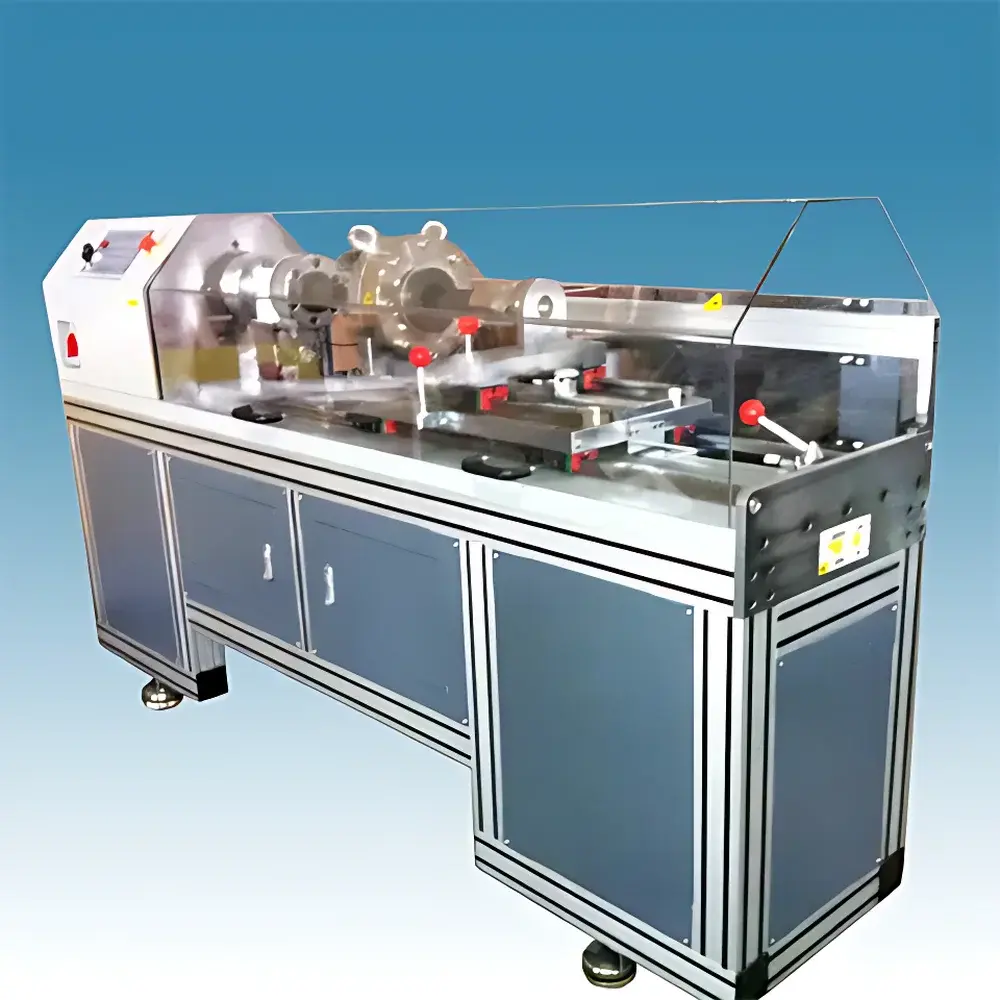
Hengyi HY-2000N·m Wind Turbine High-Strength Bolt Axial Force & Torque Coefficient Testing Machine
| Brand | Hengyi |
|---|---|
| Origin | Shanghai, China |
| Manufacturer Type | Direct Manufacturer |
| Model | HY-2000N·mYUJV |
| Max Torque | 2000 N·m |
| Torque Measurement Range | 2–2000 N·m |
| Torque Resolution | 1/500,000 |
| Torsion Angle Range | 0–100,000° (or continuous) |
| Motor Power | 5 kW |
| Axial Force Range | 5–500 kN |
| Torque Accuracy | ±0.5% FS |
| Angle Accuracy | ±0.5% FS |
| Clamping Distance | 1000 mm |
| Rotational Speed | 5–40 rpm (up to 200 rpm) |
| Specimen Diameter | M10–M30 |
| Dimensions (L×W×H) | ~2200×540×1250 mm |
| Weight | 1800 kg |
Overview
The Hengyi HY-2000N·m Wind Turbine High-Strength Bolt Axial Force & Torque Coefficient Testing Machine is a precision torsion testing system engineered for the quantitative evaluation of mechanical fastening behavior under controlled tightening conditions. It operates on the principle of simultaneous dual-sensor measurement—integrating high-fidelity axial load (clamping force) and multi-component torque decomposition (total torque, thread torque, bearing surface torque)—to derive critical fastener performance parameters in accordance with internationally recognized mechanical test standards. Designed specifically for wind energy infrastructure applications, this machine addresses the stringent reliability requirements of high-strength bolted joints subjected to cyclic loading, fatigue stress, and long-term preload decay. Its architecture supports full-cycle tightening–loosening sequences—including first insertion, first release, fifth release, and fifteenth release—to assess frictional stability, self-loosening resistance, and coefficient reproducibility across repeated engagements.
Key Features
- Integrated dual-axis sensing: Simultaneous acquisition of axial clamping force (5–500 kN) and three torque components (total, thread, bearing surface) via calibrated composite transducers compliant with ISO 16047 metrological traceability.
- High-resolution torque measurement: 2000 N·m maximum capacity with 1/500,000 internal resolution and ±0.5% full-scale accuracy, enabling detection of micro-frictional deviations during low-torque pre-tightening phases.
- Precision angular control: Torsion angle measurement up to 100,000° (or continuous rotation mode), with ±0.5% FS repeatability and programmable speed profiles from 5 to 200 rpm for both quasi-static and dynamic tightening simulation.
- Modular specimen adaptability: Adjustable jaw spacing (up to 1000 mm) and interchangeable chucks support M10–M30 threaded fasteners—including ASTM A193 B7, ASTM A320 L7, and EN 10269 grade bolts—without mechanical reconfiguration.
- Robust structural design: 1800 kg cast-iron frame with vibration-damped base and reinforced load train ensures mechanical stability during high-torque transient events and long-duration creep tests.
- Compliance-ready hardware interface: Analog and digital I/O ports support external data logging, PLC synchronization, and integration into factory-level quality management systems adhering to ISO 9001 and IATF 16949 workflows.
Sample Compatibility & Compliance
This testing machine accommodates standard and custom bolt–nut assemblies used in wind turbine tower flanges, rotor hub connections, gearbox mounting, and blade pitch systems. Tested specimens include zinc-plated M10/M12 Class 8.8 anti-loosening nuts with matching galvanized bolts, as well as higher-grade materials such as ASTM A325, ASTM A490, and ISO 898-1 Grade 10.9/12.9 fasteners. All measurement protocols align with ISO 16047:2015 (Fasteners — Mechanical properties of fasteners made of carbon steel and alloy steel — Torque/clamp force testing), GB/T 3098.9–2010 (Mechanical properties of fasteners — Testing of torque–tension characteristics), GB/T 16823.3–2010 (Mechanical properties of fasteners — Proof load, hardness, and tensile tests), and EN 14399 series for preloaded structural bolting systems. The system supports GLP-compliant audit trails when paired with validated software configurations.
Software & Data Management
The embedded control software provides real-time visualization of torque–angle curves, axial force–torque hysteresis loops, and friction coefficient evolution across tightening cycles. Raw sensor data is timestamped and stored in CSV and HDF5 formats with metadata tagging (operator ID, batch number, environmental temperature/humidity). Exported datasets comply with ASTM E2911 requirements for digital record integrity. Optional FDA 21 CFR Part 11–compliant software modules offer electronic signatures, role-based access control, and immutable audit logs—suitable for regulated manufacturing environments operating under GMP or AS9100 frameworks. Calibration certificates are digitally linked to sensor serial numbers and auto-embedded in test reports.
Applications
- Preload consistency validation for offshore wind turbine foundation bolts exposed to marine corrosion and thermal cycling.
- Friction coefficient mapping of coated fasteners (e.g., zinc-nickel, Geomet®, Dacromet®) under varying surface roughness and lubrication conditions.
- K-factor (torque coefficient) certification per ISO 16047 Annex C for OEM supplier qualification programs.
- Yield point detection during controlled tightening to prevent over-torque-induced thread stripping or shank yielding.
- Statistical process control (SPC) of torque–tension relationships across production lots using Cp/Cpk analysis tools integrated into reporting dashboards.
- Research into relaxation behavior of high-strength bolts under sustained load, simulating 20-year service life scenarios per IEC 61400-1.
FAQ
What standards does this machine directly support for calibration and reporting?
ISO 16047:2015, GB/T 3098.9–2010, GB/T 16823.3–2010, EN 14399-1:2005, and ISO 898-1:1999 are natively implemented in test method templates and report generation.
Can the system perform automated multi-cycle loosening tests up to 15 repetitions without manual intervention?
Yes—the controller executes fully programmable tightening–loosening sequences with user-defined dwell times, torque thresholds, and reversal logic, all logged with individual cycle metadata.
Is axial force measurement traceable to national metrology institutes?
Transducers are supplied with UKAS-accredited calibration certificates (valid for 12 months), and optional on-site recalibration services are available through Hengyi’s ISO/IEC 17025 accredited lab in Shanghai.
Does the machine support third-party data acquisition systems (e.g., LabVIEW, MATLAB)?
Yes—via Ethernet TCP/IP API and analog voltage outputs (±10 V) synchronized to encoder pulses, enabling real-time integration with external DAQ platforms.
What maintenance intervals are recommended for long-term accuracy retention?
Biannual verification of torque and axial load channels against reference standards is advised; annual mechanical inspection of drive train backlash and chuck alignment is included in the preventive maintenance package.



