
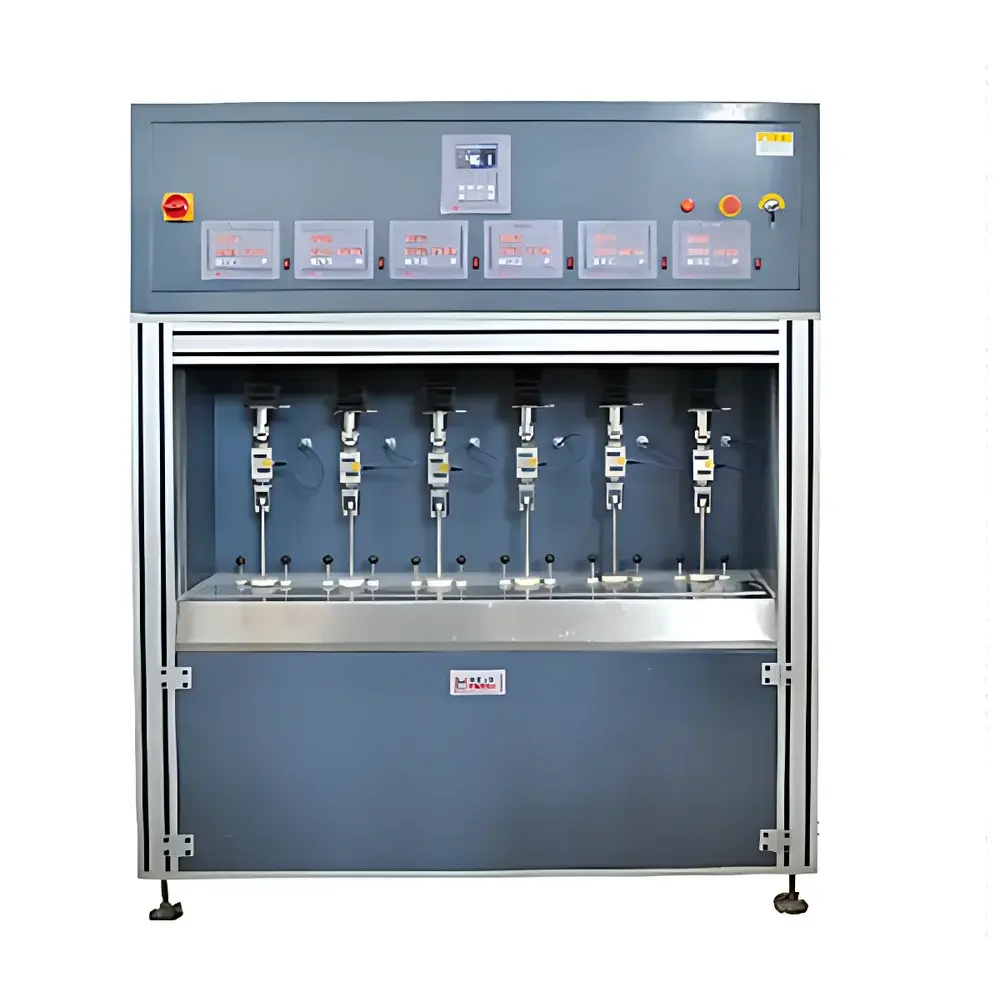
Hengyi HY-QKRB Polyethylene Full-Notch Tensile Creep Testing Machine
| Brand | Hengyi / Hengyitest |
|---|---|
| Origin | Shanghai, China |
| Manufacturer Type | Direct Manufacturer |
| Region Classification | Domestic (China) |
| Model | HY-QKRB |
| Quotation | Upon Request |
| Load Capacity | 2000 N (interchangeable load cells available below 2000 N) |
| Force Measurement Range | 0.4–99.999% of full scale |
| Effective Test Width | 120 mm |
| Effective Test Stroke | 200 mm |
| Test Speed | 0.001–100 mm/min (adjustable) |
| Speed Accuracy | ±1% of indicated value |
| Displacement Accuracy | ±1% of indicated value |
| Strain/Deformation Accuracy | ±1% of indicated value |
| Test Stations | 12 independent stations |
| Temperature Control Range (Constant-Temp Bath) | Ambient to 95 °C |
| Temperature Stability | ±0.5 °C |
| Control System | PC-based automated control |
| Power Requirement | 10 kW, 220 V AC |
| Net Weight | 850 kg |
| Dimensions (W×D×H) | 1620 × 850 × 1750 mm |
| Compliance Standards | GB/T 15820–1995, GB/T 11546, GB/T 32682–2016, ISO 899-1, ISO 16770, ISO 3501 |
Overview
The Hengyi HY-QKRB Polyethylene Full-Notch Tensile Creep Testing Machine is a purpose-built, multi-station mechanical testing system engineered for the standardized evaluation of environmental stress cracking (ESC) resistance in polyethylene (PE) and other thermoplastic polymers under sustained tensile loading in controlled thermal and chemical environments. It operates on the principle of full-notch creep testing (FNCT), as defined in ISO 16770 and GB/T 32682–2016, where pre-notched specimens are subjected to constant tensile stress—applied via dead-weight or electromechanical loading—while immersed in a temperature-regulated bath containing a specified surfactant solution (e.g., Igepal CO-630). The primary output is time-to-failure (tf) at defined stress levels, enabling quantification of material resistance to slow crack growth under combined mechanical and environmental stressors. This method is critical for quality assurance of PE pressure piping systems, geosynthetic liners, and blow-molded containers, particularly where long-term structural integrity under service conditions must be validated against international design life targets (e.g., 50–100 years).
Key Features
- Twelve independently operated test stations, each equipped with precision electromechanical loading and real-time force feedback—eliminating cross-talk between units through isolated elastic support structures;
- High-resolution force measurement with 0.5-class accuracy and dynamic range spanning 0.4% to 99.999% of full scale (2000 N max; optional lower-capacity load cells available);
- Programmable displacement control from 0.001 to 100 mm/min, with speed stability maintained within ±1% of setpoint across the entire range;
- Integrated thermostatic bath with PID-controlled heating and circulation, maintaining temperature uniformity within ±0.5 °C from ambient to 95 °C—critical for reproducible ESC kinetics;
- Automated diagnostic routines including overload protection, thermal cutoff, position limit sensing, and sensor calibration verification—ensuring unattended operation over extended test durations (up to 10,000+ hours);
- Dual-language (English/Chinese) PC software compliant with GLP data integrity requirements: timestamps, user authentication, audit trails, and electronic signatures for all test parameters and results.
Sample Compatibility & Compliance
The HY-QKRB accommodates standardized FNCT specimens per ISO 16770 (10 mm × 4 mm × 4 mm, with 0.3 mm deep notch) and tensile creep bars per ISO 899-1 (Type 1A, 80 mm gauge length). It supports both dry-air and liquid-immersion configurations, with bath compatibility verified for aqueous surfactant solutions, glycol-water mixtures, and other chemically aggressive media used in ESC screening. All mechanical and thermal subsystems conform to CE safety directives (2014/30/EU EMC, 2014/35/EU LVD) and meet essential requirements of ISO/IEC 17025 for accredited testing laboratories. Test reports generated by the system satisfy traceability mandates under ISO/IEC 17025:2017 Clause 7.8 and support FDA 21 CFR Part 11 compliance when deployed in regulated pharmaceutical or medical device packaging validation workflows.
Software & Data Management
The embedded Windows-based control and analysis suite provides synchronized acquisition of force, displacement, time, and bath temperature at configurable sampling intervals (10–1000 Hz). Raw data is stored in vendor-neutral CSV and XML formats, with metadata embedded per ASTM E2500-18 guidelines. Automated calculations include time-to-failure (tf), creep strain rate (dε/dt), and normalized stress rupture curves (log tf vs. σ). Curve-fitting modules support Master Curve construction using time–temperature superposition (TTS) per ISO 6721-1. All data archives are structured for direct import into LIMS platforms and support batch reporting aligned with ISO/IEC 17025 documentation requirements—including instrument calibration history, operator ID, environmental logs, and raw waveform exports for third-party reanalysis.
Applications
- Accelerated ESC lifetime prediction of PE100 and PE100-RC pipe resins for water/gas distribution networks;
- Comparative ranking of polymer stabilizer packages under standardized FNCT conditions;
- Validation of fusion joint integrity in HDPE butt-welded pipe assemblies per GB/T 15820;
- Quality control of geomembrane materials for landfill liner systems per GRI-GM13;
- Regulatory submission support for ISO 1133, ASTM D1238, and EN 12226-compliant material dossiers;
- Research into molecular architecture effects (e.g., long-chain branching, comonomer distribution) on slow crack growth mechanisms.
FAQ
What standards does the HY-QKRB fully support for FNCT testing?
It implements ISO 16770, GB/T 32682–2016, and ISO 3501 with hardware-level alignment to specimen geometry, notch fabrication tolerances, and bath immersion depth requirements.
Can the system perform non-standard creep tests outside FNCT protocols?
Yes—the open-loop control architecture permits custom ramp-hold profiles, multi-step stress sequences, and displacement-controlled creep, provided user-defined methods remain within mechanical and thermal operating limits.
Is remote monitoring and data export compatible with enterprise IT infrastructure?
The system supports OPC UA server integration, TLS-encrypted HTTP API endpoints, and scheduled FTP/SFTP uploads to central data repositories without requiring proprietary middleware.
How is calibration traceability maintained across the 12 stations?
Each station undergoes individual load cell and encoder calibration using NIST-traceable reference standards; calibration certificates are digitally linked to test records and auto-embedded in exported reports.
What maintenance intervals are recommended for continuous operation?
Bath fluid replacement every 90 days, load cell zero-check weekly, and annual full metrological verification—including thermal uniformity mapping and force linearity assessment—are advised per ISO/IEC 17025 preventive maintenance schedules.



