
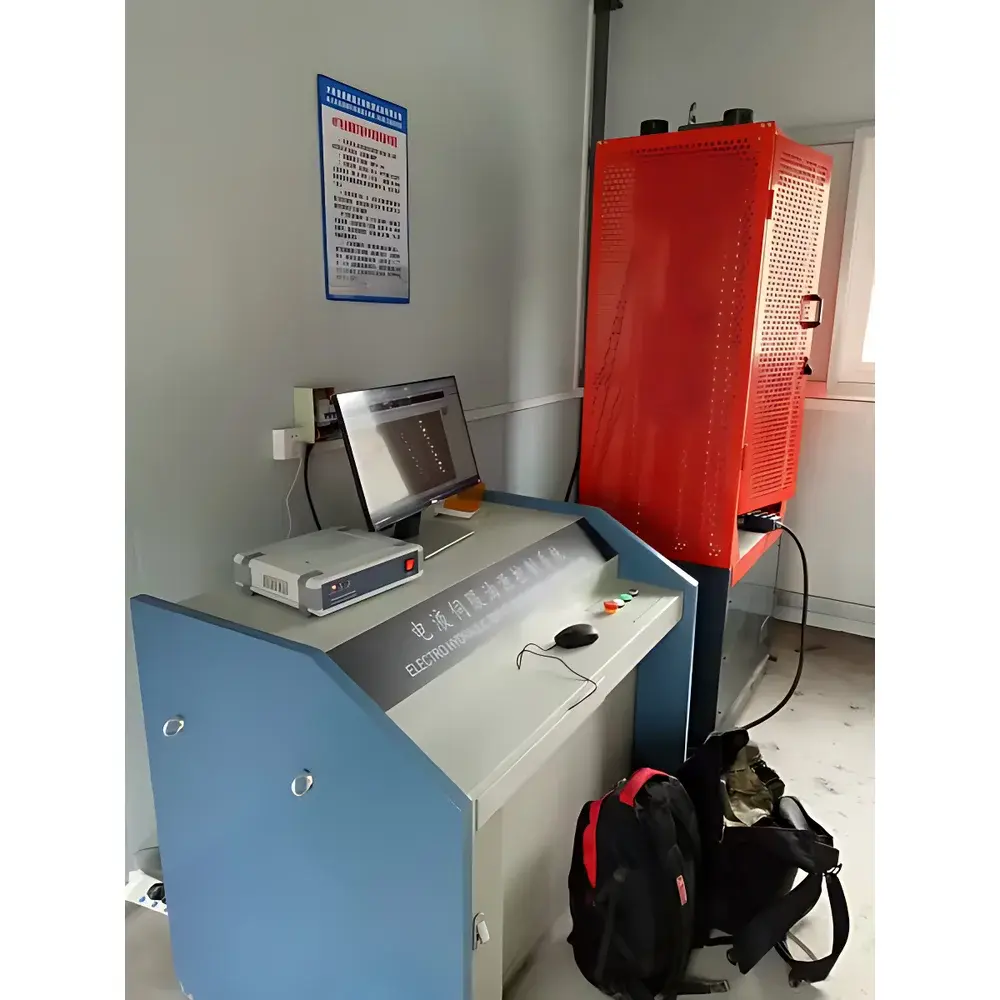
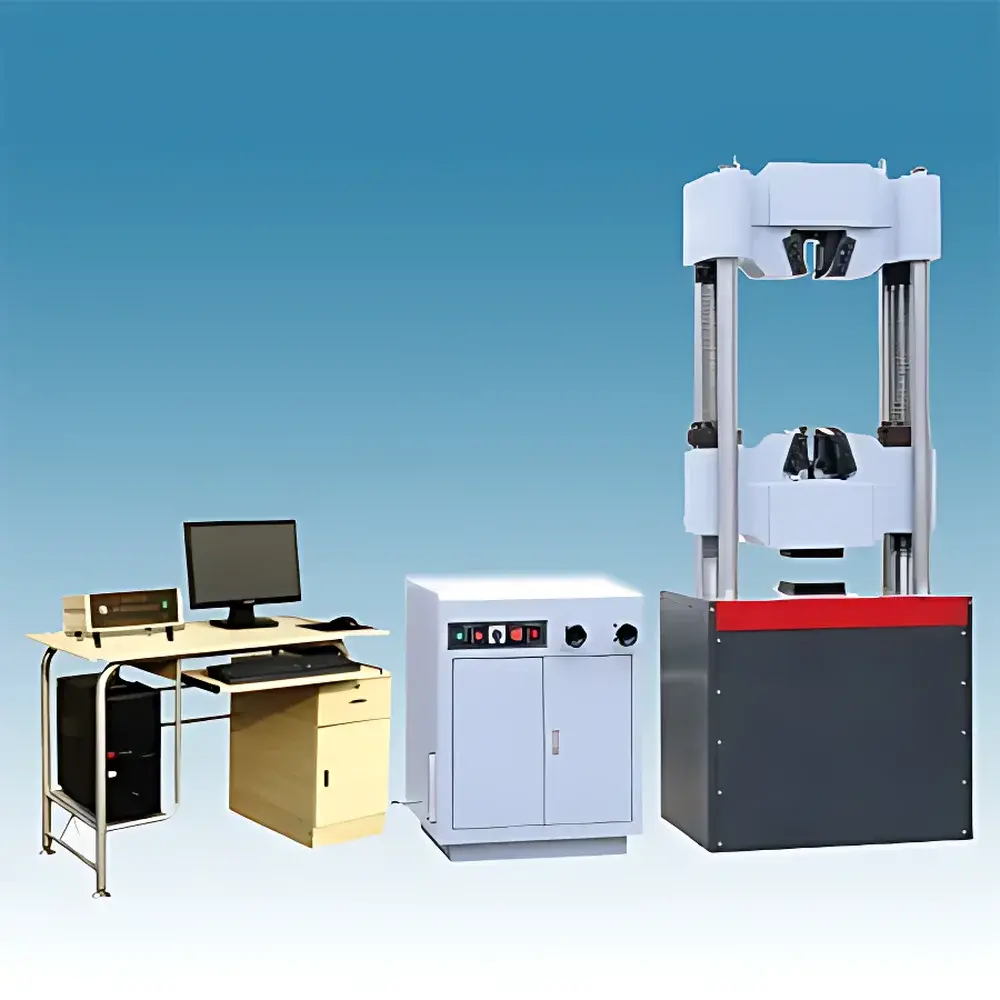
Hengyi HY(WE)100060 Electro-Hydraulic Servo Universal Testing Machine
| Brand | Hengyi / Hengyitest |
|---|---|
| Origin | Shanghai, China |
| Manufacturer Type | Direct Manufacturer |
| Regional Classification | Domestic (China) |
| Model | HY(WE)100060TYUYHB |
| Instrument Type | Electro-Hydraulic Servo Testing Machine |
| Maximum Load Capacity | 1000 kN |
| Load Measurement Accuracy | ±0.5% of reading |
| Displacement Resolution | ≤0.5% of full scale |
| Compression Test Space | 600 mm |
| Tensile Test Space | 600 mm |
| Round Specimen Grip Range | Φ20–Φ60 mm |
| Flat Specimen Thickness Capacity | 0–40 mm |
| Piston Stroke | 150 mm |
| Bend Support Span Adjustment | 100–600 mm |
| Shear Specimen Diameter | Φ10 mm |
| Strain Measurement Accuracy | ±0.5% of reading |
| Stress Rate Control Range | 1–60 N/mm²/s |
| Strain Rate Control Range | 0.00025–0.0025 s⁻¹ |
| Closed-Loop Control Accuracy (Force/Displacement/Strain) | ±1% of setpoint |
| Overall Dimensions (W×D×H) | 880 × 580 × 2860 mm |
| Motor Power | 1.5 kW, 3-phase |
| Weight | 3500 kg |
Overview
The Hengyi HY(WE)100060 Electro-Hydraulic Servo Universal Testing Machine is a high-capacity, precision-engineered mechanical testing system designed for static mechanical property evaluation of metallic and non-metallic materials under controlled loading conditions. Based on the principles of servo-controlled hydraulic actuation and closed-loop feedback regulation, it delivers consistent force application across tensile, compression, bending, and shear test modes. The machine employs a bottom-mounted hydraulic cylinder architecture with a rigid dual-column frame, enabling stable load transmission and minimal deflection during high-force testing up to 1000 kN. Its electro-hydraulic proportional control system ensures smooth, programmable loading profiles—including ramp, hold, and cyclic sequences—while maintaining traceability to international calibration standards such as ISO 7500-1 (Class 1), ASTM E4, and GB/T 228.1. The system is engineered for laboratory and industrial quality control environments where reproducibility, long-term stability, and compliance-ready data integrity are essential.
Key Features
- Electro-hydraulic servo actuation with proportional valve control for precise force and displacement regulation
- Bottom-mounted oil cylinder design with reinforced crosshead and precision-guided moving beam for axial alignment stability
- Integrated high-accuracy load cell (±0.5% FS) and optical encoder-based displacement measurement (±0.5% FS)
- Automated range switching and auto-calibration of force and deformation channels
- Adjustable test space: 600 mm tensile gap and 600 mm compression height, accommodating standard and custom specimens
- Dual-mode gripping system: self-aligning wedge-type clamps for round specimens (Φ20–Φ60 mm) and flat specimens (0–40 mm thickness)
- Modular bending fixture assembly with adjustable support span (100–600 mm) and standardized shear tooling (Φ10 mm)
- 1.5 kW three-phase motor driving a high-efficiency gear pump, optimized for low-noise, low-heat operation
- Rigid structural frame (880 × 580 × 2860 mm) with 3500 kg mass ensuring vibration damping and operational stability
Sample Compatibility & Compliance
The HY(WE)100060 supports standardized mechanical testing of metallic rods, bars, plates, castings, and weldments per ISO 6892-1, ASTM A370, EN 10002-1, and GB/T 228.1. It also accommodates non-metallic specimens including concrete cylinders (per ASTM C39), cement mortars (ASTM C109), and polymer rods (ISO 527-1). All hardware interfaces—including grips, platens, and bending fixtures—comply with dimensional tolerances specified in ISO 2041 and ASTM E1012. The system meets electromagnetic compatibility requirements per IEC 61326-1 and safety standards per ISO 12100 and GB/T 5226.1. For regulated industries, the software architecture supports audit trails, electronic signatures, and 21 CFR Part 11-compliant user access controls when configured with validated firmware and documentation packages.
Software & Data Management
Control and analysis are executed via a Windows-based, Chinese-English bilingual software suite with real-time multi-channel acquisition (load, displacement, strain). The system provides automatic calculation of key mechanical parameters: ultimate tensile strength (Rm), upper/lower yield strengths (ReH/ReL), proof stress at 0.2% offset (RP0.2), Young’s modulus (E), fracture elongation (A), and reduction in area (Z). Raw data is stored in ASCII-compatible .csv format with timestamped metadata, supporting post-test curve overlay, local zoom, and differential analysis. Reporting templates conform to ISO 14289-1 and ASTM E691 guidelines, generating PDF or printed reports with embedded test curves, statistical summaries, and calibration certificate references. Optional GLP/GMP modules enable electronic lab notebook (ELN) integration, change control logs, and instrument qualification records (IQ/OQ/PQ).
Applications
- Tensile characterization of structural steel, stainless alloys, aluminum extrusions, and titanium forgings
- Compression testing of ductile iron castings, high-strength concrete, and ceramic composites
- Three-point and four-point bending evaluation of welded joints, rail profiles, and composite laminates
- Shear strength assessment of riveted, bolted, or adhesively bonded interfaces
- Quality assurance testing for automotive chassis components, aerospace fasteners, and pressure vessel materials
- Routine mechanical verification in metallurgical labs, third-party certification bodies, and R&D centers
FAQ
What standards does this machine comply with for calibration and verification?
It conforms to ISO 7500-1 Class 1 accuracy requirements for force measurement systems and supports verification per ASTM E4, ISO 376, and GB/T 16825.1.
Can the system perform closed-loop strain-controlled tests?
Yes—it supports closed-loop control of force, displacement, and true strain (via extensometer input) with a control accuracy of ±1% of setpoint.
Is remote diagnostics or network connectivity supported?
The system features Ethernet port and RS232 interface; optional OPC UA or Modbus TCP gateways enable integration into factory MES/SCADA networks.
What maintenance intervals are recommended for the hydraulic system?
Oil filtration and level checks every 500 operating hours; full hydraulic oil replacement and seal inspection every 2000 hours or annually, whichever occurs first.
Does the software support multi-user permission levels and audit trail generation?
Yes—when deployed with the validated GLP package, it provides role-based access, electronic signatures, and immutable audit logs compliant with 21 CFR Part 11.



