
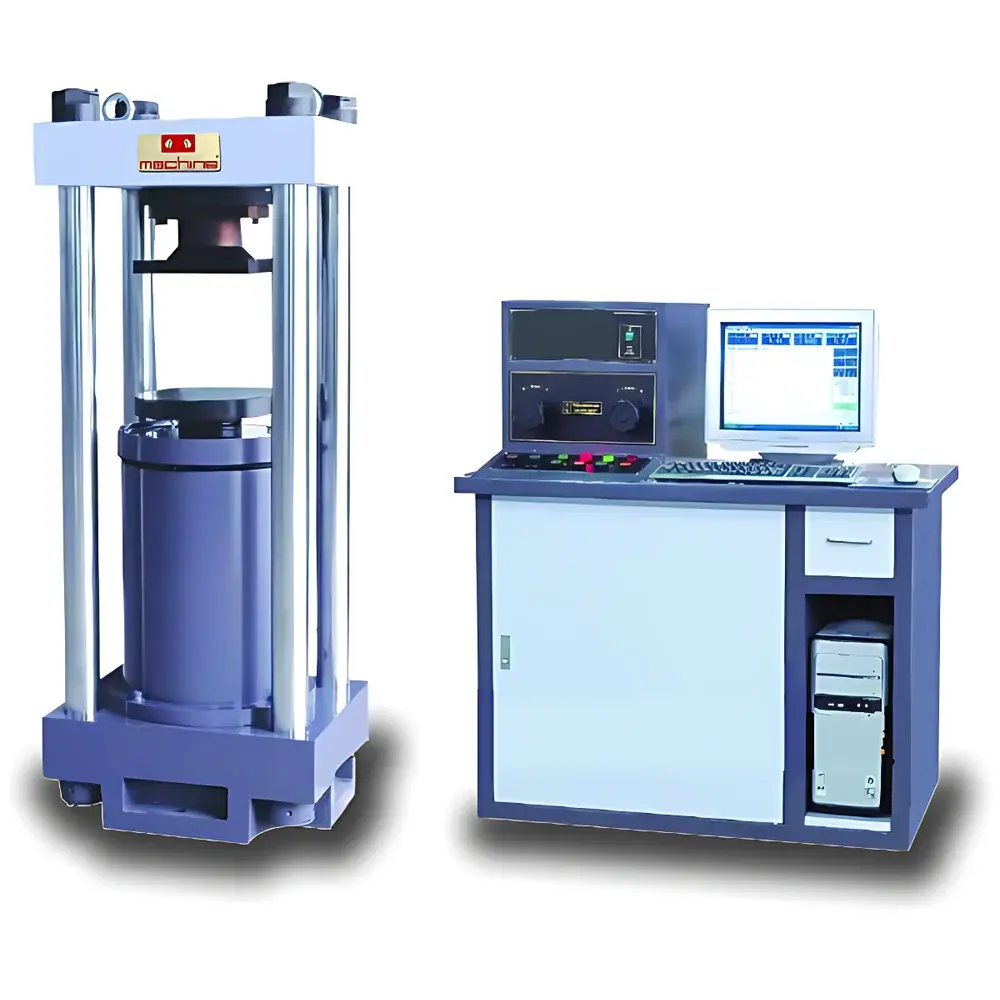
Hengyi HY(YE)-300008RTYY 3000 kN Computer-Controlled Hydraulic Compression Testing Machine
| Brand | Hengyi / Hengyitest |
|---|---|
| Origin | Shanghai, China |
| Manufacturer Type | Direct Manufacturer |
| Country of Origin | China |
| Model | HY(YE)-300008RTYY |
| Quotation | Upon Request |
| Maximum Load Capacity | 3000 kN |
| Accuracy Class | Class 1 |
| Force Measurement Range | 120–3000 kN |
| Relative Indicated Error | ±1% |
| Loading Speed | 1–15 mm/s (adjustable) |
| Clear Distance Between Columns | 320 mm |
| Upper Platen Dimensions | 320 × 220 mm |
| Lower Platen Dimensions | 400 × 400 mm |
| Piston Stroke | 80 mm |
| Motor Power | 2.2 kW |
| Net Weight | ~1500 kg |
| Overall Dimensions (W×D×H) | 700 × 550 × 1800 mm |
| Compliance Standards | GB/T 228–2002, GB/T 5224–1995, GB/T 232–1999 |
Overview
The Hengyi HY(YE)-300008RTYY 3000 kN Computer-Controlled Hydraulic Compression Testing Machine is a high-capacity, electro-hydraulic servo-controlled system engineered for precise and repeatable uniaxial compression testing of structural construction materials. It operates on the principle of controlled hydraulic force application through a closed-loop proportional pressure control system, enabling stable load ramping, dwell, and displacement-controlled loading protocols. Designed specifically for civil engineering laboratories, quality control departments in precast concrete plants, highway infrastructure testing centers, and national building material inspection institutes, this machine delivers deterministic mechanical response data under ASTM C39/C39M, ISO 7500-1, and GB/T 228–2002 compliant conditions. Its rigid four-column frame architecture, integrated high-precision load cell, and real-time feedback-driven actuation ensure minimal compliance error and high reproducibility across repeated test cycles — critical for certification-grade reporting in regulatory and contractual compliance environments.
Key Features
- Electro-hydraulic proportional control system with real-time PID-regulated load and displacement feedback for consistent loading profiles.
- Motor-driven vertical adjustment mechanism with precision lead screw assembly for rapid, repeatable specimen alignment and height optimization.
- Dual-platen configuration: fixed lower platen (400 × 400 mm) and adjustable upper platen (320 × 220 mm), optimized for standard concrete cubes (150 mm), cylinders (150 mm Ø × 300 mm), bricks, and natural stone specimens.
- Integrated Dell industrial-grade computer with dedicated Windows-based test software, supporting automated test sequencing, multi-step loading programs, and real-time curve visualization (load vs. displacement, stress vs. strain).
- Automatic data logging at user-defined sampling intervals; raw test files stored in CSV and proprietary binary formats with full metadata tagging (operator ID, timestamp, environmental notes, calibration traceability).
- HP thermal printer interface for immediate hardcopy generation of standardized test reports compliant with GB/T 228–2002 Annex B formatting requirements.
- Network-ready Ethernet port supporting remote diagnostics, centralized lab data aggregation via LIMS integration, and secure file export to shared network drives or cloud storage endpoints.
Sample Compatibility & Compliance
This system accommodates standard and non-standard compression specimens per major international and national standards, including but not limited to concrete cubes (100 mm, 150 mm, 200 mm), cylindrical concrete cores (100 mm Ø × 200 mm), autoclaved aerated concrete blocks, fired clay bricks (MU10–MU30), and natural rock cores. The 320 mm column clearance and 80 mm piston stroke allow testing of specimens up to 300 mm in height without reconfiguration. All mechanical and metrological performance parameters conform to GB/T 228–2002 (Metallic Materials – Tensile Testing), GB/T 5224–1995 (Steel Strands for Prestressed Concrete), and GB/T 232–1999 (Metallic Materials – Bend Test). While not certified to ISO/IEC 17025 or ASTM E4, the system supports GLP-aligned documentation practices including electronic audit trails, operator authentication, and version-controlled calibration records.
Software & Data Management
The embedded test software provides role-based access control (administrator, technician, reviewer), configurable test templates, and built-in calculation modules for compressive strength (MPa), modulus of elasticity (GPa), and Poisson’s ratio estimation where applicable. Data export supports CSV, Excel (.xlsx), PDF report generation, and XML schema for interoperability with enterprise quality management systems (QMS). All test sessions are time-stamped and digitally signed; changes to test parameters or post-processing edits are logged with user ID and timestamp. The system meets baseline requirements for electronic record integrity as defined in FDA 21 CFR Part 11 when deployed with appropriate IT governance controls (e.g., password policies, session timeouts, and backup validation).
Applications
- Compressive strength evaluation of ready-mix concrete, precast elements, and grout formulations in accordance with ACI 318 and JGJ/T 70.
- Quality conformance testing of masonry units (clay, concrete, and calcium silicate bricks) per GB/T 2542 and EN 772-1.
- Mechanical characterization of geological core samples and quarry-derived aggregates for pavement subbase design validation.
- Structural verification of recycled aggregate concrete and supplementary cementitious material (SCM)-blended mixes in R&D laboratories.
- Third-party certification testing for CE marking, CCC (China Compulsory Certification), and provincial construction material licensing programs.
FAQ
What standards does this machine directly support out-of-the-box?
It is configured to meet the procedural and accuracy requirements of GB/T 228–2002, GB/T 5224–1995, and GB/T 232–1999. Custom test methods can be programmed for ASTM C39, ISO 4108, or EN 12390-3 upon request.
Is the system compatible with existing laboratory information management systems (LIMS)?
Yes — it offers ODBC-compliant database connectivity and RESTful API endpoints for bidirectional data exchange with validated LIMS platforms.
What maintenance intervals are recommended for hydraulic oil and filter replacement?
Hydraulic oil should be replaced every 2,000 operating hours or biannually, whichever occurs first; the return-line filter requires replacement every 500 hours.
Can the machine perform split tensile (Brazilian) testing on cylindrical specimens?
No — it is configured exclusively for uniaxial compression. Split tensile testing requires a separate fixture and software module, available as an optional upgrade.
Does the system include factory calibration documentation traceable to CNAS-accredited standards?
Yes — each unit ships with a NIST-traceable calibration certificate for the load cell and displacement transducer, valid for 12 months from date of shipment.



