
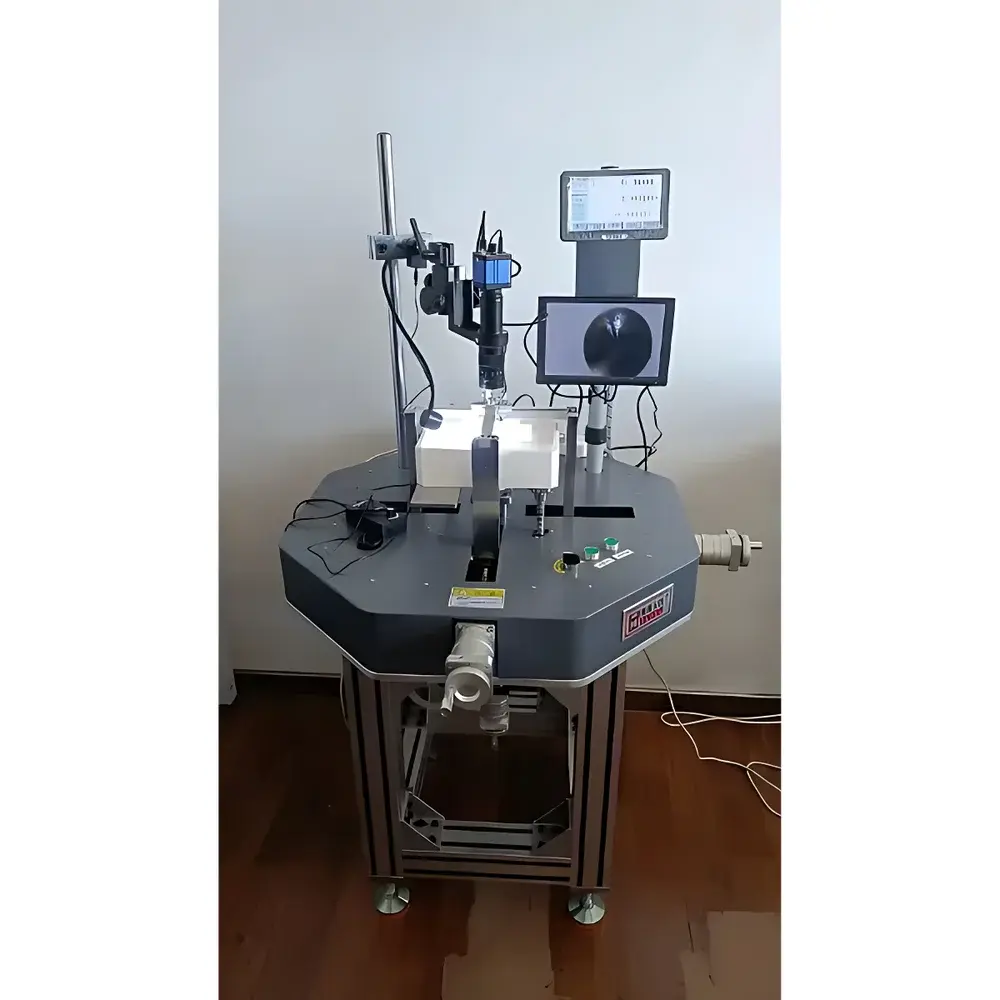
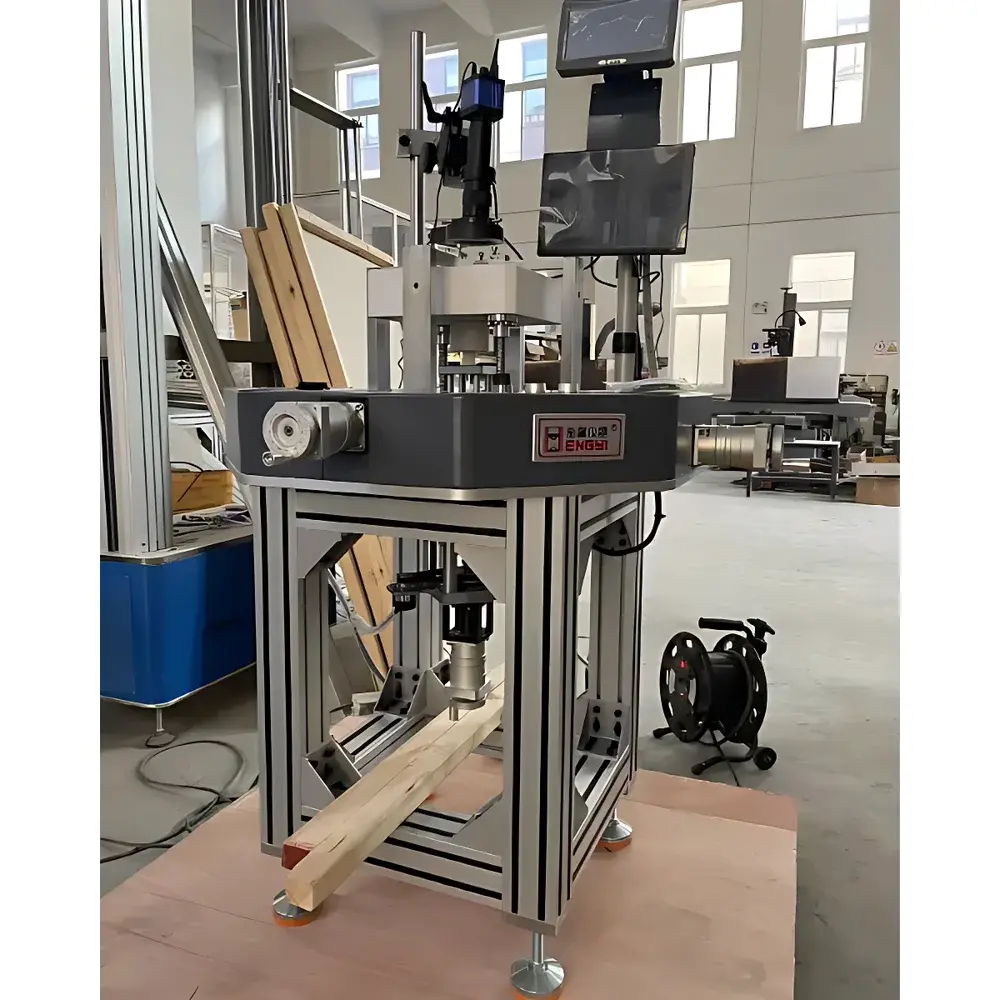
Hengyi HY(SZ)-0110 In-Situ Biaxial Stretching Tester for Polymer Films
| Brand | Hengyi / Hengyitest |
|---|---|
| Origin | Shanghai, China |
| Manufacturer Type | Direct Manufacturer |
| Region | Domestic (China) |
| Model | HY(SZ)-0110 |
| Price Range | USD 7,000 – 14,000 |
| Rated Load Capacity | 100 N |
| Displacement Accuracy | Class 1 |
| Displacement Resolution | 0.01 mm |
| X-Axis Travel Range | 0–100 mm |
| Y-Axis Travel Range | 0–100 mm |
| Z-Axis Travel Range | 0–100 mm |
| Effective Grip Width | 20 mm |
| Maximum Specimen Thickness | 1 mm |
| Loading Mode | Manual Continuous-Speed Control |
| Host Dimensions (L×W×H) | 800 × 800 × 800 mm |
| Net Weight | ~50 kg |
Overview
The Hengyi HY(SZ)-0110 In-Situ Biaxial Stretching Tester is an engineered platform designed for controlled, real-time mechanical deformation of polymer films and thin-sheet materials under precisely defined thermal and mechanical boundary conditions. It operates on the principle of simultaneous or sequential biaxial tensile loading—applying programmable strain in both orthogonal in-plane directions (X and Y), with optional vertical (Z-axis) force application to simulate multiaxial stress states. The system integrates temperature-controlled annealing stages to enable thermal softening prior to stretching, supporting protocols aligned with industry-standard film orientation processes such as Tenter Frame or Bubble methods. Its core function is to replicate industrial-scale biaxial drawing conditions within a laboratory environment, facilitating structure–property correlation studies between molecular alignment, crystallinity evolution, and macroscopic mechanical response.
Key Features
- True in-situ biaxial capability: Independent, synchronized, or asynchronous displacement control along X and Y axes via precision manual micrometer drives, each equipped with optical encoder feedback (0.01 mm resolution).
- Z-axis vertical loading module: Enables combined in-plane tension and out-of-plane compression or peel-mode testing, supporting multiaxial deformation analysis.
- Integrated corrosion-resistant liquid bath: Allows immersion-based environmental conditioning—e.g., humidity-controlled swelling, solvent-induced plasticization, or hydrolytic aging during stretching.
- Real-time optical monitoring: 200× CCD digital microscope mounted on adjustable gantry provides high-contrast, non-contact visualization of specimen surface morphology, necking onset, microcrack propagation, and localized strain heterogeneity throughout deformation.
- Rigid aluminum alloy frame architecture: Minimizes parasitic deflection and ensures mechanical stability across full travel range (100 mm per axis), contributing to Class 1 displacement accuracy per GB/T 16491 and ISO 7500-1.
- Modular grip system: Standard 20 mm effective width clamping with adjustable pressure plates accommodates specimens up to 1 mm thick, including PET, PP, PI, PC, and metallized polymer substrates.
Sample Compatibility & Compliance
The HY(SZ)-0110 supports standardized test specimens per ASTM D882 (tensile properties of thin plastic sheeting), ISO 527-3 (plastics—determination of tensile properties—films and sheets), and GB/T 1040.3 (Chinese national standard for plastic tensile testing). Its design permits compatibility with thermally sensitive polymers requiring pre-annealing at temperatures up to 120 °C (external heating stage required). All mechanical components are constructed from anodized aluminum and stainless steel fasteners to ensure long-term dimensional stability and resistance to chemical exposure during aqueous or organic solvent testing. The system meets general laboratory safety requirements per IEC 61010-1 and is suitable for use in GLP-compliant environments when paired with documented calibration records and operator training logs.
Software & Data Management
While the base configuration utilizes manual displacement control, the system is designed for future integration with third-party data acquisition hardware (e.g., NI DAQ systems or LabVIEW-compatible load cells) via standardized analog output interfaces. Displacement values from optical encoders can be logged externally using TTL-synchronized pulse counting. For regulatory traceability, users may implement electronic lab notebook (ELN) integration to record test parameters—including grip spacing, stretch ratio, dwell time, bath temperature, and microscope capture timestamps—supporting audit readiness under FDA 21 CFR Part 11 when paired with appropriate access controls and electronic signature workflows.
Applications
- Development of high-barrier packaging films (e.g., SiOx-coated PET, AlOx laminates) where biaxial orientation directly influences oxygen transmission rate (OTR) and moisture vapor transmission rate (MVTR).
- Structure–property mapping of semicrystalline polymers (e.g., polypropylene, polyethylene naphthalate) to correlate draw ratio with lamellar reorganization, as observed via in-situ WAXS/SAXS coupling.
- Mechanical reliability assessment of flexible electronics substrates under multiaxial fatigue, including crack initiation thresholds in transparent conductive oxide layers.
- Validation of constitutive models (e.g., Ogden, Arruda–Boyce) for hyperelastic thin-film behavior under large-strain conditions.
- Accelerated aging studies combining mechanical strain with aggressive chemical environments (e.g., acidic/alkaline immersion during stretching).
FAQ
Does the HY(SZ)-0110 support automated motorized actuation?
No—the current model uses manually operated micrometer-driven stages for displacement control. Motorized upgrade kits with stepper motor integration and closed-loop position feedback are available upon request.
Can the CCD microscope be used for quantitative strain field analysis?
Yes—when paired with commercial DIC (Digital Image Correlation) software such as VIC-2D or open-source alternatives like Ncorr, the 200× imaging system provides sufficient resolution for full-field strain mapping at subpixel accuracy.
Is the liquid bath compatible with organic solvents?
The standard bath is constructed from PTFE-lined acrylic and rated for aqueous solutions and mild organics (e.g., ethanol, isopropanol); extended chemical resistance requires optional fluoropolymer-coated variants.
What calibration documentation is provided?
Each unit ships with a factory calibration certificate for displacement encoders traceable to national metrology institutes; load cell calibration (if added) follows ISO/IEC 17025-accredited procedures.
How is thermal conditioning integrated?
The system does not include built-in heating; however, it features mounting interfaces and thermal isolation zones to accommodate external hot plates, IR lamps, or environmental chambers operating within −20 °C to +150 °C ranges.



