
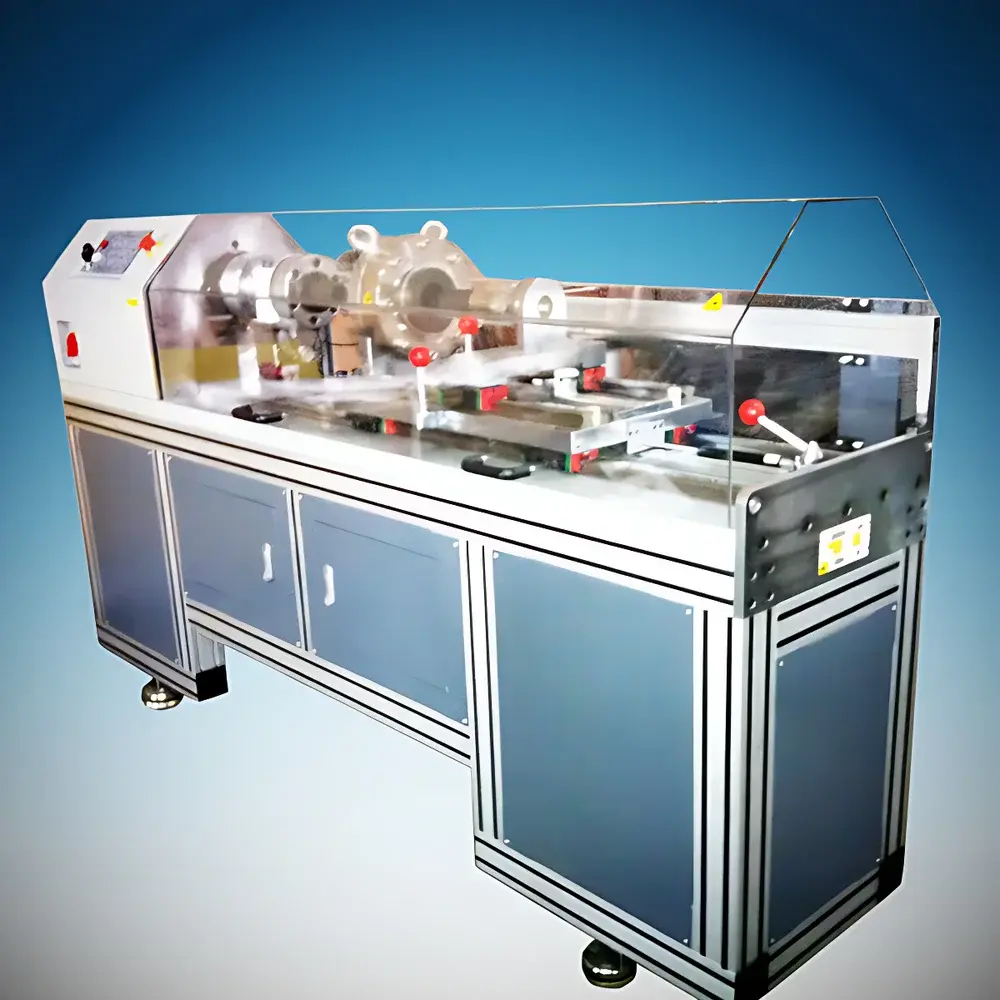
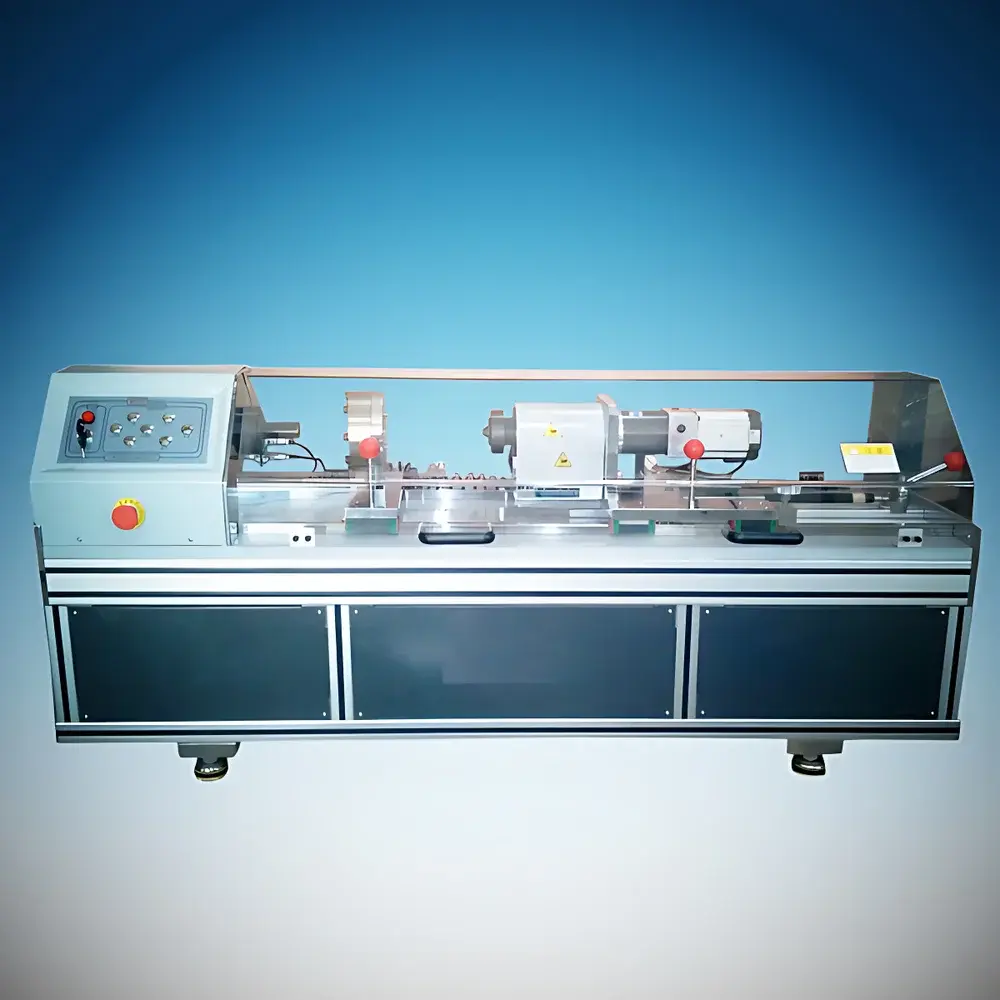
Hengyi HY-2000N.MTYYU Torsion Testing Machine for Fastener Friction Coefficient Analysis
| Brand | Hengyi / Hengyitest |
|---|---|
| Origin | Shanghai, China |
| Manufacturer Type | Direct Manufacturer |
| Product Origin | Domestic (China) |
| Model | HY-2000N.MTYYU |
| Max Torque | 2000 N·m |
| Torque Measurement Range | 2–2000 N·m |
| Torque Resolution | 1/50000 |
| Torsion Angle Range | 0–100000° |
| Motor Power | 5 kW |
| Axial Force Range | 5–500 kN |
| Torque Measurement Accuracy | ±0.5% FS |
| Torsion Angle Accuracy | ±0.5% FS |
| Rotational Speed Range | 0–40 rpm (up to 200 rpm) |
| Clamping Diameter Range | M10–M30 |
| Test Space (Grip Separation) | 1000 mm |
| Dimensions (L×W×H) | 2200 × 540 × 1250 mm |
| Weight | 2000 kg |
Overview
The Hengyi HY-2000N.MTYYU Torsion Testing Machine is a precision-engineered electromechanical system designed specifically for standardized friction coefficient characterization of threaded fasteners in accordance with ISO 2320:2015, GB/T 3098.9–2010 (equivalent to ISO 2320), and ASTM F1019. It operates on the principle of controlled torsional loading combined with simultaneous high-fidelity axial force measurement, enabling decoupled quantification of thread friction, bearing surface friction, and total system friction during both tightening and loosening phases. The instrument implements a dual-sensor architecture — one torque transducer integrated into the drive train and a separate axial load cell mounted in-line with the specimen axis — allowing real-time calculation of key mechanical parameters including K-factor (torque coefficient), μthread, μbearing, and μtotal. Its robust frame, high-stiffness drivetrain, and closed-loop servo control ensure repeatable angular positioning and torque delivery across multi-cycle protocols, making it suitable for R&D validation, production line QC, and regulatory compliance testing under GLP/GMP environments.
Key Features
- Full-range torsion testing capability from 2 N·m to 2000 N·m with ≤0.5% full-scale accuracy and 1/50,000 torque resolution
- Integrated axial force measurement up to 500 kN with synchronized sampling at ≥1 kHz for dynamic friction analysis
- Programmable five-cycle tightening/loosening sequence per ISO 2320, capturing peak insertion torque, minimum removal torque, and fifth-cycle stabilization data
- Bi-directional rotational control (clockwise/counterclockwise) with speed regulation from 0.1 to 200 rpm and ≤0.5% speed stability
- Adjustable grip separation (up to 1000 mm) and modular jaw sets accommodating threaded fasteners from M10 to M30 (customizable for non-standard geometries)
- High-rigidity cast-iron base and reinforced crosshead structure minimizing parasitic deflection during high-torque events
- Industrial-grade servo motor (5 kW continuous rating) with regenerative braking for energy-efficient high-dynamic operation
Sample Compatibility & Compliance
The HY-2000N.MTYYU supports standardized test specimens defined in ISO 2320, GB/T 3098.9, and DIN 267-29, including hex nuts, flange nuts, locknuts, and bolt-nut assemblies with nominal diameters ranging from M10 to M30. Optional jaw inserts enable secure clamping of non-cylindrical or coated fasteners without slippage. All measurement outputs comply with metrological traceability requirements per ISO/IEC 17025. Data acquisition meets audit-trail requirements for FDA 21 CFR Part 11 when paired with validated software modules. The system supports calibration verification using NIST-traceable torque standards and certified reference fasteners.
Software & Data Management
Control and analysis are performed via Hengyi’s proprietary TorsionTest Pro v4.x software, running on Windows 10/11 platforms. The application provides real-time dual-channel visualization (torque vs. angle; axial force vs. angle), automated parameter extraction (yield torque, ultimate torque, K-value, friction coefficients), and customizable report generation compliant with ISO 17025 documentation templates. Raw data export is supported in CSV, Excel (.xlsx), and XML formats. Software includes user role management, electronic signature capability, and optional 21 CFR Part 11 compliance packages with audit trail logging, data integrity checks, and password-protected method locking.
Applications
- Quantitative evaluation of lubricant performance on threaded interfaces under simulated assembly conditions
- Validation of coating adhesion and consistency for dry-film lubricants (e.g., molybdenum disulfide, PTFE-based coatings)
- Comparative analysis of friction variability across lot batches in automotive, aerospace, and wind turbine manufacturing
- Development and qualification of self-locking fasteners (e.g., nylon-insert, distorted-thread, and prevailing-torque nuts)
- Root-cause analysis of joint relaxation, scatter in clamp load, or premature thread stripping in structural bolting applications
- Supporting failure investigations where preload loss or galling is suspected due to uncontrolled interface friction
FAQ
What international standards does this instrument support out-of-the-box?
ISO 2320:2015, GB/T 3098.9–2010, ASTM F1019, and DIN 267-29 test procedures are pre-configured in the software with automatic pass/fail evaluation against specified limits.
Can the system measure both static and dynamic friction coefficients?
Yes — by analyzing the torque-angle hysteresis loop during controlled low-speed (<1 rpm) tightening and loosening cycles, the system distinguishes between static breakaway friction and kinetic sliding friction at the thread and bearing surfaces.
Is third-party calibration certification available?
Hengyi provides factory calibration certificates traceable to CNAS-accredited laboratories; optional on-site calibration by ISO/IEC 17025-certified service providers is supported upon request.
How is axial force applied and measured independently of torque?
A precision load cell is mounted in series between the stationary grip and the reaction base, isolating axial force measurement from drivetrain torsional loads — eliminating crosstalk errors common in single-transducer systems.
Does the machine support automated reporting for quality audits?
Yes — reports include operator ID, timestamp, environmental conditions (optional sensor integration), raw data plots, calculated parameters, and digital signatures; all fields are configurable to match internal QA templates or customer-specific requirements.



