
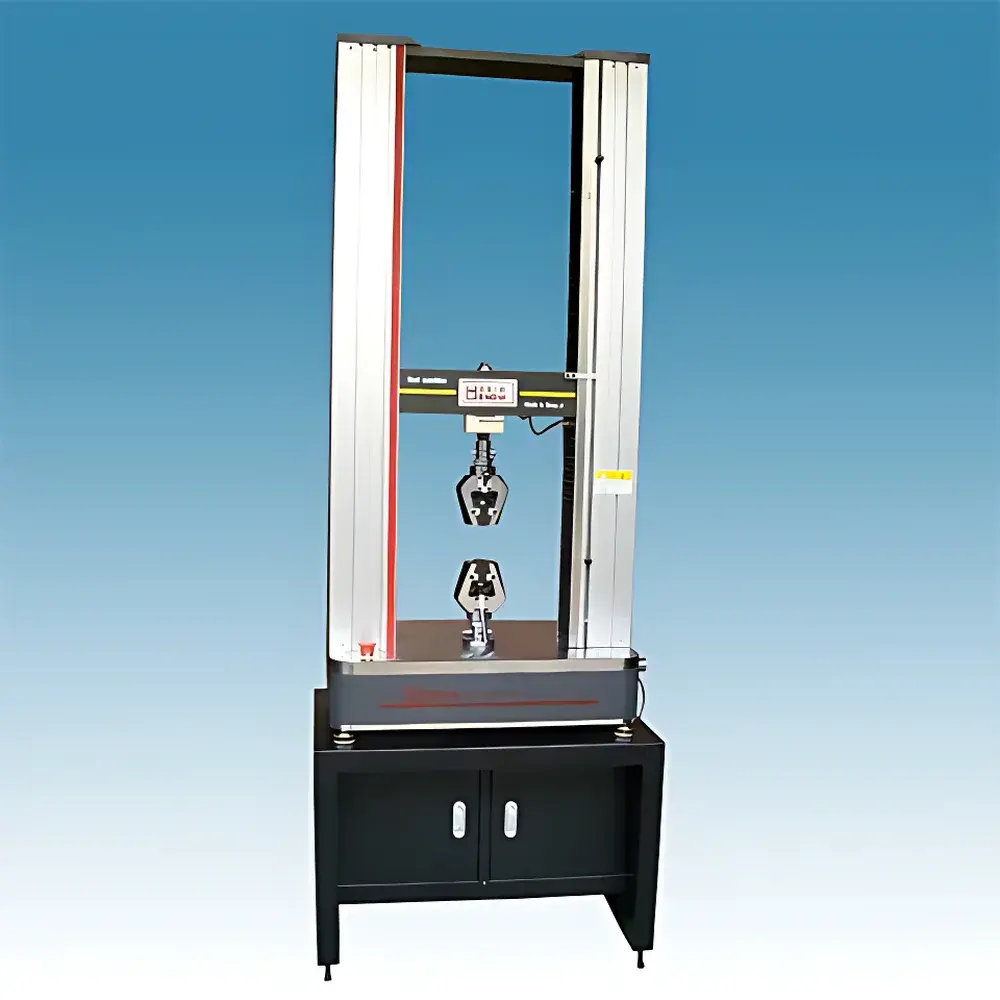
Hengyi HY-1080WE Universal Testing Machine
| Brand | Hengyi |
|---|---|
| Origin | Shanghai, China |
| Manufacturer Type | Direct Manufacturer |
| Regional Classification | Domestic (China) |
| Model | HY-1080WE |
| Instrument Type | Electromechanical Tensile Testing Machine |
| Price Range | USD 2,800 – 7,200 (FOB Shanghai) |
| Structural Configuration | Dual-column Portal Frame |
Overview
The Hengyi HY-1080WE Universal Testing Machine is a precision-engineered electromechanical system designed for static mechanical characterization of materials under uniaxial tensile, compressive, flexural, shear, peel, tear, and cyclic loading conditions. Based on the fundamental principles of force-displacement transduction and closed-loop servo control, it complies with standardized test methodologies defined in ASTM E4, ASTM E8/E8M, ASTM D638, ASTM D790, ISO 6892-1, ISO 178, ISO 527, and GB/T 228.1–2021. The machine employs a rigid dual-column portal architecture with preloaded high-precision ball screws and a bidirectional load cell to ensure minimal frame compliance and high reproducibility across repeated measurements. Its modular design supports both single- and dual-test-space configurations, enabling simultaneous or sequential testing of specimens with divergent geometry and mechanical behavior — critical for laboratories performing comparative material qualification under GLP or internal QA protocols.
Key Features
- Rigid dual-column portal frame with high structural stiffness (deflection < 0.05 mm/kN), optionally configurable as dual-space for independent upper/lower test zones.
- High-efficiency Panasonic AC servo motor and digital driver system — maintenance-free operation with torque ripple < ±0.3% and dynamic response time < 20 ms.
- Two pre-tensioned, ground-rolled ball screws (C5 grade, 16 mm diameter) ensuring axial alignment accuracy ≤ ±0.02 mm over full stroke.
- Imported bidirectional load cell (U.S.-sourced, ±0.5% FS accuracy, overload protection up to 150% FS) with automatic sensor recognition and auto-zero calibration.
- Digital controller supporting open-loop speed control and closed-loop force/displacement/strain regulation; firmware includes multi-language UI (English, German, French, Spanish, Chinese) and unit switching (N, kN, lbf, kgf, MPa, psi).
- Ergonomic handheld remote control with jog, start/stop, and emergency stop functions — compatible with glove use and integrated safety interlock circuitry.
Sample Compatibility & Compliance
The HY-1080WE accommodates a broad spectrum of specimen geometries and material classes without hardware modification: thin films (≥10 µm), polymer fibers (diameter < 0.5 mm), metallic foils (Al/Cu, thickness ≤ 0.2 mm), photovoltaic interconnect ribbons, biomedical sutures, hydrogels, elastomeric tubing, orthopedic fixation devices, corrugated paperboard, honeycomb composites, and ceramic-coated substrates. All standard test fixtures — including wedge-action tensile grips, compression platens, three/four-point bending assemblies, peel anvils, and puncture probes — conform to ISO 204, ISO 1133, and ASTM F1825 specifications. The system meets electromagnetic compatibility (EMC) requirements per IEC 61326-1 and electrical safety standards per IEC 61010-1. Optional traceable calibration certificates are issued per ISO/IEC 17025 by CNAS-accredited metrology labs in Shanghai.
Software & Data Management
The embedded test software provides real-time plotting of stress–strain, load–displacement, and time-based curves with ≥1 kHz data acquisition resolution. Raw data export is supported in CSV, XLSX, and universal ASCII formats; metadata tagging includes operator ID, environmental temperature/humidity (via optional external probe), test standard reference, and instrument serial number. Audit trails comply with FDA 21 CFR Part 11 requirements when paired with user authentication and electronic signature modules. Software features include automated yield point detection (0.2% offset method), modulus calculation via linear regression (user-definable slope range), and batch reporting with statistical summary (mean, SD, CV%, min/max). Data integrity is preserved through write-once storage mode and encrypted local database backup.
Applications
This system serves as a primary mechanical testing platform in R&D labs, quality control departments, and third-party certification bodies. Typical applications include: tensile property validation of medical-grade silicone tubing per ISO 5840-3; peel strength assessment of pressure-sensitive adhesives per PSTC-101; compressive yield evaluation of polyurethane foam per ASTM D3574; flexural modulus determination of CFRP laminates per ISO 14125; elongation-at-break measurement of biodegradable PLA filaments per ISO 527-2; and proof-load verification of surgical staple cartridges per ISO 7206-4. It is routinely deployed in photovoltaic module qualification (IEC 61215 mechanical load testing), packaging integrity assurance (ASTM D882), and wire bond pull testing for semiconductor packaging.
FAQ
What standards does the HY-1080WE support out-of-the-box?
Pre-configured test methods include ASTM D638, ASTM D790, ISO 6892-1, ISO 178, GB/T 228.1, and ISO 527-2. Custom method templates can be imported via XML schema.
Can the system perform strain-controlled ramp-hold tests?
Yes — the closed-loop controller supports strain rate programming from 0.002% to 6% FS/s with tracking error < ±0.5% FS during hold phases.
Is the load cell calibrated to NIST-traceable standards?
Standard configuration includes factory calibration against deadweight standards traceable to NIM (National Institute of Metrology, China); optional NIST-traceable certificate available upon request.
What safety certifications apply to the electrical subsystem?
Complies with IEC 61010-1:2010 (Safety Requirements for Electrical Equipment for Measurement, Control, and Laboratory Use) and CE marking per Machinery Directive 2006/42/EC.
How is thermal drift compensated during long-duration creep tests?
The load cell incorporates temperature-compensated semiconductor bridge circuitry; ambient temperature monitoring (optional) enables real-time correction using built-in polynomial compensation algorithms.



