
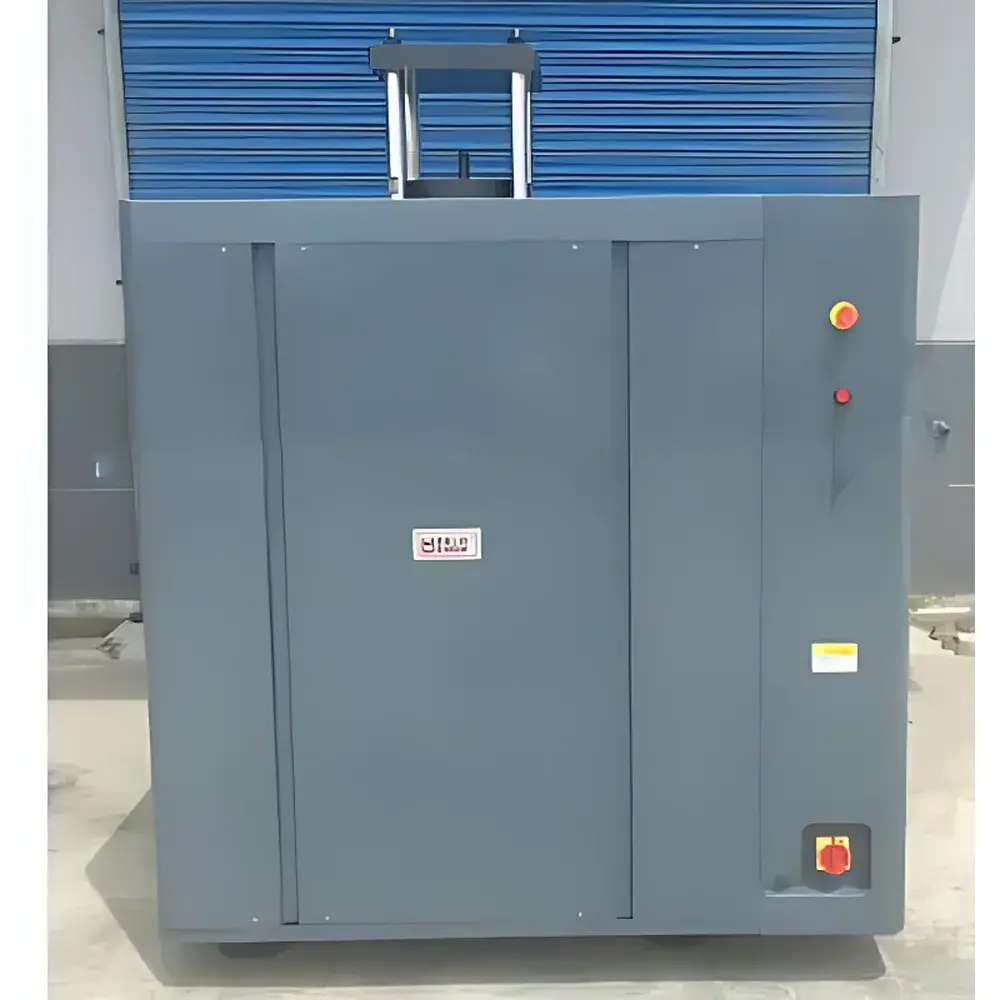
Hengyi HY-50030 Microcomputer-Controlled Electronic Universal Testing Machine
| Brand | Hengyi |
|---|---|
| Origin | Shanghai, China |
| Manufacturer Type | Manufacturer |
| Product Origin | Domestic (China) |
| Model | HY-50030 |
| Load Capacity | 500 kN |
| Accuracy Class | 0.5 |
| Effective Test Width | 500 mm |
| Effective Test Space | 200–300 mm |
| Test Speed Range | 0.1–300 mm/min |
| Speed Accuracy | ±0.5% of indicated value |
| Force Resolution | ±500,000 counts (full-scale, no range switching) |
| Force Measurement Range | 0.1%–99.9999% FS |
| Displacement & Strain Measurement Accuracy | ±0.5% of indicated value |
| Stress Control Rate Range | 0.005–6% FS/s |
| Strain Control Rate Range | 0.002–6% FS/s |
| Constant-Load/Displacement/Strain Control Accuracy | ±1% (if setpoint <10% FS), ±0.1% (if ≥10% FS) |
| Overload Protection | Automatic shutdown at >110% FS |
| Power Supply | 220 V AC |
| Power Consumption | 5000 W |
| Host Weight | 2000 kg |
| Dimensions (W×D×H) | 1500 × 500 × 1800 mm |
| Compliance | GB/T, ASTM E4, ASTM E9, ISO 7500-1, ISO 5893, DIN 51221, JIS Z2241, Q/HY305-2018 |
Overview
The Hengyi HY-50030 is a high-capacity, microcomputer-controlled electronic universal testing machine engineered for precision compression, tensile, and flexural mechanical property evaluation of metallic, polymeric, composite, ceramic, and geotechnical materials. Based on closed-loop servo-electromechanical actuation, it employs a high-stiffness dual-column frame architecture with preloaded ball screws and precision linear guides to ensure minimal deflection and high axial alignment fidelity under full 500 kN load. The system implements real-time digital PID control for force, displacement, strain, and stress-rate regulation—enabling strict adherence to quasi-static loading protocols defined in ISO 7500-1 (Class 0.5 accuracy), ASTM E4 (verification of force-measuring systems), and ASTM E9 (compression testing of metallic materials). Its modular software architecture supports multi-step test sequencing, including ramp-hold, cyclic loading, and creep protocols, making it suitable for both R&D validation and routine QC/QA in accredited laboratories operating under GLP or ISO/IEC 17025 frameworks.
Key Features
- 500 kN maximum load capacity with 0.5-class force measurement accuracy per ISO 7500-1 and ASTM E4
- Full-scale force resolution of ±500,000 digital counts—no internal range switching, constant resolution across 0.1%–99.9999% of full scale
- Adjustable crosshead speed from 0.1 to 300 mm/min, calibrated to ±0.5% of setpoint
- Dual-mode crosshead positioning: high-speed jog for rapid sample setup and low-speed fine positioning for precise contact detection
- Integrated electronic limit switches and automatic overload protection (>110% FS) with hardware-level emergency cutoff
- Real-time diagnostics monitoring drive current, motor temperature, encoder feedback, and load cell excitation voltage; triggers immediate fault logging and safe stop
- Stress and strain rate control compliant with ASTM E2309 requirements for closed-loop material testing instrumentation
- Modular load frame with 500 mm effective test width and 200–300 mm vertical test space—accommodates standard ASTM and ISO compression specimens (e.g., concrete cylinders, polymer blocks, battery cells)
Sample Compatibility & Compliance
The HY-50030 accommodates cylindrical, prismatic, and irregularly shaped specimens up to 500 mm wide and 300 mm tall. Standard configurations support ASTM C39 (concrete cylinders), ASTM D695 (rigid plastics), ISO 604 (plastics compression), ISO 14126 (fiber-reinforced composites), and EN 12390-3 (hardened concrete). Optional fixtures—including platens with self-aligning spherical seats, compression dies, and bending jigs—ensure proper load distribution and minimize edge effects. All calibration and verification procedures conform to ISO/IEC 17025 traceability requirements, with factory-certified calibration reports traceable to NIM (National Institute of Metrology, China) standards. The system meets electromagnetic compatibility (EMC) requirements per IEC 61326-1 and safety standards per IEC 61010-1.
Software & Data Management
The embedded Windows-based control software provides intuitive test programming, real-time curve visualization (force–displacement, stress–strain, load–time), and automated result calculation per user-defined formulas. It supports ASTM E2309-compliant data acquisition at up to 1 kHz sampling rate, with timestamped raw data export in CSV and XML formats. Audit trail functionality logs all operator actions, parameter changes, and system events—fully compliant with FDA 21 CFR Part 11 requirements when configured with electronic signatures and role-based access control. Data integrity is reinforced via cyclic redundancy check (CRC) validation during file write operations and automatic backup to network drives or USB storage.
Applications
- Compression testing of structural concrete, mortar, and grout per ASTM C39, EN 12390-3, and GB/T 50081
- Mechanical characterization of aerospace-grade aluminum alloys, titanium, and high-strength steels per ASTM E9 and ISO 15630-1
- Crush resistance evaluation of lithium-ion battery modules and pouch cells under controlled displacement rates
- Creep and relaxation behavior analysis of thermoplastics and elastomers per ISO 899-1 and ASTM D2990
- Quality conformance testing of medical device packaging (e.g., blister trays, sterile barrier systems) per ASTM F88 and ISO 11607-2
- Validation of additive manufacturing (AM) build quality through compressive yield strength and modulus determination per ASTM F3049
FAQ
What international standards does the HY-50030 comply with for force calibration?
It complies with ISO 7500-1 (Class 0.5), ASTM E4, and JJG 139–2014 (Chinese national metrological verification regulation).
Can the system perform strain-controlled compression tests on brittle ceramics?
Yes—its strain-rate control mode (0.002–6% FS/s) and high-speed data acquisition enable stable testing of low-ductility materials without oscillation or overload.
Is the software validated for regulated environments such as pharmaceutical QC labs?
Yes—when deployed with optional 21 CFR Part 11 compliance package (including audit trail, electronic signatures, and secure user authentication), it meets GMP/GLP data integrity requirements.
What maintenance intervals are recommended for long-term accuracy retention?
Annual verification of force transducer linearity, crosshead alignment, and encoder resolution is recommended; biannual lubrication of ball screws and inspection of limit switch functionality are advised.
Does the system support third-party test method import (e.g., custom ASTM or internal SOPs)?
Yes—the software allows importing XML-based test templates with predefined control profiles, pass/fail criteria, and result reporting logic.



