
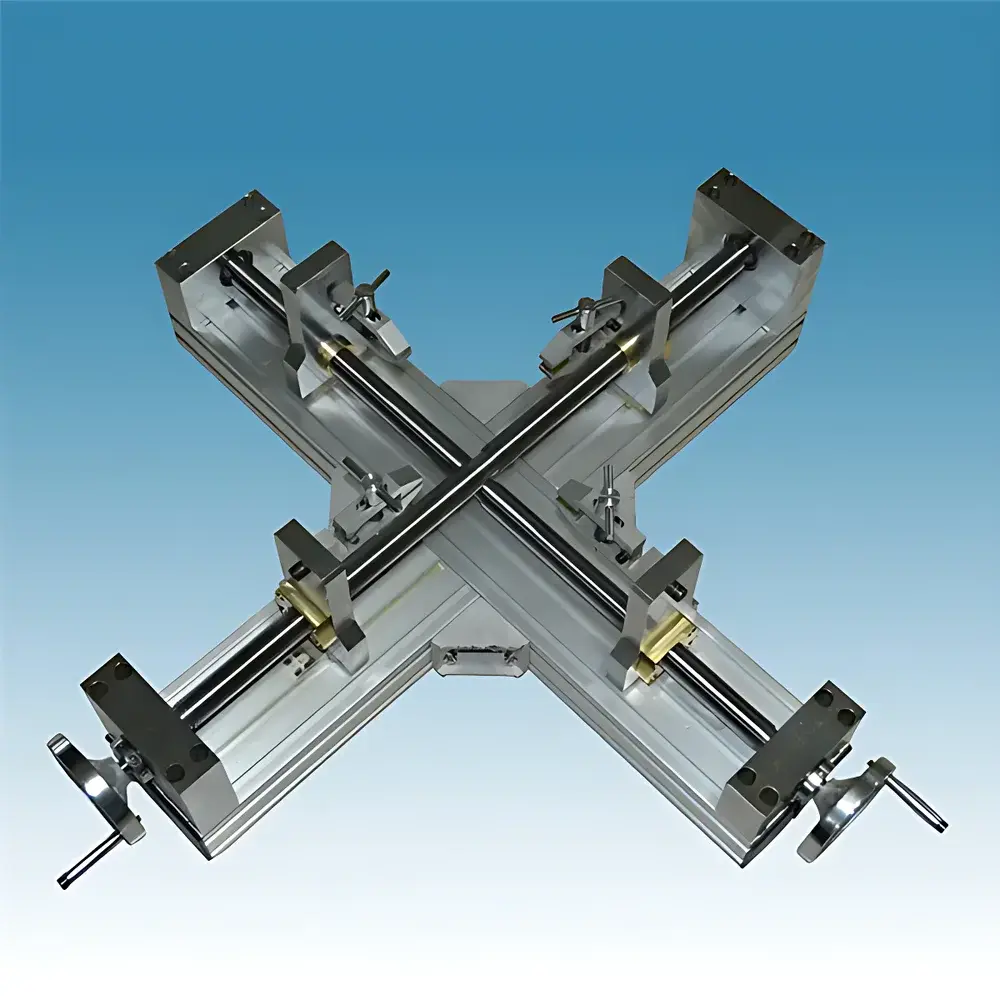
Hengyi HY-0130MJK Manual Biaxial Tensile Testing System
| Brand | Hengyi / Hengyitest |
|---|---|
| Origin | Shanghai, China |
| Manufacturer Type | Direct Manufacturer |
| Country of Origin | China |
| Model | HY-0130MJK |
| Pricing | Upon Request |
| Load Capacity | 1000 N |
| Accuracy Class | 0.5 |
| X/Y Axis Effective Travel | 300 mm × 300 mm |
| Test Speed Range | 0.001–300 mm/min |
| Speed Accuracy | ±0.5% of indicated value |
| Force Resolution | ±500000 counts (full-scale, no range switching) |
| Force Measurement Accuracy | ±0.5% of indicated value |
| Displacement & Strain Measurement Accuracy | ±0.5% of indicated value |
| Stress Control Rate Range | 0.005–6 %FS/S |
| Strain Control Rate Range | 0.002–6 %FS/S |
| Overload Protection | +10% of full scale |
| Power Supply | 220 V AC, 400 W |
| Net Weight | 80 kg |
| Dimensions (W×D×H) | 800 × 800 × 800 mm |
Overview
The Hengyi HY-0130MJK Manual Biaxial Tensile Testing System is a precision-engineered mechanical testing platform designed for static biaxial tensile characterization of thin-sheet materials—including polymers, metallic foils, elastomers, and advanced composites. Unlike conventional uniaxial testers, this system applies controlled, independent tensile loads simultaneously along two orthogonal axes (X and Y), enabling true planar stress-state evaluation. Its rigid, monolithic cast-iron “closed-loop” frame—fabricated without structural joints or welds—minimizes parasitic deformation and ensures high mechanical stability across repeated test cycles. The manual actuation architecture eliminates servo complexity while preserving metrological integrity, making it especially suitable for academic labs, quality control environments, and R&D facilities requiring deterministic, repeatable biaxial loading without real-time closed-loop automation.
Key Features
- Rigid monolithic cast-iron frame in a closed-loop geometry, delivering exceptional structural stiffness and minimal frame compliance (<0.02% deflection under full 1000 N load).
- Manual dual-axis actuation with independent micrometer-driven loading screws—each calibrated to ±0.5% force accuracy per ISO 7500-1 Class 0.5 requirements.
- Uniform 300 mm × 300 mm active biaxial test area, accommodating specimens up to 250 mm square with standardized dog-bone, cruciform, or circular geometries.
- High-resolution force measurement system with 500,000-count A/D resolution, maintaining consistent sensitivity across the entire 0.1%–99.9999% FS range without auto-ranging or hardware switching.
- Integrated electronic limit switches and overload cutoff (triggered at 110% FS) compliant with EN ISO 12100 mechanical safety principles.
- Manual rapid-return and fine-positioning capability for efficient specimen setup and post-test reset—no motorized return required.
- Passive displacement and strain monitoring via calibrated linear potentiometers, traceable to NIST-traceable standards with ±0.5% linearity error over full stroke.
Sample Compatibility & Compliance
The HY-0130MJK supports standardized specimen configurations per ASTM D882 (thin plastic films), ISO 10390 (biaxially oriented polypropylene), and GB/T 1040.3 (plastics tensile testing—film and sheet). It accommodates cruciform specimens per ISO 16842 for balanced biaxial loading, as well as asymmetric geometries for non-proportional loading protocols. All mechanical components meet CE machinery directive 2006/42/EC essential health and safety requirements. While not equipped with automated data logging, the system’s analog output interface (±10 V) enables integration with third-party DAQ systems compliant with FDA 21 CFR Part 11 when paired with validated software and audit-trail-enabled acquisition hardware.
Software & Data Management
This is a manually operated, non-computer-controlled system. Force and displacement signals are provided via analog outputs (0–10 V DC proportional to load and position), allowing connection to external data acquisition systems such as National Instruments DAQmx platforms, Keysight U2300A series, or LabVIEW-based custom solutions. Users retain full control over sampling rate, filtering, calibration mapping, and report generation—enabling full GLP/GMP-aligned documentation when implemented within a validated laboratory information management system (LIMS). No embedded firmware or proprietary software is included; calibration certificates and mechanical verification reports are supplied with each unit per ISO/IEC 17025 guidelines.
Applications
- Biaxial tensile property mapping of polymer films (e.g., PET, PP, PE) for packaging and barrier layer development.
- Mechanical anisotropy assessment of rolled metal foils used in battery current collectors and flexible electronics substrates.
- Cruciform testing of soft biomaterials (hydrogels, electrospun scaffolds) under equibiaxial or ratio-controlled loading conditions.
- Validation of constitutive models (e.g., Ogden, Yeoh, Arruda-Boyce) requiring multi-axial stress-strain data inputs.
- Educational demonstration of plane stress theory, yield surface evolution, and necking instability in thin ductile sheets.
- Pre-compliance screening prior to automated biaxial testing per ASTM D5617 or ISO 16842 for regulatory submissions.
FAQ
Is this system compatible with ASTM D5617 or ISO 16842?
Yes—the mechanical architecture, specimen geometry support, and load/displacement metrology fully satisfy the apparatus requirements of both standards for quasi-static biaxial testing.
Does the system include calibration documentation?
Each unit ships with a factory-issued calibration certificate traceable to CNAS-accredited standards, covering force transducers and displacement sensors per ISO 376 and ISO 9513.
Can I integrate it with my existing LabVIEW or MATLAB environment?
Yes—via its analog voltage outputs (±10 V), the system interfaces directly with standard DAQ hardware supporting differential input channels and programmable gain.
What is the maximum specimen thickness supported?
The standard grip configuration accommodates specimens up to 2.5 mm thick; custom jaw inserts are available upon request for thicker or irregular cross-sections.
Is remote operation possible?
No—this is a manually actuated system. All loading and positioning are performed physically using calibrated handwheels; no motor, encoder, or network interface is included.



