
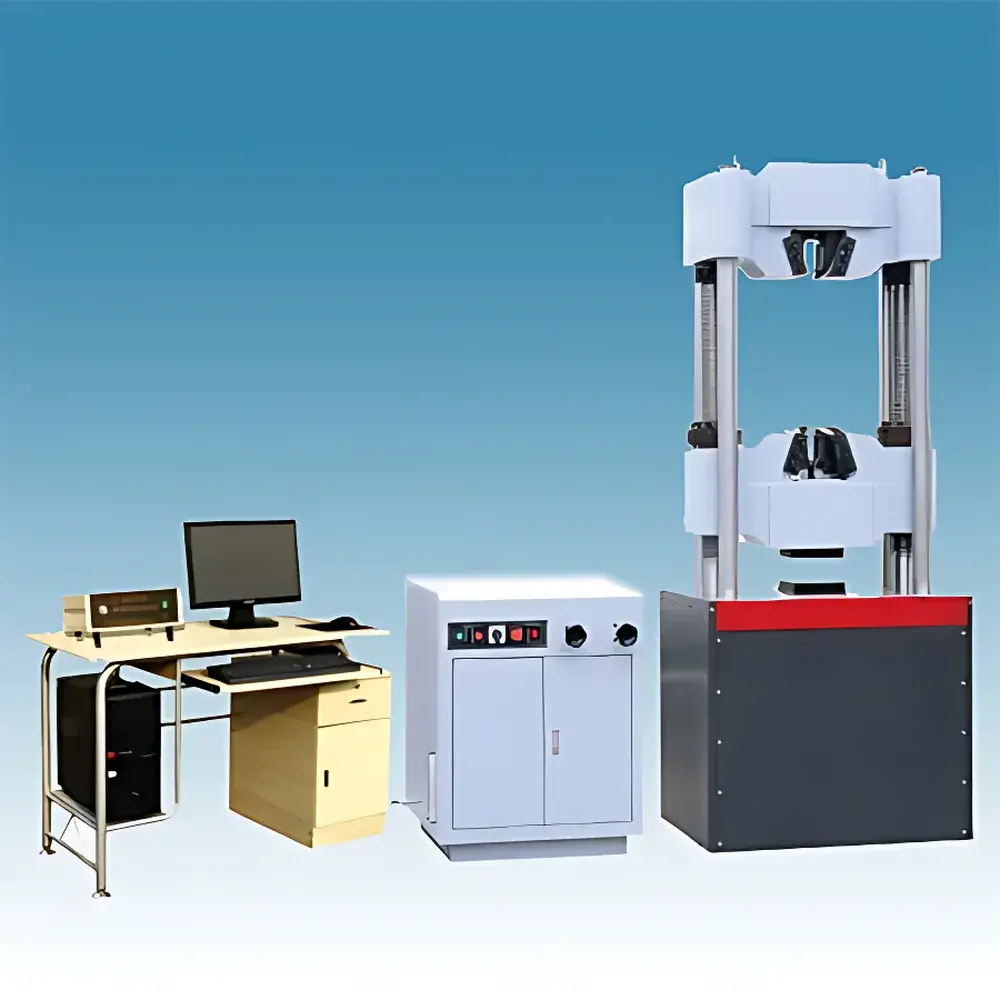
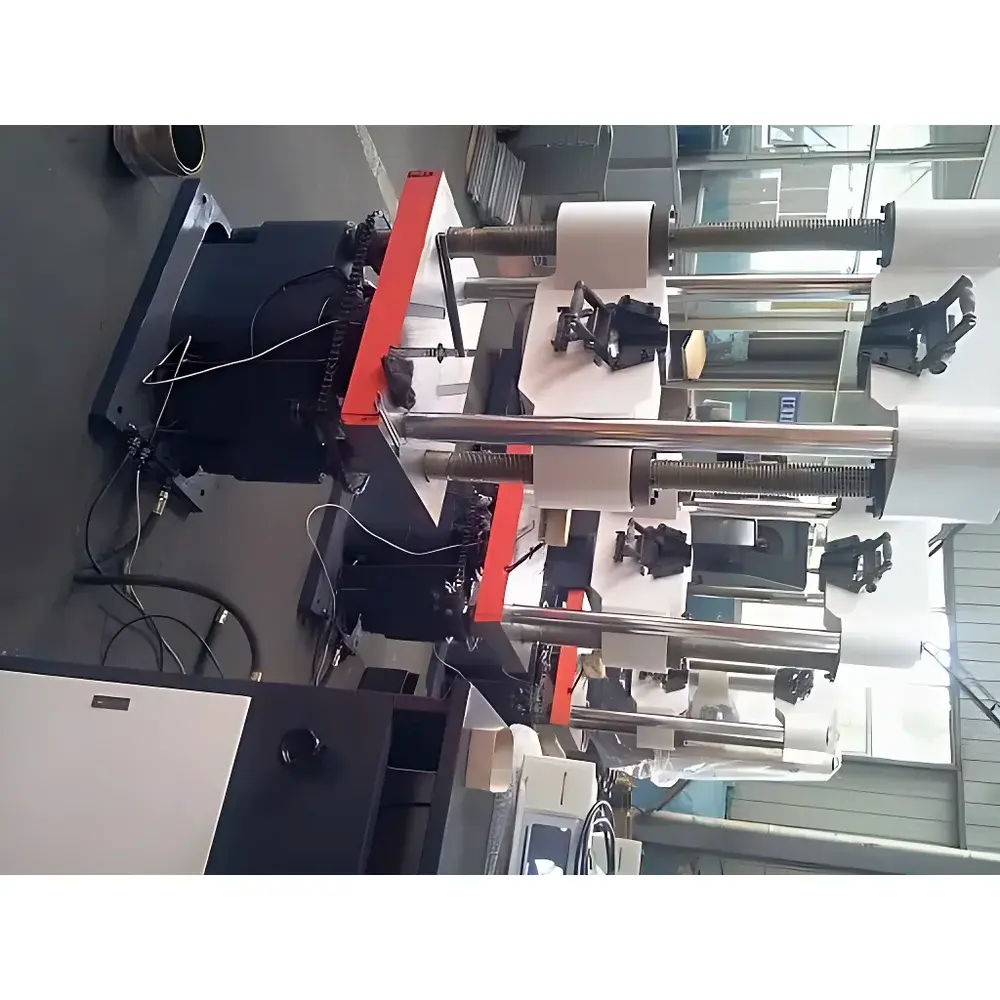
Hengyi HY(WE)200060 2000 kN Electro-Hydraulic Servo Universal Testing Machine
| Brand | Hengyi |
|---|---|
| Origin | Shanghai, China |
| Manufacturer Type | Direct Manufacturer |
| Country of Origin | China |
| Model | HY(WE)200060 |
| Instrument Type | Electro-Hydraulic Servo Universal Testing Machine |
| Load Capacity | 0–2000 kN |
| Force Accuracy | ±1% of reading |
| Deformation Accuracy | ±0.5% of reading |
| Displacement Accuracy | ±0.5% of reading |
| Compression Space | 700 mm |
| Tensile Space | 700 mm |
| Round Specimen Grip Range | Φ20–Φ70 mm |
| Flat Specimen Thickness Capacity | 0–40 mm |
| Piston Stroke | 150 mm |
| Maximum Bend Span | 100–800 mm |
| Shear Specimen Diameter | Φ30 mm |
| Stress Rate Control Range | 1–60 N/mm²/s |
| Strain Rate Control Range | 0.00025–0.0025 /s |
| Closed-Loop Control Accuracy (Force/Displacement/Deformation) | ±1% of setpoint |
| Overall Dimensions (W×D×H) | 1100 × 760 × 2700 mm |
| Motor Power | 1.5 kW, 3-phase |
| Weight | 3500 kg |
Overview
The Hengyi HY(WE)200060 is a high-capacity electro-hydraulic servo universal testing machine engineered for precision mechanical property evaluation of metallic and non-metallic structural materials under static loading conditions. It operates on the principle of controlled hydraulic actuation combined with real-time digital closed-loop feedback—using high-fidelity load cells, displacement transducers, and strain measurement channels to maintain strict adherence to user-defined stress, strain, or displacement rate profiles. Designed for compliance with international mechanical testing standards—including ASTM E4, ASTM E8/E8M, ISO 6892-1, and GB/T 228.1—the system delivers reproducible, traceable, and auditable test data across tensile, compression, bending, and shear configurations. Its oil-cylinder-underneath architecture enables flexible vertical workspace adjustment, supporting both standard and custom specimen geometries up to 2000 kN (204 metric tons force), making it suitable for quality control laboratories, R&D centers, and third-party certification facilities engaged in structural material validation.
Key Features
- Electro-hydraulic servo actuation with proportional control valve for smooth, low-noise, and highly responsive load application
- Digital closed-loop control system supporting simultaneous regulation of force, displacement, and deformation at user-specified rates
- High-accuracy dual-channel measurement: ±1% force accuracy per ISO 7500-1 Class 1, ±0.5% for both deformation and displacement
- Adjustable test space: 700 mm tensile clearance and 700 mm compression height, optimized for long specimens and multi-condition setups
- Modular grip system accommodating round specimens (Φ20–Φ70 mm) and flat specimens (up to 40 mm thick)
- Integrated bending fixture with variable support span (100–800 mm) and standardized shear die (Φ30 mm)
- Rugged cast-iron base and reinforced column structure ensuring minimal frame deflection and long-term metrological stability
- 1.5 kW three-phase motor driving a precision ball-screw lifting mechanism for crosshead positioning
Sample Compatibility & Compliance
The HY(WE)200060 supports standardized mechanical testing of ferrous and non-ferrous metals, concrete, cementitious composites, and polymer-reinforced structural elements. Its modular fixture suite—including tensile wedge grips, compression platens, three-point bending fixtures, and shear dies—enables full conformance with GB/T 228.1–2021 (tensile), GB/T 232–2010 (bend), GB/T 7314–2017 (compression), and GB/T 2611–2013 (general requirements for testing machines). The system meets ISO 16840 (metallic materials—tensile testing) and ASTM E1012 (verification of testing machine alignment), with optional calibration certificates traceable to NIM (National Institute of Metrology, China) or equivalent national metrology institutes. All hardware and software components are designed to support GLP-compliant workflows, including audit trail logging, user access control, and electronic signature readiness.
Software & Data Management
The included Hengyi proprietary testing software—localized in English and Chinese—is built on a Windows-based platform and fully compliant with ISO/IEC 17025 documentation requirements. It provides real-time graphical display of stress–strain, load–displacement, and time-history curves; automatic yield point detection (0.2% offset method); modulus calculation (tangent, secant, chord); and fracture energy quantification. Test methods can be preconfigured and saved as templates, with parameter locking to prevent unauthorized modification during routine QC runs. Data export is supported in CSV, XLSX, PDF, and XML formats, and raw files include embedded metadata (operator ID, timestamp, environmental conditions, calibration status). Optional integration with LIMS via TCP/IP or OPC UA ensures seamless data flow into enterprise quality management systems. Software updates are provided free of charge for the duration of hardware warranty.
Applications
This system is routinely deployed in steel mill QA labs for incoming billet and rebar verification; in aerospace component suppliers for cast aluminum and titanium alloy tensile qualification; in civil engineering labs for high-strength concrete cylinder compression and flexural strength assessment; and in university materials science departments for creep and relaxation studies under sustained loading. Its 2000 kN capacity allows full-scale testing of welded joints, anchor bolts, structural connectors, and pre-stressed concrete tendons. With configurable ramp-hold cycles and multi-step loading protocols, it also supports ISO 6892-2 intermediate temperature testing (when paired with external furnace accessories) and ASTM D695-compliant rigid plastic compression analysis.
FAQ
What standards does this machine support out-of-the-box?
It natively supports GB/T 228.1, GB/T 232, GB/T 7314, ISO 6892-1, ASTM E8/E8M, and ASTM E9—all accessible via preloaded test method templates.
Is the system compatible with FDA 21 CFR Part 11 requirements?
Yes, with optional 21 CFR Part 11 module enabled, it provides electronic signatures, role-based permissions, and immutable audit trails for regulated pharmaceutical and medical device material testing.
Can the software generate certified test reports with digital signatures?
Yes—reports include customizable headers, calibrated instrument IDs, operator credentials, environmental data, and digital signature fields compliant with ISO/IEC 17025 Annex A.
What maintenance intervals are recommended for hydraulic components?
Oil filtration and system flush every 12 months; seal inspection and pressure transducer recalibration every 24 months; full hydraulic power unit service per OEM schedule based on operational hours.
Is remote diagnostics and firmware update supported?
Yes—via secure HTTPS-enabled remote desktop access (with customer authorization) and over-the-air firmware update capability through the embedded Ethernet interface.



