
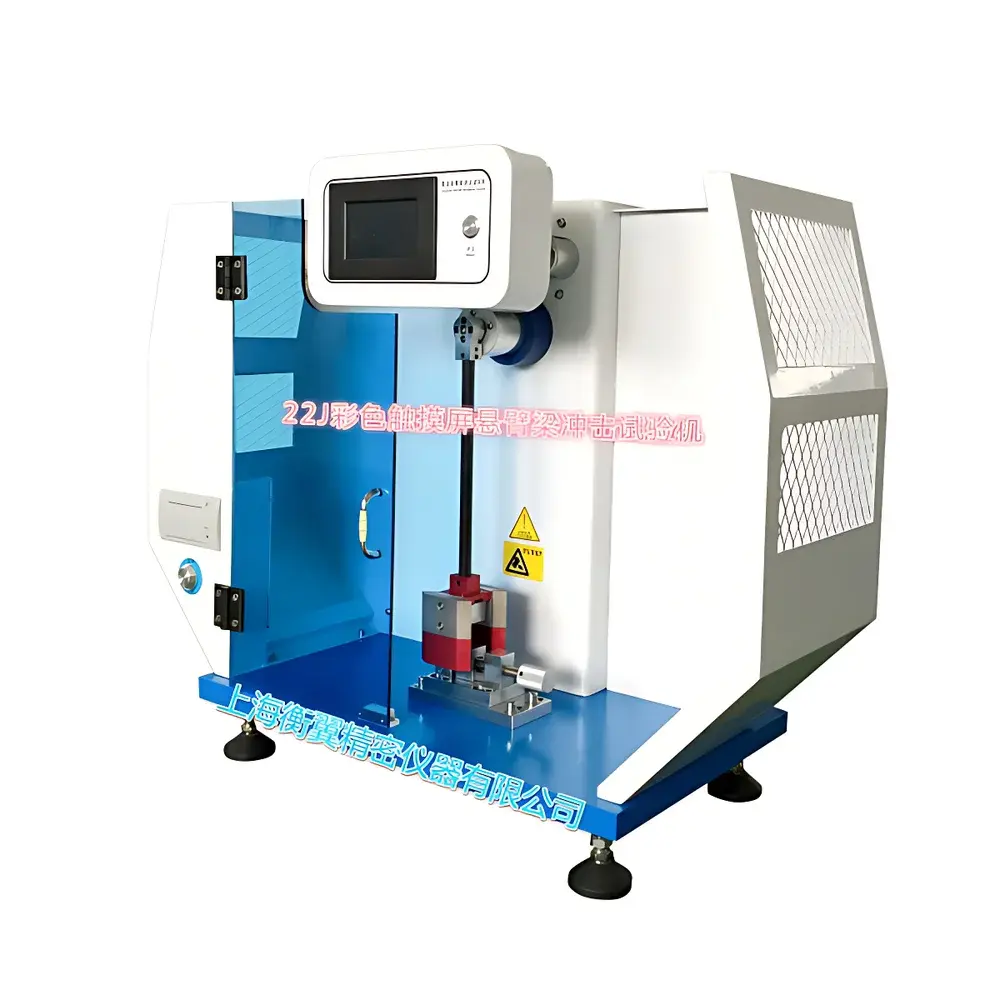
Hengyi HY(XB)-22J Ceramic Cantilever Beam Impact Tester
| Brand | Hengyi |
|---|---|
| Origin | Shanghai, China |
| Manufacturer Type | Direct Manufacturer |
| Product Category | Domestic |
| Model | HY(XB)-22J |
| Price Range | USD 1,400–2,800 |
| Instrument Type | Pendulum Impact Tester |
| Nominal Impact Energy | 22 J |
| Impact Velocity | 3.5 m/s |
| Pendulum Moment (Impact Constant) | 1 N·m/rad |
| Load Cell Range | 1 kN |
| Maximum Pendulum Lifting Height | 1 m |
| Display | Color Touchscreen (English/Chinese) |
| Angular Resolution | 0.01° (Omron Encoder) |
| Energy Resolution | 0.01 J |
| Impact Blade Radius | R = 0.8 ± 0.2 mm |
| Support Span | 60 mm (per ISO 180) |
| Specimen Clamp Distance to Blade | 22 mm |
| Pendulum Axis to Blade Distance | 335 mm |
| Pendulum Elevation Angle | 150° |
| Weight | 85 kg |
| Power Supply | AC 220 V ±10%, 50 Hz |
Overview
The Hengyi HY(XB)-22J Ceramic Cantilever Beam Impact Tester is a precision-engineered pendulum-type impact testing instrument designed for the quantitative determination of notched Izod impact strength in rigid non-metallic materials—including technical ceramics, glass-ceramics, advanced composites, engineering plastics, reinforced nylons, fiberglass-reinforced polymers (FRP), and electrical insulating materials. It operates on the classical cantilever beam (Izod) principle: a standardized specimen is clamped vertically with a defined notch at the base; a calibrated pendulum strikes the free upper edge, and the energy absorbed during fracture is calculated from the difference between initial and residual potential energy—derived via high-resolution angular displacement measurement. This method delivers reproducible, traceable data essential for material qualification, quality control, and comparative mechanical performance evaluation under dynamic loading conditions.
Key Features
- Patented carbon-fiber pendulum arm—engineered to maximize torsional rigidity along the impact axis, minimize vibrational modes, and concentrate effective mass at the pendulum’s center of gravity for true single-mode impact delivery.
- High-stability Omron rotary encoder (imported, 0.01° angular resolution) ensures sub-millijoule energy resolution (0.01 J) and long-term calibration retention without drift.
- Aerodynamically optimized impact hammer with precision-ground hardened steel blade (R = 0.8 ± 0.2 mm) and low-friction imported ball bearings—reducing parasitic energy loss and improving repeatability across >10,000 test cycles.
- Full-color touchscreen HMI with dual-language support (English/Chinese), real-time graphical energy trajectory display, and auto-calculated mean values from up to 24 consecutive tests.
- Integrated thermal-printing module compliant with GLP documentation requirements—generates timestamped, specimen-ID-tagged reports with raw angle traces, absorbed energy (J), and normalized impact strength (kJ/m² or J/m).
- Modular energy configuration: standard 22 J nominal capacity with optional interchangeable pendulum assemblies (e.g., 2.75 J, 5.5 J, 11 J) for extended dynamic range across brittle-to-tough material classes.
Sample Compatibility & Compliance
The HY(XB)-22J accommodates standard Izod specimens per ISO 180:2000 (10 × 10 × 80 mm, 2 mm notch depth), ASTM D256–2010 (Type A, 63.5 × 12.7 × 3.2 mm), and GB/T 1843–2008. Its rigid cast-iron frame, precision-machined anvil, and repeatable clamping mechanism ensure consistent specimen alignment—critical for ceramic testing where microstructural heterogeneity amplifies sensitivity to fixture-induced stress concentrations. The system complies with metrological requirements of JJG 145–2007 (Chinese National Verification Regulation for Pendulum Impact Testers) and supports audit-ready operation under ISO/IEC 17025, ASTM E29, and FDA 21 CFR Part 11 when paired with secure user access controls and electronic signature-enabled software (available as optional upgrade).
Software & Data Management
Embedded firmware enables local data storage (24-test buffer), unit conversion (J/m, kJ/m², ft·lb/in, kg·cm/cm), automatic energy-loss correction for air resistance and bearing friction, and export-ready CSV output via USB interface. Optional PC-based HengyiTest Suite provides advanced features: statistical process control (SPC) charts, batch reporting with PDF generation, multi-instrument fleet monitoring, and full 21 CFR Part 11 compliance—including electronic audit trails, role-based permissions, and biometric or token-based authentication. All test records include metadata: operator ID, environmental temperature/humidity (if connected to optional sensors), calibration certificate expiry, and pendulum serial number traceability.
Applications
- Quality assurance of structural ceramics (Al₂O₃, SiC, ZrO₂) used in aerospace bushings, semiconductor wafer chucks, and armor components.
- R&D evaluation of fracture toughness trends in sintered ceramic composites under varying grain size, porosity, or second-phase reinforcement.
- Comparative assessment of embrittlement effects following thermal cycling, hydrothermal aging, or ion implantation in bio-ceramics (e.g., hydroxyapatite, zirconia-toughened alumina).
- Validation of ISO 180 pass/fail criteria for ceramic substrates in high-voltage insulators and MEMS packaging.
- Teaching laboratories requiring robust, standards-aligned instrumentation for mechanical behavior coursework in materials science and ceramic engineering curricula.
FAQ
What is the maximum specimen thickness supported?
The standard clamp accommodates specimens up to 10.2 mm thick per ISO 180; custom fixtures for thicker ceramic tiles (up to 25 mm) are available upon request.
Is calibration certification included with shipment?
Yes—each unit ships with a factory calibration report traceable to CNAS-accredited national standards, including pendulum moment verification, energy linearity (±0.5% full scale), and blade geometry inspection.
Can the tester be integrated into a LIMS environment?
Via optional RS-232/USB-to-Ethernet gateway and HengyiTest API, enabling direct data push to LabVantage, Thermo Fisher SampleManager, or custom LIMS platforms.
Does the system meet CE or UKCA marking requirements?
The HY(XB)-22J meets EMC Directive 2014/30/EU and Low Voltage Directive 2014/35/EU; CE documentation is provided upon order confirmation.
What maintenance intervals are recommended for ceramic testing applications?
Blade sharpening every 500 impacts on hard ceramics; annual recalibration of encoder and load cell; biannual verification of pendulum pivot bearing preload and damping characteristics.
Related Products



