
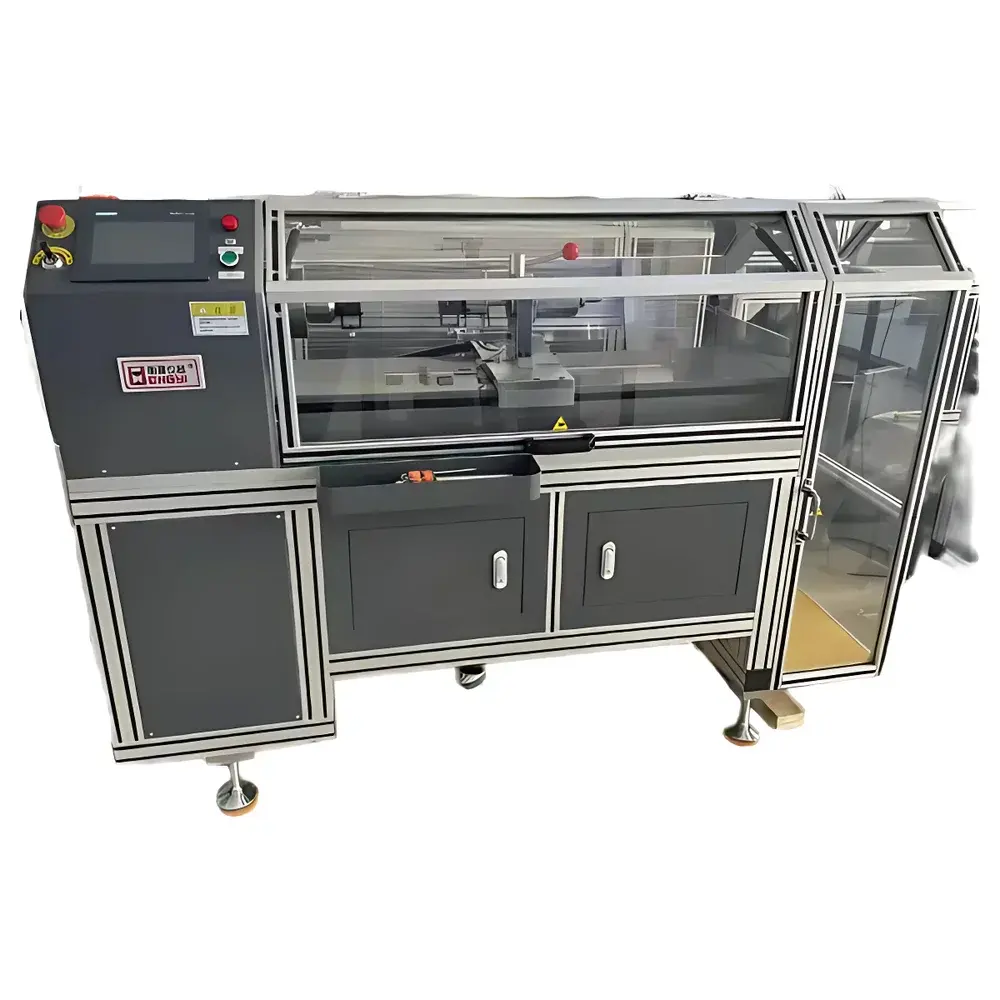
Hengyi HY(NZ)0.1–3 Dual-Directional Torsion Testing Machine for Metallic Wires
| Brand | Hengyi / Hengyitest |
|---|---|
| Origin | Shanghai, China |
| Manufacturer Type | Direct Manufacturer |
| Regional Classification | Domestic (China) |
| Model | HY(NZ)0.1–3 |
| Pricing | Upon Request |
| Wire Diameter Range | Ø0.1–3 mm |
| Gauge Length | 600 mm |
| Max Counting Capacity | 999.9 revolutions |
| Clamp Jaw Range | Ø0.1–3 mm |
| Rotational Speeds | 30, 60, 90, 120, 180, 300 rpm |
| Speed Accuracy | < ±1% |
| Minimum Revolution Resolution | 0.1 rev |
| Dimensions (L×W×H) | ≈1700 × 450 × 1200 mm |
| Weight | ≈350 kg |
| Power Supply | 220 V, 50 Hz, 1 kW |
| Compliance | GB/T 239.1–2012, GB/T 239.2–2012, GB/T 239–1999, ISO 7800:1984, ISO 9649:1990 |
| Structural Conformance | GB/T 2611, JB/T 614 |
Overview
The Hengyi HY(NZ)0.1–3 Dual-Directional Torsion Testing Machine is an electromechanically controlled precision instrument engineered for standardized mechanical evaluation of metallic wire specimens under controlled torsional loading. It operates on the principle of axial rotational deformation—applying torque about the specimen’s longitudinal axis to quantify ductility, surface integrity, internal homogeneity, and fatigue resistance through controlled unidirectional or bidirectional twisting. Designed in strict accordance with national and international torsion testing standards—including GB/T 239.1–2012 (Unidirectional Method), GB/T 239.2–2012 (Bidirectional Method), ISO 7800:1984, and ISO 9649:1990—the system delivers repeatable, traceable, and metrologically sound data for quality assurance, material qualification, and R&D validation in metallurgical laboratories, wire manufacturing facilities, and third-party testing centers.
Key Features
- Programmable dual-mode operation: supports both unidirectional continuous rotation and symmetrical bidirectional reversal (e.g., +N rev → −N rev) with user-defined cycle counts and direction-switching logic.
- Precision stepper-motor-driven rotation system with six calibrated speed settings (30, 60, 90, 120, 180, 300 rpm), maintaining speed stability within ±1% tolerance across full load range.
- High-resolution revolution counter with 0.1-revolution resolution and a maximum capacity of 999.9 turns—enabling precise endpoint detection for fracture-based termination or pre-set cycle completion.
- Adjustable gauge length of 600 mm ensures consistent strain distribution per ASTM E8/E8M conventions; accommodates standard wire diameters from Ø0.1 mm to Ø3.0 mm via parallel-jaw clamping mechanism.
- Rigid cast-iron base and reinforced structural frame (conforming to GB/T 2611 general requirements for testing machines) minimize vibration-induced measurement drift and enhance long-term dimensional stability.
- Integrated safety interlocks, emergency stop circuitry, and overload protection comply with IEC 61000-6-2/6-4 electromagnetic compatibility and functional safety expectations for industrial lab equipment.
Sample Compatibility & Compliance
The HY(NZ)0.1–3 is validated for tensile ductile metallic wires exhibiting uniform cross-sections and sufficient torsional rigidity—primarily carbon steel, stainless steel, spring steel, copper, copper alloys (e.g., brass, phosphor bronze), aluminum and aluminum alloys, titanium alloys, and specialty composites such as metal-coated fiber strands. It is not intended for brittle materials (e.g., tungsten carbide rods), non-circular profiles, or polymer monofilaments without prior method validation. All test procedures align with regulatory expectations for mechanical property verification under GLP-compliant environments. Documentation includes full traceability to national metrological standards (CNAS-accredited calibration paths available upon request), and mechanical design adheres to JB/T 614 packaging and transport specifications for laboratory instrumentation.
Software & Data Management
While the base configuration operates via front-panel digital interface with real-time revolution display and manual speed selection, optional PC-integrated software (Hengyi TorsionLab v3.x) enables automated test sequencing, parameter logging, and export-ready CSV/Excel reports. The software supports audit-trail generation (user ID, timestamp, parameter set, pass/fail flag), configurable pass/fail criteria per standard clause (e.g., minimum required revolutions before fracture per GB/T 239.2), and graphical plotting of torque vs. rotation angle (where torque transducer integration is selected). For regulated environments, optional 21 CFR Part 11-compliant modules provide electronic signature capability, role-based access control, and immutable record archiving—supporting FDA, ISO 17025, and GMP-aligned QA workflows.
Applications
- Verification of cold-drawn wire ductility during draw-process optimization and incoming raw material inspection.
- Evaluation of surface defect sensitivity (e.g., seams, laps, scratches) and subsurface inclusions via post-fracture examination of twist-induced failure morphology.
- Comparative assessment of heat treatment efficacy—e.g., annealing temperature impact on torsional endurance of piano wire or valve spring steel.
- Qualification of electroplated diamond wire (EDW) used in silicon wafer slicing, where torsional resilience directly correlates with cutting life and kerf loss consistency.
- Development testing of high-strength micro-alloyed wires for medical guidewires, aerospace fasteners, and MEMS actuator elements.
- Supporting ISO/IEC 17025 accredited test reports for certification bodies requiring documented uncertainty budgets and repeatability studies per ISO 5725.
FAQ
What standards does the HY(NZ)0.1–3 explicitly support?
It is fully aligned with GB/T 239.1–2012, GB/T 239.2–2012, GB/T 239–1999, ISO 7800:1984, and ISO 9649:1990 for unidirectional and bidirectional torsion testing of round metallic wires.
Can the machine accommodate non-circular cross-sections?
No—it is designed exclusively for cylindrical wires with diameters between 0.1 mm and 3.0 mm. Non-round profiles require custom fixturing and are outside the scope of standardized compliance.
Is torque measurement included in the base configuration?
Standard delivery includes rotational kinematics only (revolutions, speed, direction); torque sensing is available as an optional add-on module with calibrated load cell and signal conditioning.
What maintenance intervals are recommended?
Lubrication of lead screws and bearing assemblies every 500 operational hours; annual verification of speed accuracy and revolution counter linearity using NIST-traceable rotary encoder calibrators.
Does the system support automated pass/fail judgment based on standard thresholds?
Yes—when paired with TorsionLab software, users can define acceptance criteria (e.g., “≥120 revolutions without fracture”) and generate binary outcome flags synchronized with test logs.



