
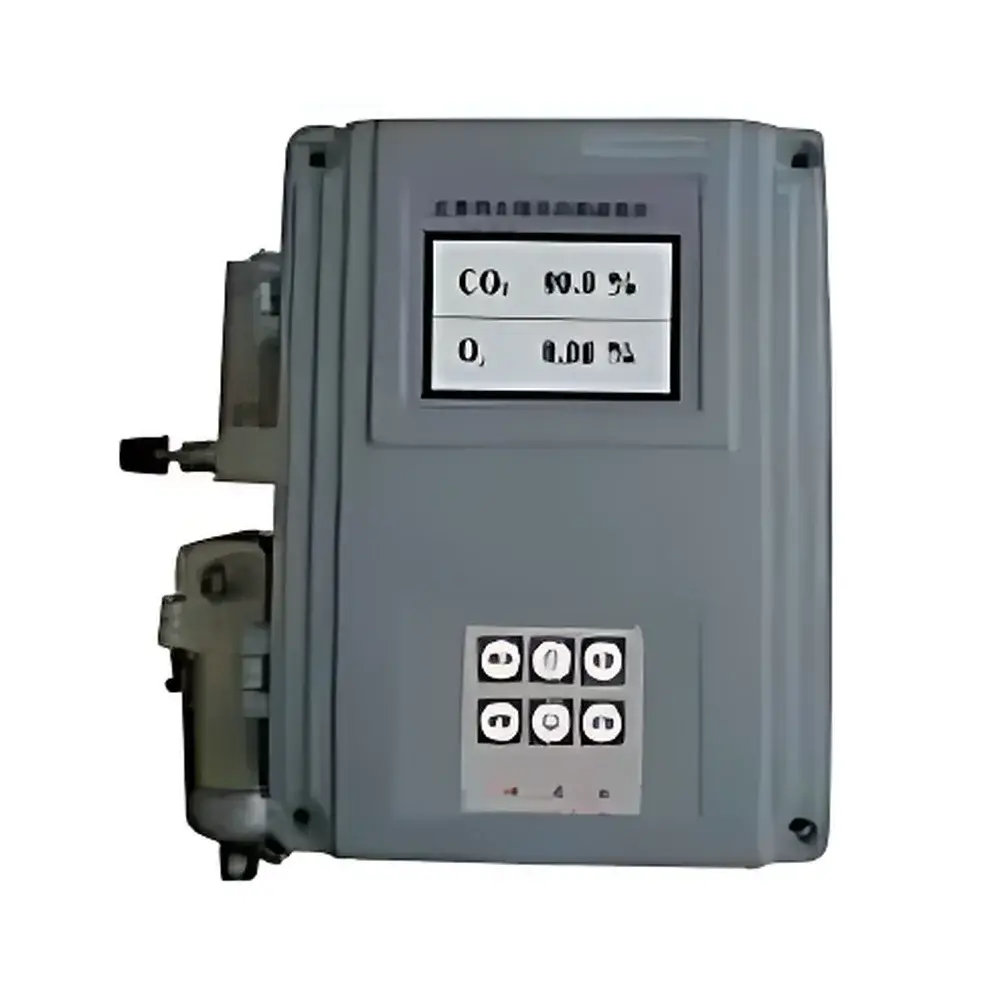
SIELINS XLZ-3090GXH Dual-Channel Infrared Gas Analyzer for CO and CO₂
| Brand | SIELINS |
|---|---|
| Model | XLZ-3090GXH |
| Detection Principle | NDIR (Non-Dispersive Infrared) |
| Gas Channels | CO and CO₂ (simultaneous dual-component measurement) |
| Measurement Range (CO) | 0–50.0 ppm or 0–200.0 ppm (user-selectable) |
| Resolution | 0.1 ppm |
| Accuracy (Linearity) | ≤ ±1% F.S. |
| Repeatability | ≤ 0.5% F.S. |
| Zero Drift | ≤ ±1% F.S./h |
| Span Drift | ≤ ±1% F.S./3 h |
| Response Time (T₉₀) | ≤ 30 s |
| Sampling Flow Rate | 1.5 L/min |
| Interference Tolerance | ≤ ±2% F.S. under 500 mg/m³ CO₂ or saturated water vapor at ambient temperature |
| Output Interface | RS232 serial port with PC-compatible software |
| Data Storage Capacity | Up to 5,000 records |
| Display Units | ppm and mg/m³ (real-time conversion) |
| Power Supply | AC 220 V ±10% / internal rechargeable battery |
| Weight | ≤ 3 kg |
| Dimensions | 245 mm × 190 mm × 85 mm |
| Operating Environment | 0–40 °C, 20–90% RH (non-condensing) |
| Compliance | Designed for field-deployable environmental monitoring per ISO 12039 (CO), ISO 4223 (CO₂), and applicable national ambient air quality standards |
Overview
The SIELINS XLZ-3090GXH is a compact, dual-channel non-dispersive infrared (NDIR) gas analyzer engineered for simultaneous, real-time quantification of carbon monoxide (CO) and carbon dioxide (CO₂) in ambient air and controlled environments. Based on the fundamental principles of Lambert–Beer absorption spectroscopy, the instrument leverages two independent, thermally stabilized NDIR optical paths—each tuned to the characteristic mid-infrared absorption bands of CO (around 4.6 µm) and CO₂ (around 4.26 µm). This architecture eliminates cross-sensitivity between channels while ensuring high spectral selectivity and long-term stability. Unlike single-gas analyzers requiring external calibration gases or manual switching, the XLZ-3090GXH integrates an internal six-port solenoid valve and auto-zero filtration system, enabling automated zero-point referencing and span verification without operator intervention. Its portable form factor (≤3 kg), integrated sampling pump (1.5 L/min), and dual power mode (AC mains or rechargeable battery) support both stationary indoor monitoring and mobile field deployment across agricultural facilities, urban air quality networks, laboratory safety zones, and military logistics environments.
Key Features
- Dual NDIR optical modules with dedicated photodetectors and narrow-band interference filters for CO and CO₂—ensuring minimal spectral overlap and <0.5% F.S. repeatability
- Automated zero calibration via built-in activated charcoal filter and motorized six-way valve—reducing drift to ≤±1% F.S./h and eliminating manual zeroing procedures
- High-resolution 0.1 ppm detection limit for CO across two selectable ranges (0–50 ppm and 0–200 ppm), configurable via on-device menu or PC software
- Real-time unit conversion between ppm and mg/m³ (based on molecular weight, temperature, and pressure inputs) displayed on backlit LCD screen
- RS232 serial interface compliant with standard ASCII protocol—enabling direct integration into SCADA systems, data loggers, or custom LabVIEW/Python acquisition platforms
- Onboard memory storing up to 5,000 timestamped readings with automatic overwrite protection and CSV export capability
- Ruggedized enclosure rated IP54 for dust and splash resistance—suitable for operation in variable humidity (20–90% RH, non-condensing) and temperatures from 0 °C to 40 °C
Sample Compatibility & Compliance
The XLZ-3090GXH is validated for continuous analysis of ambient air, indoor workplace atmospheres, greenhouse ventilation streams, and post-combustion exhaust dilutions. It maintains accuracy in the presence of common interferents: ≤±2% F.S. error induced by 500 mg/m³ CO₂ background or saturated water vapor at 25 °C—demonstrating robustness against humidity-induced baseline shift. The analyzer complies with core metrological requirements outlined in ISO 12039 (for CO in ambient air) and ISO 4223 (for CO₂ in industrial hygiene applications). While not certified to UL/CSA safety standards for hazardous locations, its design adheres to IEC 61000-4 electromagnetic compatibility guidelines and supports traceability through documented factory calibration certificates (NIST-traceable reference gases used during final verification). For regulated environments, audit-ready data logging—including operator ID, calibration timestamps, and sensor health flags—can be enabled via optional firmware extension supporting GLP-aligned metadata tagging.
Software & Data Management
The included Windows-based configuration and data retrieval software provides full instrument control: range selection, alarm threshold setting (high/low limits per channel), zero/span scheduling, and real-time graphing of dual-channel concentration trends. All stored measurements include UTC timestamps, battery voltage, pump status, and diagnostic codes (e.g., “Filter Life Remaining”, “Optical Path Contamination Alert”). Export functions generate ISO 8601-compliant CSV files compatible with Excel, MATLAB, or EPA-approved air quality modeling tools (e.g., AERMOD preprocessor). The RS232 protocol supports Modbus RTU over serial for integration into building management systems (BMS) or PLC-controlled environmental chambers. Firmware updates are delivered via signed binary packages with SHA-256 checksum validation—ensuring integrity during field upgrades.
Applications
- Ambient air quality monitoring networks—deployed at urban traffic intersections, school campuses, and industrial fence-line sites for compliance reporting under national ambient air quality standards
- Controlled-environment agriculture—continuous CO₂ dosing feedback in greenhouses and CO leak detection in hydroponic nutrient solution rooms
- Occupational health and safety—real-time CO exposure assessment in boiler rooms, parking garages, and confined-space entry operations
- Research laboratories—gas exchange studies in plant physiology, combustion efficiency testing, and HVAC system commissioning verification
- Military field operations—portable toxic gas screening in forward operating bases and vehicle maintenance bays where fuel-powered equipment generates CO
FAQ
Does the XLZ-3090GXH require periodic recalibration with certified gas standards?
Yes—while the auto-zero function compensates for short-term drift, annual full-scale calibration using NIST-traceable CO and CO₂ reference gases (certified to ±1% uncertainty) is recommended for regulatory compliance and long-term measurement integrity.
Can the instrument operate continuously on battery power?
Yes—the internal rechargeable Li-ion battery supports ≥6 hours of continuous sampling and display operation at 1.5 L/min flow rate; battery level and estimated runtime are shown on-screen.
Is the RS232 interface compatible with modern laptops lacking legacy serial ports?
Yes—standard USB-to-RS232 adapters (FTDI chipset recommended) enable plug-and-play connectivity; drivers and terminal configuration settings are provided in the software installation package.
What maintenance is required beyond filter replacement?
The internal activated charcoal zero filter should be replaced every 6 months under typical use; optical windows require cleaning only if visible contamination occurs—using lens-grade tissue and isopropyl alcohol per maintenance manual instructions.
Does the analyzer meet FDA 21 CFR Part 11 requirements for electronic records?
Out-of-the-box, it does not include electronic signature or audit trail features; however, the raw CSV data output can be imported into validated LIMS or ELN platforms that provide Part 11 compliance for GxP workflows.
Related Products







