
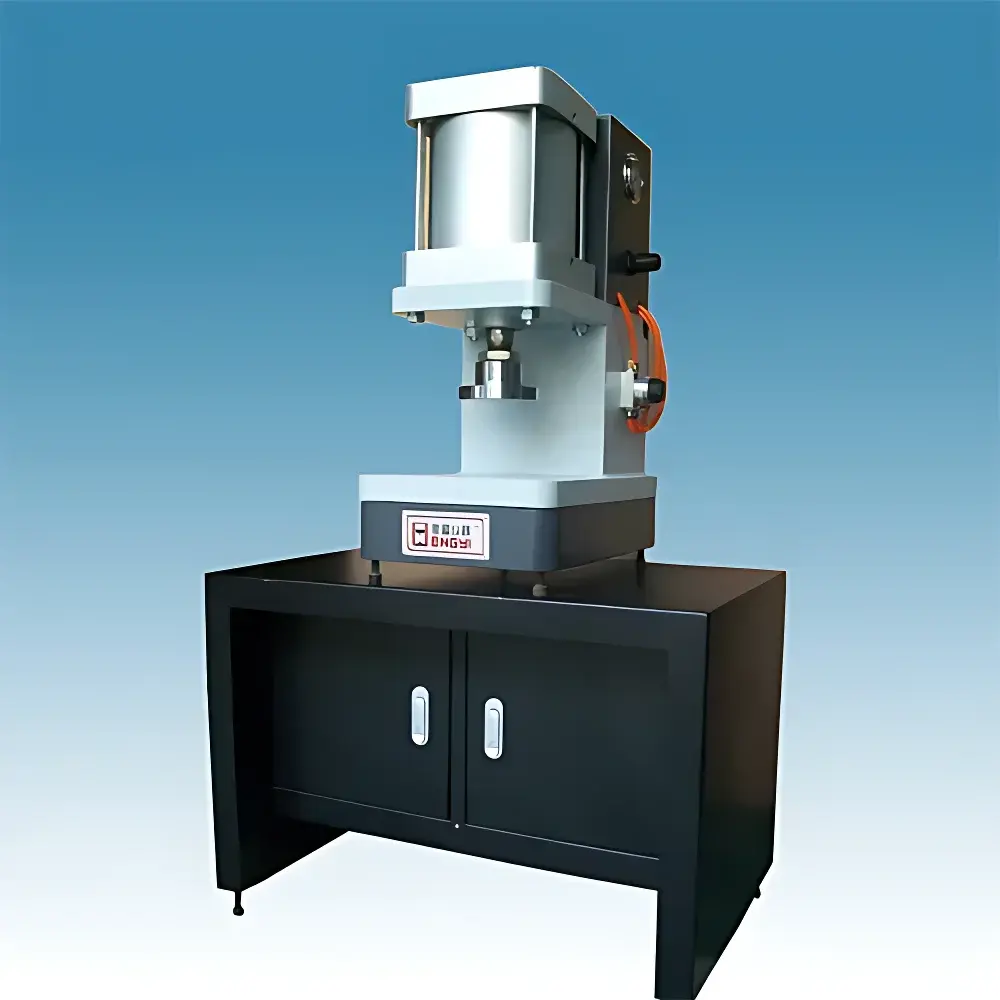
Hengyi HY(QDCP)TY Pneumatic Dumbbell Specimen Cutter for Rubber and Polymer Sheets
| Brand | Hengyi |
|---|---|
| Origin | Shanghai, China |
| Manufacturer Type | Direct Manufacturer |
| Country of Origin | China |
| Model | HY(QDCP)TY |
| Quotation | Upon Request |
| Stroke | >50 mm |
| Worktable Dimensions | 300 × 200 mm |
| Die Width | 6 mm |
| Overall Dimensions | 520 × 450 × 520 mm |
| Operating Air Pressure | 0.6 MPa |
| Punching Force | 20 kN |
| Net Weight | 85 kg |
Overview
The Hengyi HY(QDCP)TY Pneumatic Dumbbell Specimen Cutter is an industrial-grade, precision-engineered specimen preparation system designed specifically for standardized mechanical testing of elastomeric and polymeric sheet materials. It operates on a controlled pneumatic actuation principle, delivering consistent, repeatable cutting force without manual variability—critical for achieving ASTM D412, ISO 37, GB/T 528, and other international tensile test standard compliance. Unlike hydraulic or manually operated cutters, this system utilizes regulated compressed air (0.6 MPa) to drive a robust toggle-link mechanism, translating linear motion into high-force, vertical die penetration with minimal deflection. The cutter’s rigid cast-iron frame and hardened steel guide columns ensure long-term dimensional stability and alignment integrity—essential for maintaining ±0.1 mm tolerance across thousands of cutting cycles. Its primary function is to produce dumbbell-shaped specimens from flat sheets of rubber, thermoplastic elastomers (TPE), silicone, PVC, PU, leather, and composite laminates, enabling downstream tensile, tear, and elongation measurements in quality control laboratories and R&D facilities.
Key Features
- Pneumatic actuation system with adjustable pressure regulation ensures stable 20 kN nominal punching force—sufficient to cut through 10 mm thick vulcanized rubber sheets without edge deformation or burring.
- Fixed-stroke design (>50 mm stroke depth) guarantees full die penetration regardless of material thickness within operational range, eliminating incomplete cuts.
- Modular die-mounting interface accommodates standardized ASTM D412 Type I, II, and IV dumbbell dies (6 mm gauge width specified), as well as custom-profile dies via interchangeable mounting plates.
- Reinforced 300 × 200 mm worktable with T-slot grooves enables secure clamping of large-format sheets (up to 280 × 180 mm usable area) using optional vacuum or mechanical fixtures.
- Integrated safety interlock system prevents actuation unless the protective guard is fully closed and locked—compliant with ISO 13857 and CE machinery directive requirements.
- Low-maintenance architecture: sealed linear bearings, self-lubricating bushings, and corrosion-resistant surface treatment extend service intervals beyond 10,000 cycles without recalibration.
Sample Compatibility & Compliance
The HY(QDCP)TY accepts sheet materials ranging from 0.5 mm to 12 mm in thickness, including sulfur-cured natural rubber (NR), styrene-butadiene rubber (SBR), nitrile rubber (NBR), EPDM, thermoplastic polyurethane (TPU), and cross-linked polyethylene (XLPE). It supports both unvulcanized compound sheets (for pre-cure rheology correlation) and post-vulcanized test specimens. All cut specimens meet dimensional repeatability requirements per ISO/IEC 17025:2017 for accredited testing laboratories. The machine itself conforms to EN 60204-1 (electrical safety), ISO 4414 (pneumatic systems), and carries CE marking for use in EU-based QC environments. Optional calibration certification traceable to NIM (National Institute of Metrology, China) is available upon request.
Software & Data Management
While the HY(QDCP)TY is a standalone mechanical system with no embedded microcontroller or digital interface, it integrates seamlessly into GLP/GMP-compliant workflows through documented operating procedures and maintenance logs. Users may pair it with external barcode-scanned specimen tracking systems (e.g., LabVantage, Thermo Fisher SampleManager) by assigning unique lot IDs to each cutting batch. Maintenance records—including air filter replacement dates, die sharpening history, and force verification reports—can be archived electronically to satisfy FDA 21 CFR Part 11 audit requirements when hosted on validated platforms. Optional force verification kits (calibrated load cells + NIST-traceable certificates) are available for periodic performance validation.
Applications
- Tensile property characterization (modulus, ultimate tensile strength, elongation at break) per ASTM D412 and ISO 37.
- Quality assurance of incoming raw elastomer batches prior to mixing or extrusion.
- R&D evaluation of novel polymer blends and filler-reinforced composites.
- Preparation of specimens for dynamic mechanical analysis (DMA) and fatigue testing.
- Small-batch prototyping where rapid, reproducible sample geometry is required without CNC machining.
- Teaching laboratories demonstrating standardized specimen preparation protocols in polymer science curricula.
FAQ
What standards does the HY(QDCP)TY support for dumbbell specimen geometry?
It produces specimens compliant with ASTM D412 Type I, II, and IV; ISO 37 Type 1 and 2; and GB/T 528—specifically configured for 6 mm wide gauge sections.
Can the machine cut non-dumbbell shapes?
Yes—by installing alternative dies (e.g., circular, rectangular, trouser-tear, or crescent-shaped), provided they fit the 6 mm width constraint and mounting interface.
Is compressed air supply included?
No—the unit requires an external clean, dry, oil-free air source regulated to 0.6 MPa (±0.02 MPa); a standard industrial air compressor with coalescing filter and pressure regulator is recommended.
How often does the cutting die require sharpening?
Under typical usage (≤500 cuts/week on NR/SBR), die sharpening is recommended every 3,000–5,000 cycles or when edge chipping or inconsistent cut depth is observed.
Does the system include force calibration documentation?
Standard delivery includes factory-set force verification at 20 kN; full calibration certificate with uncertainty budget and NIM traceability is available as an optional add-on.



