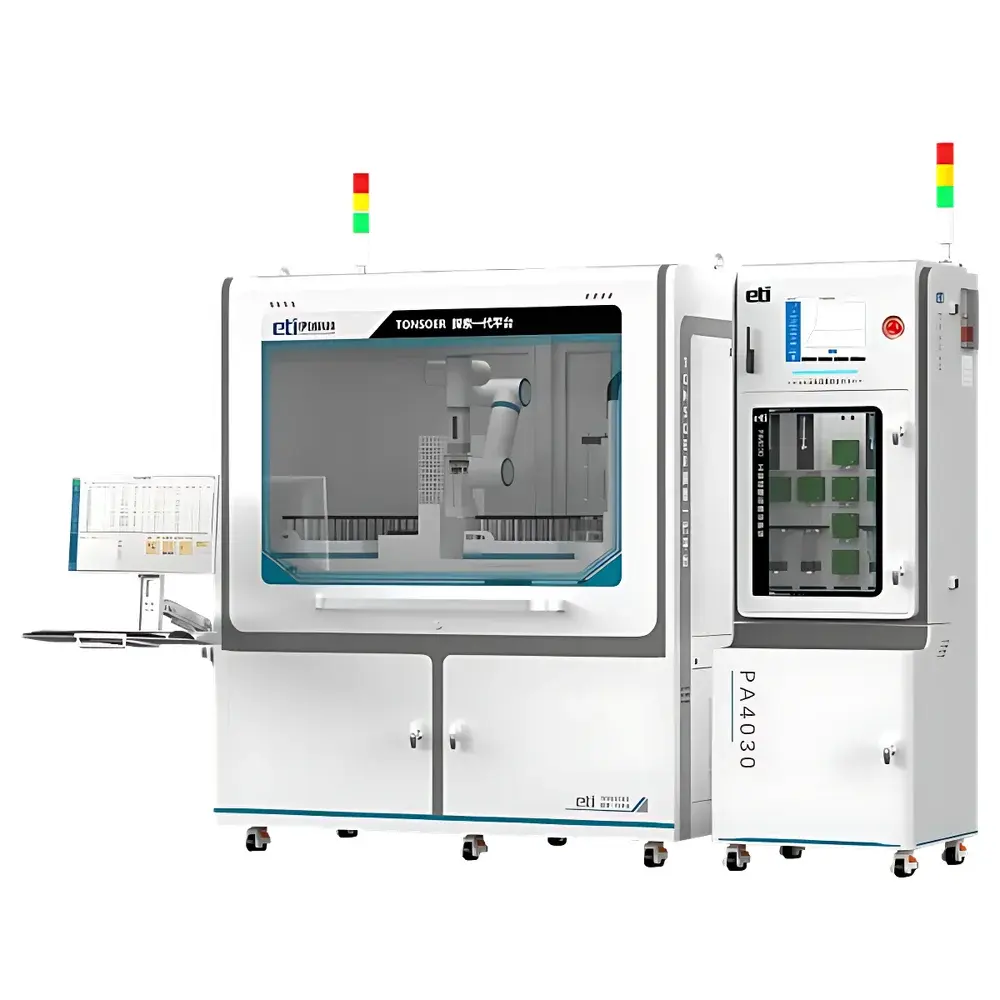
TONSOER® Explorer I Platform
| Brand | ETI |
|---|---|
| Origin | Guangdong, China |
| Manufacturer Type | Authorized Distributor |
| Country of Origin | China |
| Model | TONSOER® Explorer I Platform |
| Pricing | Upon Request |
| Measurement Scope | Designed for spatially distributed, homogeneous process monitoring applications — e.g., Cu²⁺ and H₂SO₄ concentration monitoring in PCB manufacturing lines |
| Detection Principles | Potentiometric titration (acid-base, complexometric, precipitation, redox), photometric detection, and photometric titration |
| Sample Throughput | Base configuration (4 modules): ~10 min for 4 analytes |
| Standard configuration (8 modules) | ~10 min for 8 analytes |
| System Footprint | 3550 mm (W) × 650 mm (D) × 1850 mm (H) |
| Sample Handling Unit | 1250 mm (W) × 650 mm (D) × 1000 mm (H) |
| Analytical Unit | 620 mm (W) × 650 mm (D) × 1850 mm (H) |
| Power Supply | 198–242 V AC, 50 Hz ± 0.5 Hz, 2000 W |
| Operating Environment | 15–30 °C, RH 65 % ± 20 % (max daily temperature fluctuation ≤5 °C) |
| Control Interface | Windows-based desktop PC with ≥23-inch display |
Overview
The TONSOER® Explorer I Platform is a modular, industrial-grade online reaction analysis system engineered for real-time, multi-analyte process monitoring in continuous or semi-continuous production environments. It integrates classical wet-chemical analytical principles—including potentiometric titration (acid-base, complexometric, precipitation, and redox), photometric detection, and photometric titration—into a unified automation architecture. Unlike single-parameter inline sensors, the Explorer I Platform performs discrete, laboratory-grade quantitative analysis on representative process samples without requiring manual intervention. Its core design addresses the operational challenge of distributed sampling across large-scale facilities—such as printed circuit board (PCB) fabrication plants—where copper ion (Cu²⁺) and sulfuric acid (H₂SO₄) concentrations must be tightly controlled across multiple etching, plating, and cleaning baths. The system operates on a scheduled or event-triggered sampling protocol, ensuring traceable, auditable, and statistically robust data generation aligned with process analytical technology (PAT) frameworks.
Key Features
- Modular analytical architecture supporting up to eight parallel detection modules—scalable from base (4-module) to expanded configurations based on site-specific analyte requirements.
- Automated sample handling with barcode/QR code-assisted sample tube identification, enabling unambiguous chain-of-custody tracking from acquisition to reporting.
- Intelligent sample allocation logic: automatically assigns incoming samples to appropriate analytical methods and reagent sets based on predefined assay templates.
- Robust liquid handling subsystem featuring precision peristaltic pumps, gravimetric dispensing verification, and programmable aspiration/dispense volumes for reproducible reagent addition.
- Integrated endpoint detection: combines potentiometric electrode response with real-time absorbance monitoring (via fixed-wavelength or selectable optical filters) to determine titration endpoints with high repeatability.
- Self-contained sample preparation module including automated tube capping/un-capping, homogenization, dilution, and filtration—minimizing operator dependency and cross-contamination risk.
Sample Compatibility & Compliance
The Explorer I Platform accommodates aqueous process streams typical of electronics manufacturing, electroplating, semiconductor wet benches, metal surface treatment, petrochemical refining, and fine chemical synthesis. Sample matrices include acidic etchants (e.g., H₂SO₄/H₂O₂ mixtures), plating baths (CuSO₄–H₂SO₄), passivation solutions, and rinse waters. All fluidic pathways are constructed from chemically resistant materials (e.g., PTFE, PFA, borosilicate glass) compatible with pH 0–14 and oxidizing agents. The system supports method validation per ASTM D1129 (Standard Terminology Relating to Water), ISO 5667-3 (Water quality — Sampling — Part 3: Guidance on the preservation and handling of water samples), and USP (Analytical Instrument Qualification). Data integrity safeguards—including electronic signatures, audit trails, and user-access controls—facilitate alignment with FDA 21 CFR Part 11 and GLP/GMP documentation requirements.
Software & Data Management
Control and data acquisition are managed via ETI’s proprietary Windows-based platform, featuring a 23-inch touchscreen interface with intuitive workflow navigation. The software enables full method configuration: selection of titration mode (fixed-volume, dynamic-volume, drift-controlled, or equivalence-point), calibration curve definition (linear, quadratic, or multi-point), and limit-setting for automatic out-of-specification (OOS) flagging. All raw sensor signals (mV, absorbance units), calculated concentrations, timestamps, and instrument status logs are stored in an embedded SQL database with configurable export options (CSV, PDF, XML). Secure OPC UA and Modbus TCP interfaces allow seamless integration into DCS/SCADA systems and enterprise MES platforms. Audit trail functionality records every user action—including method edits, calibration events, and result overrides—with immutable timestamps and operator IDs.
Applications
- Real-time monitoring of Cu²⁺ and H₂SO₄ concentrations in PCB etching and electroplating baths to maintain optimal etch rates and deposit uniformity.
- Automated quality control of pickling and passivation solutions in stainless steel and aluminum surface treatment lines.
- In-process verification of catalyst concentration and acid strength in petrochemical alkylation and hydrotreating units.
- Multi-parameter analysis of electrolyte composition in lithium-ion battery electrode coating slurries and separator bath solutions.
- Regulatory-compliant wastewater effluent testing for heavy metals (Ni²⁺, Cr⁶⁺, Zn²⁺) and residual oxidants prior to discharge.
FAQ
What titration methods does the Explorer I Platform support?
It supports acid-base, complexometric (e.g., EDTA-based), precipitation (e.g., AgNO₃ for chloride), and redox titrations—including potentiometric and photometric endpoint detection.
Can the system analyze multiple analytes in a single sample?
Yes. Each sample can undergo sequential or parallel assays—for example, simultaneous determination of total acidity and Cu²⁺ concentration using dedicated modules.
Is remote monitoring and troubleshooting possible?
Yes. The platform includes secure remote access capability via encrypted VPN or TLS-enabled web interface, allowing authorized personnel to review live status, historical trends, and diagnostic logs.
How is method validation supported?
The system provides built-in tools for linearity assessment, spike recovery testing, repeatability evaluation (n ≥ 6), and limit of quantitation (LOQ) verification—fully documented in IQ/OQ/PQ-ready reports.
What maintenance intervals are recommended?
Daily: electrode cleaning and calibration verification; quarterly: pump tubing replacement and optical path inspection; annually: full performance qualification against certified reference materials.