
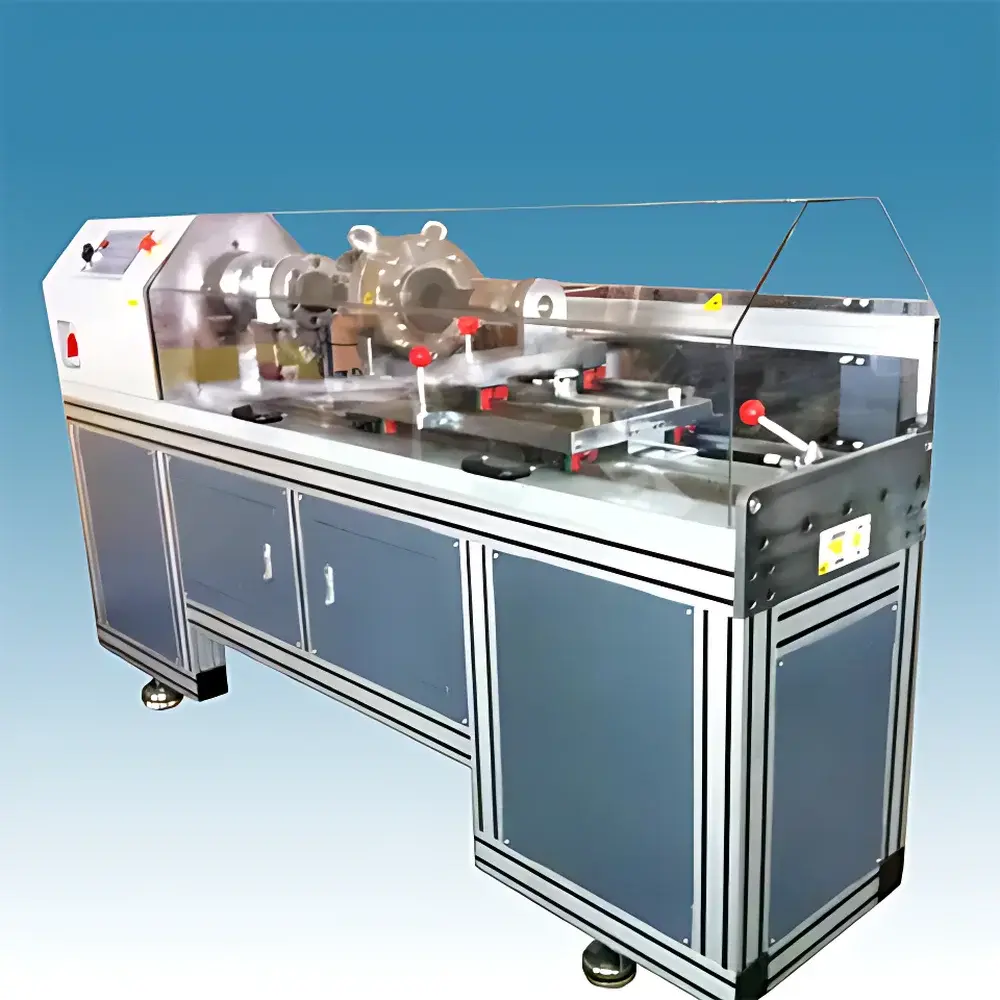
Hengyi HY-2000N.MTYUy Torsion Testing Machine for Fastener Thread Friction Coefficient Analysis
| Brand | Hengyi / Hengyitest |
|---|---|
| Origin | Shanghai, China |
| Manufacturer Type | Direct Manufacturer |
| Product Origin | Domestic (China) |
| Model | HY-2000N.MTYUy |
| Max Torque | 2000 N·m |
| Torque Measurement Range | 2–2000 N·m |
| Torque Resolution | 1/500,000 |
| Torsion Angle Range | 0–100,000° (or continuous) |
| Motor Power | 5 kW |
| Axial Force Range | 5–500 kN |
| Torque Accuracy | ±0.5% |
| Angle Accuracy | ±0.5% |
| Speed Range | 5–40 rpm (up to 200 rpm) |
| Specimen Clamp Range | M10–M30 |
| Test Space (Max) | 1000 mm |
| Dimensions (L×W×H) | ~2200 × 540 × 1250 mm |
| Weight | 1800 kg |
Overview
The Hengyi HY-2000N.MTYUy is a high-precision torsion testing machine engineered for the quantitative mechanical characterization of threaded fasteners—including bolts, screws, studs, and nut-bolt assemblies—under controlled tightening conditions. It operates on the principle of simultaneous, synchronized measurement of axial clamping force (preload) and three distinct torque components: total input torque, thread torque, and bearing surface torque. This multi-sensor architecture enables direct calculation of critical fastener performance parameters per internationally recognized standards, including ISO 16047, ISO 2320, GB/T 3098.9–2010, GB/T 16823.3–2010, EN 14399-1:2005, and EN 14399-3–6:2006. Unlike generic torsion testers, this system integrates coaxial load cells and high-fidelity torque transducers calibrated traceably to national metrological standards, ensuring repeatable, physics-based derivation of frictional behavior across thread interfaces and underhead contact zones.
Key Features
- Triple-torque measurement capability: independent real-time acquisition of total torque, thread torque, and bearing surface torque via co-located, temperature-compensated sensors
- High-resolution axial force measurement (5–500 kN range) with ±0.5% accuracy, enabling precise determination of clamp load vs. torque relationships
- Ultra-fine torque resolution of 1 part in 500,000 full scale, supporting detection of micro-frictional transitions during yield and plastic deformation phases
- Wide torsion angle range up to 100,000° (or continuous rotation mode), accommodating both static preload analysis and dynamic loosening/vibration simulation protocols
- Stable low-speed operation (5–40 rpm standard; up to 200 rpm optional) with zero speed fluctuation and no stick-slip behavior—critical for accurate K-factor and coefficient-of-friction derivation
- Modular clamping system accommodating fasteners from M10 to M30, with customizable jaw inserts for non-standard geometries and coated or lubricated specimens
- Robust structural frame (1800 kg mass) with rigid 1000 mm test zone spacing, minimizing deflection-induced measurement error during high-torque loading
Sample Compatibility & Compliance
The HY-2000N.MTYUy is validated for standardized testing of metallic and composite threaded fasteners used in aerospace, automotive, rail, power generation, and shipbuilding applications. It supports specimen configurations per ISO 898-1:1999 (mechanical properties of bolts), EN 14399 series (preloaded high-strength assemblies), and ASTM F2281 (torque-tension testing of externally threaded fasteners). All measurement subsystems are calibrated in accordance with ISO/IEC 17025 requirements, and raw data output includes timestamped, uneditable audit trails compliant with GLP and GMP documentation frameworks. The system meets electromagnetic compatibility (EMC) Class B requirements per IEC 61326-1 and is designed for integration into ISO 9001-certified quality laboratories.
Software & Data Management
The HYtest control and analysis software provides a deterministic, deterministic real-time acquisition environment with dual-channel synchronous sampling (force + torque + angle at ≥1 kHz). It delivers automated calculation of 12 standardized outputs: torque coefficient (K), total friction coefficient (μtot), thread friction coefficient (μth), bearing surface friction coefficient (μb), yield clamp load, yield torque, ultimate clamp load, ultimate torque, turn angle at yield, turn angle at failure, elastic stiffness (kel), and plastic deformation ratio. Export formats include CSV, XML, and PDF reports with embedded calibration certificates. Software validation documentation is available upon request for FDA 21 CFR Part 11 compliance readiness.
Applications
- Determination of torque-tension relationships for bolted joint design and specification validation
- Friction coefficient benchmarking of lubricants, coatings (e.g., zinc flake, phosphate), and surface treatments
- Quality assurance of high-strength fasteners (e.g., grade 10.9, 12.9, A286, Inconel) prior to assembly in critical structures
- Root-cause analysis of joint relaxation, self-loosening, or galling phenomena in service-representative test environments
- Support for finite element model calibration by providing experimentally derived μth and μb inputs
- Calibration verification of production-line torque tools and digital torque wrenches
FAQ
Does the system comply with ISO 16047 for coefficient of friction testing?
Yes—the HY-2000N.MTYUy implements all mandatory hardware and procedural requirements defined in ISO 16047:2005, including sensor placement geometry, torque/force synchronization tolerance (<±0.2° phase lag), and data sampling rate minimums.
Can it test fasteners larger than M30?
Standard configuration supports M10–M30. Customized versions with extended stroke, higher-capacity load cells (up to 1000 kN), and oversized grips are available upon engineering review.
Is the software compatible with LIMS or MES integration?
Yes—HYtest supports OPC UA and RESTful API interfaces for bidirectional data exchange with laboratory information management systems and manufacturing execution systems.
What maintenance intervals are recommended for metrological stability?
Annual recalibration of torque and force transducers is recommended; angle encoder verification every 6 months. Full system performance verification per ISO 7500-1 is advised before critical certification runs.
Does the system support cyclic torsion or vibration-induced loosening tests?
While primarily designed for quasi-static tightening analysis, the controller firmware supports programmable stepwise torque-angle profiles and limited harmonic oscillation modes (±5° at 1–10 Hz) for preliminary relaxation screening. Dedicated transverse vibration testing requires the companion HY-VIB series.



