
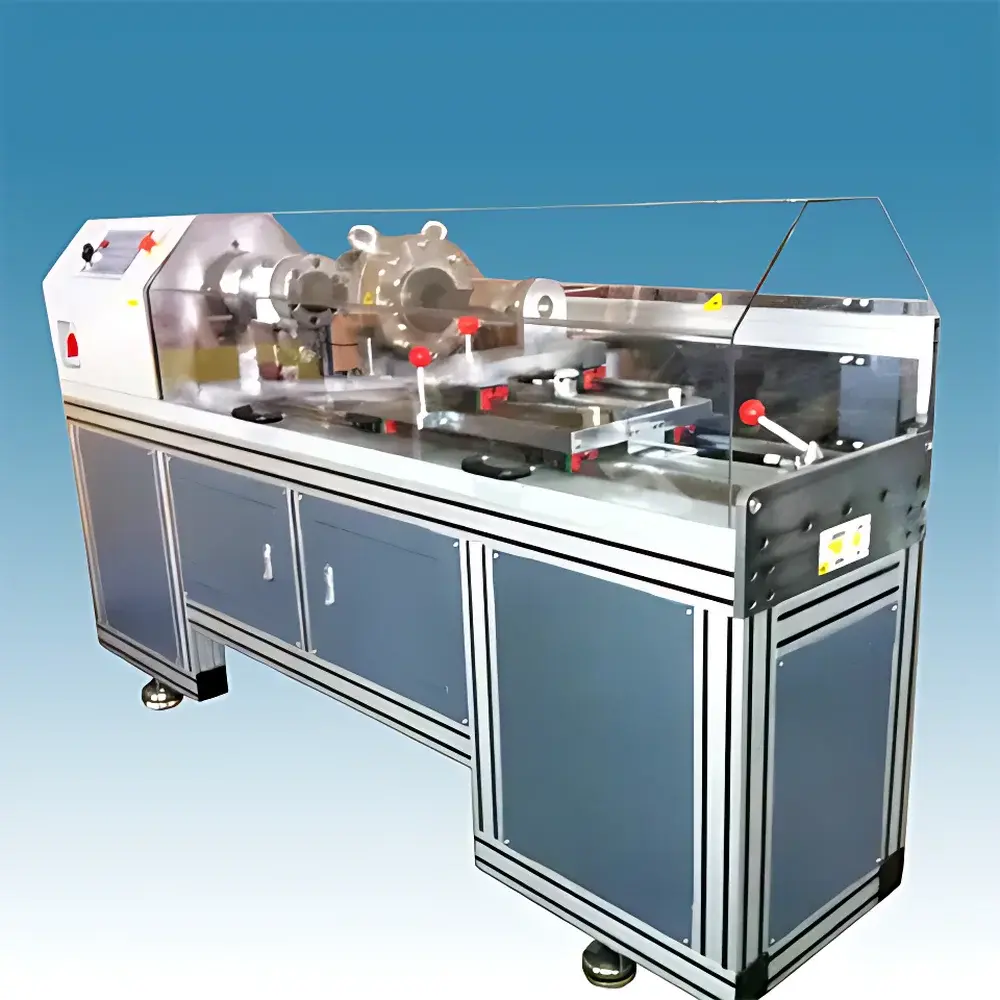
Hengyi HY-2000N·m Hex Flange Bolt Friction Coefficient Testing Machine
| Brand | Hengyi |
|---|---|
| Origin | Shanghai, China |
| Manufacturer Type | Direct Manufacturer |
| Model | HY-2000N·m |
| Max Torque | 2000 N·m |
| Torque Measurement Range | 2–2000 N·m |
| Torque Resolution | 1/500,000 full scale |
| Torsion Angle Range | 0–100,000° (or continuous) |
| Motor Power | 5 kW |
| Axial Force Range | 5–500 kN |
| Torque Accuracy | ±0.5% FS |
| Angular Position Accuracy | ±0.5% FS |
| Clamping Distance | 1000 mm |
| Rotational Speed Range | 5–40 rpm (up to 200 rpm) |
| Specimen Size Compatibility | M10–M30 (customizable) |
| Compliance Standards | ISO 16047, ISO 2320, GB/T 3098.9–2010, GB/T 16823.3–2010, EN 14399-1:2005, EN 14399-3–6:2006, ISO 898-1:1999 |
Overview
The Hengyi HY-2000N·m Hex Flange Bolt Friction Coefficient Testing Machine is a high-precision torsion testing system engineered for quantitative analysis of fastener tightening behavior under controlled preload and torque conditions. It operates on the principle of simultaneous dual-sensor measurement—integrating a calibrated axial load cell and a coaxial torque transducer—to resolve the interdependent mechanical responses of bolted joints during tightening and loosening cycles. This architecture enables traceable separation of total torque into three primary components: thread friction torque, bearing surface (under-head) friction torque, and pure clamping torque. The system complies with internationally recognized fastener characterization standards—including ISO 16047 (Fasteners — Mechanical properties of fasteners made of carbon steel and alloy steel — Part 2: Nuts with specified proof load values), ISO 2320 (Prevailing torque type nuts — Mechanical and performance requirements), and GB/T 16823.3–2010 (Mechanical properties of fasteners — Part 3: Torque/clamp force testing)—ensuring data interoperability across global R&D, quality assurance, and certification workflows.
Key Features
- High-resolution torque measurement with 1/500,000 full-scale resolution and ±0.5% accuracy across the 2–2000 N·m range, enabling detection of micro-frictional variations in coated, lubricated, or surface-treated fasteners.
- Dual-axis synchronized acquisition: simultaneous real-time recording of axial clamping force (5–500 kN), total torque, thread torque, bearing surface torque, and angular displacement (0–100,000°, extendable).
- Motor-driven precision actuation with programmable speed control (5–40 rpm standard; up to 200 rpm optional), supporting both quasi-static and dynamic tightening protocols per ISO 16047 Annex A.
- Modular gripping system accommodating threaded fasteners from M10 to M30; configurable jaw inserts available for non-standard geometries including hex flange bolts, flange nuts, and structural anchor assemblies.
- Rigid C-frame construction (2200 × 540 × 1250 mm; 1800 kg mass) with 1000 mm maximum parallel jaw spacing, minimizing frame compliance and ensuring measurement integrity at peak loads.
- Integrated thermal management and overload protection circuits, compliant with IEC 61000-6-2 (immunity) and IEC 61000-6-4 (emission) for laboratory-grade electromagnetic compatibility.
Sample Compatibility & Compliance
The HY-2000N·m system is validated for standardized testing of metallic threaded fasteners—including bolts, screws, studs, and prevailing-torque nuts—across strength classes 8.8 through 12.9 and surface treatments such as yellow zinc plating, phosphate-oil coating, PTFE dry film, and hot-dip galvanizing. Test specimens include but are not limited to: M10/M12 Class 8 hex flange bolts with matching nuts; ASTM A325/A490 structural assemblies; ISO 4014/4017 heavy-duty bolts; and EN 14399 preloaded bolt assemblies for steel structures. All test methods align with regulatory expectations for GLP-compliant environments: audit trails, user access control, electronic signatures, and raw-data immutability are supported via optional FDA 21 CFR Part 11–compliant software modules.
Software & Data Management
The embedded Hengyi FastenerTest Suite v4.x provides ISO 16047–compliant test sequence automation—including multi-cycle tightening/loosening (e.g., first insertion, first removal, fifth removal, fifteenth removal), yield point detection via slope-based algorithm (ASTM F606–22 Annex X1), and K-factor derivation per ISO 16047 Clause 6.3. Raw data (force, torque, angle, time) are stored in vendor-neutral CSV and HDF5 formats. Export options include PDF test reports with embedded calibration certificates, annotated torque-angle curves, friction coefficient histograms, and statistical summaries (mean, SD, Cp/Cpk) for process capability analysis. Data archiving supports network-attached storage (NAS) integration and role-based permissions per ISO/IEC 17025:2017 clause 7.5.2.
Applications
- Quantitative validation of lubricant efficacy and consistency in high-volume automotive and aerospace fastener production lines.
- Development and verification of anti-loosening mechanisms (e.g., nylon insert, serrated flange, chemical threadlockers) per SAE J2249 and DIN 267–27.
- Root-cause analysis of joint slippage, embedment loss, or premature yielding in wind turbine tower bolting and rail infrastructure projects.
- Calibration and cross-validation of torque-controlled assembly tools against physical reference standards.
- Research into tribological behavior of novel coatings (e.g., MoS₂, DLC, ZnAl) under variable humidity and temperature profiles.
- Third-party certification testing for ISO/IEC 17025-accredited laboratories serving OEMs in construction machinery, power generation, and shipbuilding sectors.
FAQ
Does the HY-2000N·m system support automated multi-cycle testing per ISO 16047 Annex B?
Yes—the system executes fully programmable sequences including initial tightening, repeated loosening cycles (up to 50 iterations), dwell periods, and relaxation measurements, all synchronized with high-frequency data logging at ≥1 kHz.
Can the machine measure K-factor (torque coefficient) directly without manual calculation?
Yes—K-factor is computed in real time using the formula K = T / (F × d), where T is total torque (N·m), F is clamping force (kN), and d is nominal diameter (m); results are displayed alongside confidence intervals derived from sensor uncertainty budgets.
Is calibration traceable to national metrology institutes?
All torque and force transducers are supplied with UKAS-accredited calibration certificates (ISO/IEC 17025) traceable to NIM (China) and NIST (USA); annual recalibration services include drift assessment and sensitivity matrix verification.
What electrical infrastructure is required for installation?
A dedicated 220 VAC ±10%, 50/60 Hz single-phase circuit with 32 A breaker and isolated earth ground (≤5 Ω resistance) is mandatory; voltage stabilization is recommended in industrial environments with frequent load switching.
Are custom fixtures available for non-standard fastener geometries?
Yes—Hengyi offers engineering consultation and CNC-machined fixture design for specialized applications, including blind-hole studs, countersunk bolts, and composite-material fasteners, subject to mechanical interface review and static load validation.



