
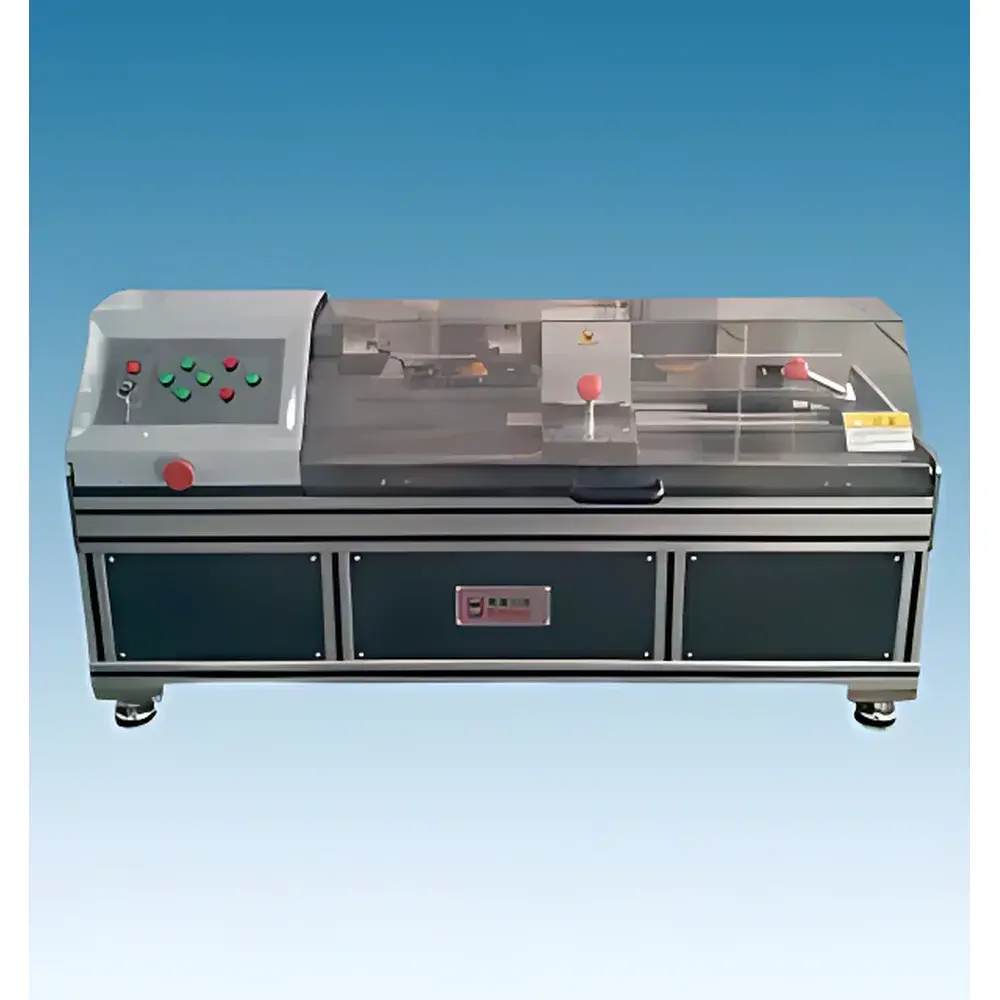
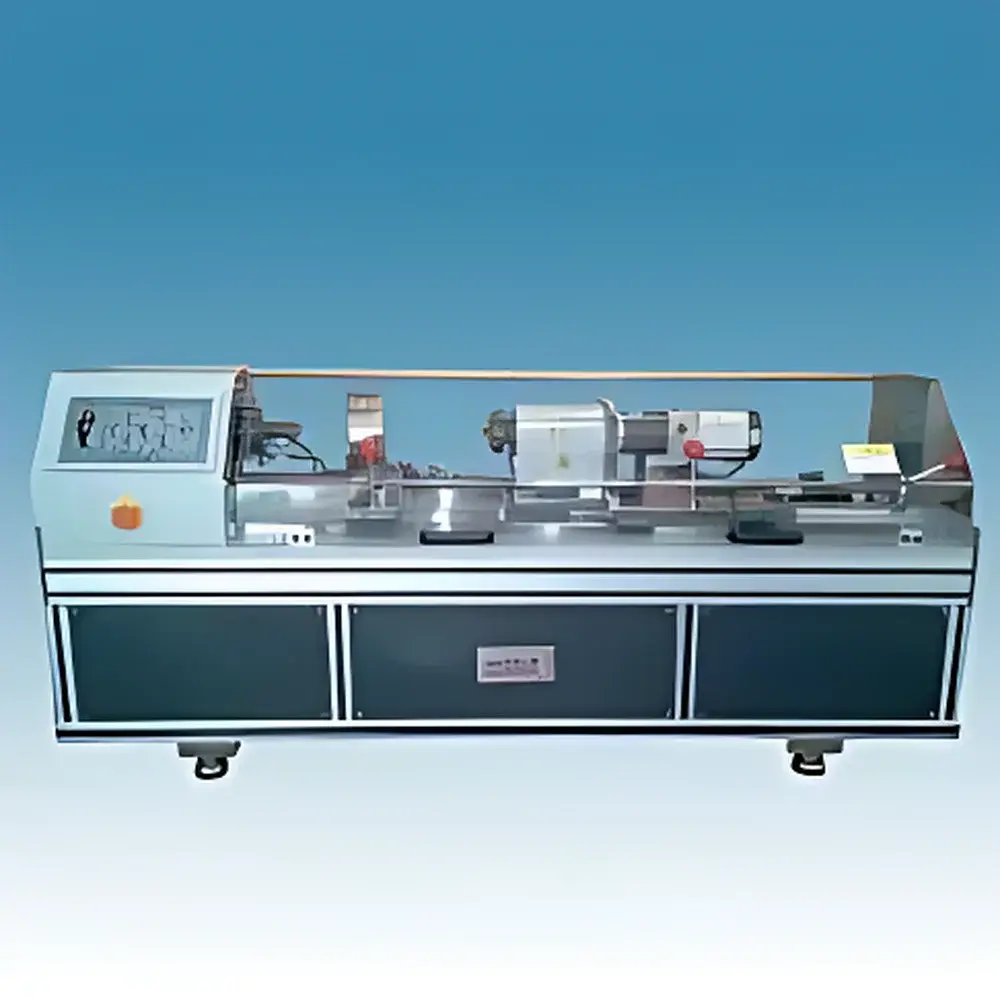
Hengyi HY-50N·m Compact Torsion Testing Machine
| Brand | Hengyi |
|---|---|
| Origin | Shanghai, China |
| Manufacturer Type | Direct Manufacturer |
| Model | HY-50N·mTYHNB |
| Max Torque | 50 N·m |
| Torque Measurement Range | 0.1–50 N·m |
| Torque Resolution | 1/500,000 FS |
| Torsion Angle Range | 0–100,000° (or continuous rotation) |
| Motor Power | 0.4 kW |
| Torque Accuracy | ±0.5% FS |
| Angular Accuracy | ±0.5% FS |
| Angular Resolution | 0.0045° |
| Rotational Speed Range | 0–1000°/min |
| Specimen Clamping Diameter | Φ1–Φ5 mm (customizable) |
| Gauge Length Adjustment | Up to 200 mm |
| Dimensions (L×W×H) | ≈1000×420×500 mm |
| Weight | 200 kg |
Overview
The Hengyi HY-50N·m Compact Torsion Testing Machine is a precision-engineered, horizontally configured electromechanical system designed for high-fidelity static and quasi-static torsional characterization of small-scale specimens in biomechanics, biomaterials research, and advanced material development. It operates on the principle of controlled angular displacement under applied torque, enabling direct quantification of shear stress–strain behavior, torsional stiffness, yield torque, ultimate torsional strength, and post-yield deformation characteristics. The machine integrates a high-resolution torque transducer (±0.5% FS accuracy), an optical encoder-based angular measurement system (0.0045° resolution), and a closed-loop servo control architecture—ensuring traceable, repeatable, and ISO/IEC 17025-aligned mechanical testing performance. Its compact footprint and modular design make it suitable for integration into university biomechanics labs, medical device R&D facilities, orthopedic implant QA/QC environments, and regulatory-compliant materials testing centers.
Key Features
- High-precision torque sensing with 1/500,000 full-scale resolution and verified ±0.5% FS linearity across the entire 0.1–50 N·m range
- Dual-channel real-time acquisition: synchronized torque vs. time, angle vs. time, torque vs. angle, and torque vs. rotational displacement waveforms
- Imported Panasonic AC servo motor with 1:2,000,000 speed regulation ratio and ±0.5% rotational speed accuracy (0–1000°/min)
- Bidirectional automatic loading capability—enabling cyclic torsion, hysteresis loop analysis, and fatigue pre-conditioning protocols
- Modular clamping system supporting cylindrical specimens from Φ1 mm to Φ5 mm; gauge length adjustable up to 200 mm (custom extensions available)
- Robust steel frame with electrostatically coated enclosure; total mass 200 kg ensures vibration-damped operation during low-torque, high-sensitivity measurements
- Embedded 32-bit ARM microprocessor controller delivering 100 Hz sampling rate, 56 MIPS processing throughput, and real-time data buffering without latency
Sample Compatibility & Compliance
This torsion tester is optimized for small-diameter, high-strength biological and synthetic specimens—including human cranial, vertebral, femoral, tibial, and phalangeal bone segments; cortical and cancellous bone cores; bioresorbable screws and pins; polymer-based orthopedic implants (e.g., PEEK, PLA, Mg alloys); and fiber-reinforced composites used in dental or spinal fixation devices. It supports specimen-specific test configurations per ASTM F543 (Standard Specification and Test Methods for Metallic Medical Bone Screws), ISO 5832-3 (Implants for surgery—Metallic materials—Titanium alloy), and ISO 14801 (Dental implants—Dynamic fatigue test method). All hardware and firmware comply with electromagnetic compatibility (EMC) directives (IEC 61326-1) and functional safety requirements for laboratory equipment (IEC 61010-1). Data integrity meets GLP/GMP documentation standards with optional audit-trail-enabled software modules compliant with FDA 21 CFR Part 11.
Software & Data Management
The proprietary Hengyi TorsionTest v4.x software suite runs natively on Windows OS and provides full test sequence programming, real-time parameter visualization, and automated report generation. Users can define multi-step torsion profiles—including ramp-hold-relax cycles, stepwise torque increments, and constant-rate angular displacement—with programmable dwell times and reversal thresholds. Raw data are stored in IEEE-compliant .csv and binary .hdf5 formats, preserving timestamped metadata (torque, angle, speed, temperature if external sensor integrated). Statistical post-processing includes automatic calculation of shear modulus (G), proportional limit torque (τp), torsional yield strength, maximum torque, fracture angle, energy absorption (area under torque–angle curve), and hysteresis loss. Export options include PDF reports with embedded graphs, Excel-compatible summaries, and XML files compatible with LIMS and ELN platforms.
Applications
- Biomechanical evaluation of native and osteoporotic bone torsional strength and ductility
- Validation of screw-bone interface stability under torsional load (e.g., pedicle screw pullout resistance simulation)
- Comparative assessment of biodegradable implant degradation kinetics via longitudinal torsional property tracking
- Quality control of micro-machined metallic stents and nitinol-based orthodontic wires
- Fundamental research on viscoelastic torsional response of hydrogels and soft tissue analogs
- ISO/ASTM-compliant certification testing for Class II and III orthopedic devices prior to regulatory submission
FAQ
What is the minimum measurable torque and its corresponding resolution?
Minimum measurable torque is 0.1 N·m, with effective resolution of 0.0001 N·m (1/500,000 of 50 N·m full scale).
Can the system perform continuous rotation beyond 100,000°?
Yes—the angular encoder supports unlimited rotation; the 100,000° specification reflects default display range, not mechanical limitation.
Is calibration traceable to national metrology institutes?
All torque sensors are factory-calibrated using NIST-traceable reference standards; optional UKAS-accredited calibration certificates available upon request.
Does the software support custom test method scripting?
Yes—TorsionTest v4.x includes a built-in script editor supporting Python-based macro definitions for non-standard protocols.
What environmental conditions are recommended for optimal performance?
Operate within 15–30°C ambient temperature, <70% RH, and on a vibration-isolated optical table or reinforced concrete floor slab.



