
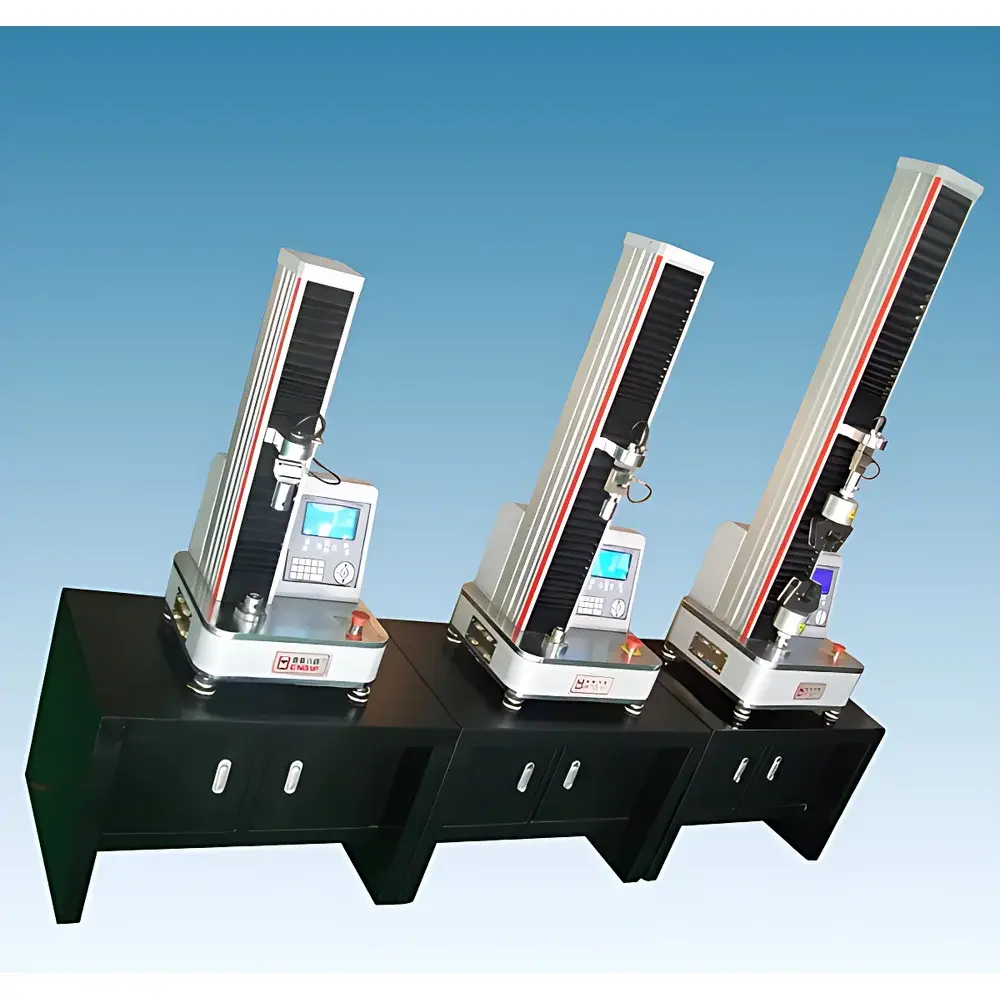
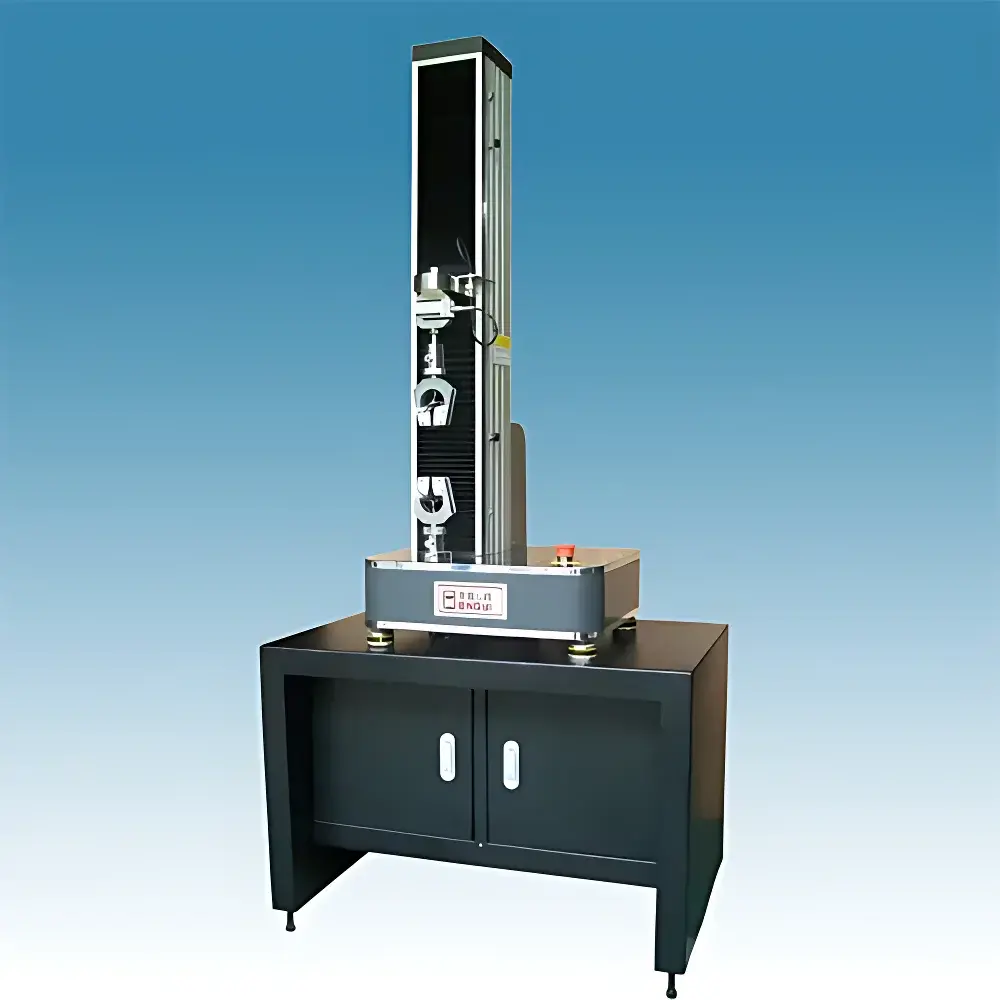
Hengyi HY-0580HJKNY Single-Column Universal Testing Machine for Thin-Film Tensile Strength Evaluation
| Brand | Hengyi |
|---|---|
| Origin | Shanghai, China |
| Manufacturer Type | Direct Manufacturer |
| Country of Origin | China |
| Model | HY-0580HJKNY |
| Instrument Type | Electromechanical Universal Testing Machine |
| Load Capacity Options | 1 N to 5000 N (interchangeable load cells) |
| Force Accuracy | ≤ ±0.5% of reading |
| Effective Test Width | 120 mm |
| Effective Vertical Travel | 800 mm |
| Speed Range | 0.001–500 mm/min (adjustable in real time) |
| Speed Accuracy | ±0.5% of set value |
| Displacement & Strain Measurement Accuracy | ±0.5% of reading |
| Force Resolution | ±500,000 counts (full-scale, no range switching) |
| Control Modes | Stress control, strain control, displacement control, constant load/strain/displacement hold |
| Safety Features | Electronic limit protection, overload auto-stop (>110% FS), self-diagnostic system for drive/sensor faults |
| Power Supply | 220 V AC, 750 W |
| Dimensions (W×D×H) | 470 × 400 × 1510 mm |
| Weight | 120 kg |
Overview
The Hengyi HY-0580HJKNY is a single-column electromechanical universal testing machine engineered for high-precision tensile strength evaluation of thin-film materials—including polymeric films, protective adhesives, semiconductor wafer dicing tapes, automotive surface protection membranes, and flexible electronics substrates. It operates on the principle of controlled uniaxial force application with real-time measurement of load, displacement, and strain—enabling quantitative determination of mechanical properties such as ultimate tensile strength (UTS), yield strength, elongation at break, modulus of elasticity, and Poisson’s ratio. Its rigid yet compact frame architecture ensures minimal deflection during loading, supporting reproducible results across low-force regimes (down to 1 N) and higher-capacity configurations (up to 5000 N). Designed for compliance with international static mechanical testing standards, it serves as a core instrument in quality assurance laboratories, R&D centers, and academic materials science departments where traceability, repeatability, and regulatory alignment are critical.
Key Features
- High-resolution force measurement system with ±500,000 internal counts and no range switching—ensuring consistent resolution across the full 0.1%–99.9999% of full scale.
- Wide dynamic speed range (0.001–500 mm/min), calibrated to ±0.5% accuracy, enabling both quasi-static creep tests and rapid tensile failure characterization.
- Multi-mode closed-loop control: stress rate (0.005–6% FS/s), strain rate (0.002–6% FS/s), and displacement rate—with automatic transition between control modes during test sequences.
- Integrated electronic limit switches and real-time overload detection (>110% FS) provide hardware-level safety redundancy beyond software-based thresholds.
- Modular load cell interface supports seamless interchange of transducers from 1 N to 5000 N—allowing one platform to serve diverse material classes without recalibration overhead.
- Self-diagnostic firmware continuously monitors motor current, encoder feedback, amplifier output, and sensor excitation—logging anomalies and triggering protective shutdown before mechanical damage occurs.
- Ergonomic manual and programmable return functions, including high-speed return to home position and post-test auto-reset, reduce operator intervention and improve throughput.
Sample Compatibility & Compliance
The HY-0580HJKNY accommodates specimens ranging from micro-thin polymer foils (<10 µm) to thicker laminated composites (≤3 mm), using customizable grips—including pneumatic film clamps, wedge-action jaws, and peel/adhesion fixtures. Its 120 mm effective test width and 800 mm vertical travel support standardized dumbbell-shaped, dog-bone, and strip geometries per ISO 527, ASTM D882, GB/T 1040, and JIS K7127. The system meets the metrological requirements of GB/T 2611-2007 (General Technical Requirements for Testing Machines), GB/T 16491-2008 (Electronic Universal Testing Machines), and GB/T 16852.1-2008 (Verification of Static Uniaxial Testing Machines). Calibration certificates are traceable to national standards (CNAS-accredited), and optional audit-ready configuration supports GLP/GMP environments—including user access levels, electronic signatures, and 21 CFR Part 11-compliant data integrity features when paired with validated software modules.
Software & Data Management
The embedded Windows-based control software provides intuitive test method setup, real-time curve plotting (load vs. displacement, stress vs. strain), and automated report generation in PDF or Excel formats. Users may define multi-step protocols—including preload conditioning, ramp-hold cycles, cyclic loading, and fracture energy integration—with conditional branching logic (e.g., stop on yield point detection or 5% strain threshold). Raw data files are stored in ASCII-delimited format with full metadata (operator ID, timestamp, environmental conditions, calibration history). Optional networked deployment enables centralized data archiving via SQL database integration, version-controlled method libraries, and remote monitoring through secure HTTPS endpoints. All software modifications undergo formal change control procedures aligned with ISO/IEC 17025 Clause 5.9.
Applications
- Quantitative evaluation of tensile performance in optical display films, battery separator membranes, and medical packaging laminates.
- Adhesion strength assessment of temporary bonding tapes used in semiconductor wafer dicing and grinding processes.
- Mechanical screening of biodegradable packaging films under variable humidity and temperature preconditioning.
- Quality conformance testing for automotive interior trim protection films per OEM-specific specifications (e.g., Ford WSS-M99P1111-A, GMW14872).
- Research-grade characterization of nanocomposite thin films, including strain-dependent conductivity transitions and interfacial delamination onset.
- Validation of accelerated aging effects on elastomeric protective coatings via sequential tensile cycling under UV exposure.
FAQ
What load cell options are available for the HY-0580HJKNY?
Standard configurations include interchangeable load cells rated at 1 N, 5 N, 10 N, 20 N, 50 N, 100 N, 200 N, 500 N, 1000 N, 2000 N, 3000 N, and 5000 N—each certified to ISO 376 Class 0.5 accuracy.
Does the system support ASTM D882 testing for thin plastic films?
Yes—the machine’s force resolution, speed control fidelity, and grip alignment meet all dimensional and procedural requirements specified in ASTM D882-22, including specimen width tolerance (±0.1 mm), gauge length accuracy (±0.2 mm), and crosshead speed verification protocol.
Can test data be exported for statistical process control (SPC) analysis?
Absolutely—raw data exports include timestamped force, displacement, and strain values at user-defined sampling intervals (minimum 100 Hz), compatible with Minitab, JMP, and Python-based SPC libraries.
Is third-party calibration and certification available?
Yes—Hengyi partners with CNAS-accredited metrology labs to deliver on-site calibration services with uncertainty budgets, NIST-traceable certificates, and ISO/IEC 17025-compliant documentation.
How is software validation handled for regulated industries?
A formal IQ/OQ/PQ protocol package is available upon request, including installation qualification checklists, operational verification scripts, performance testing against reference standards, and 21 CFR Part 11 readiness assessment reports.



