
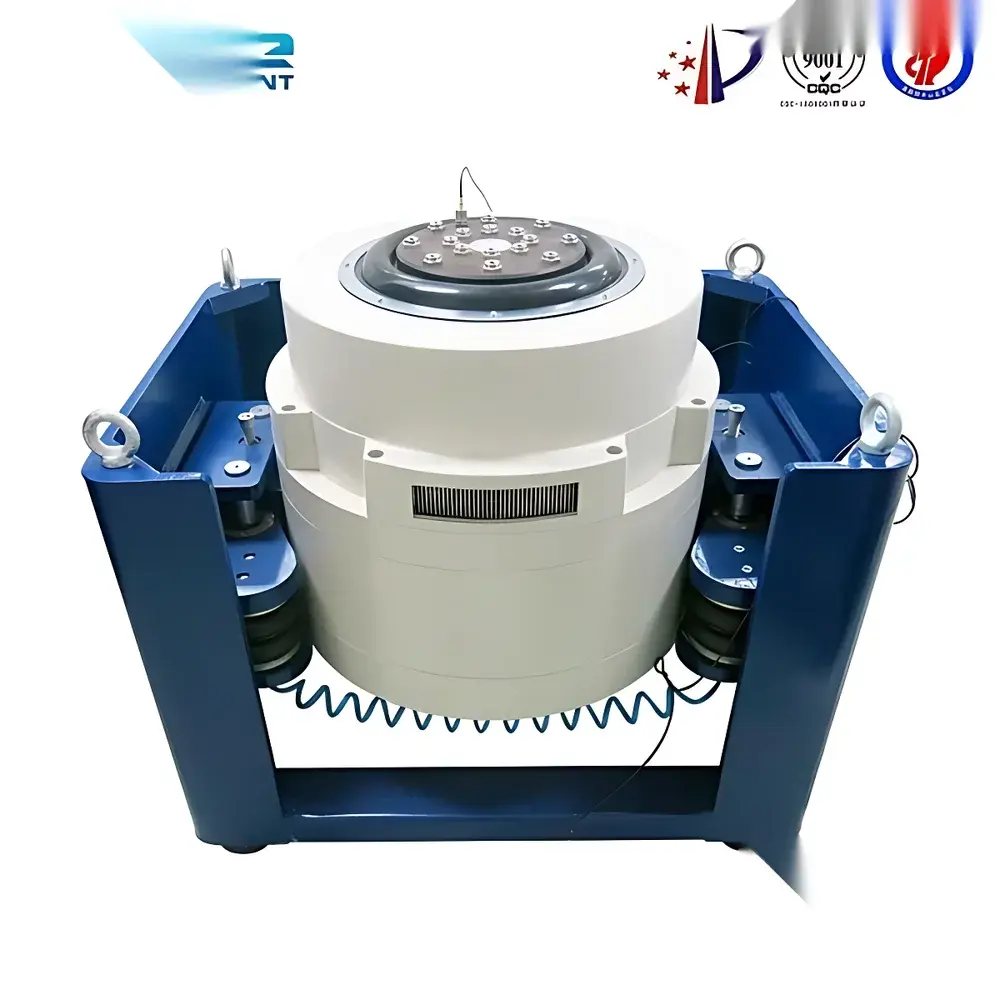
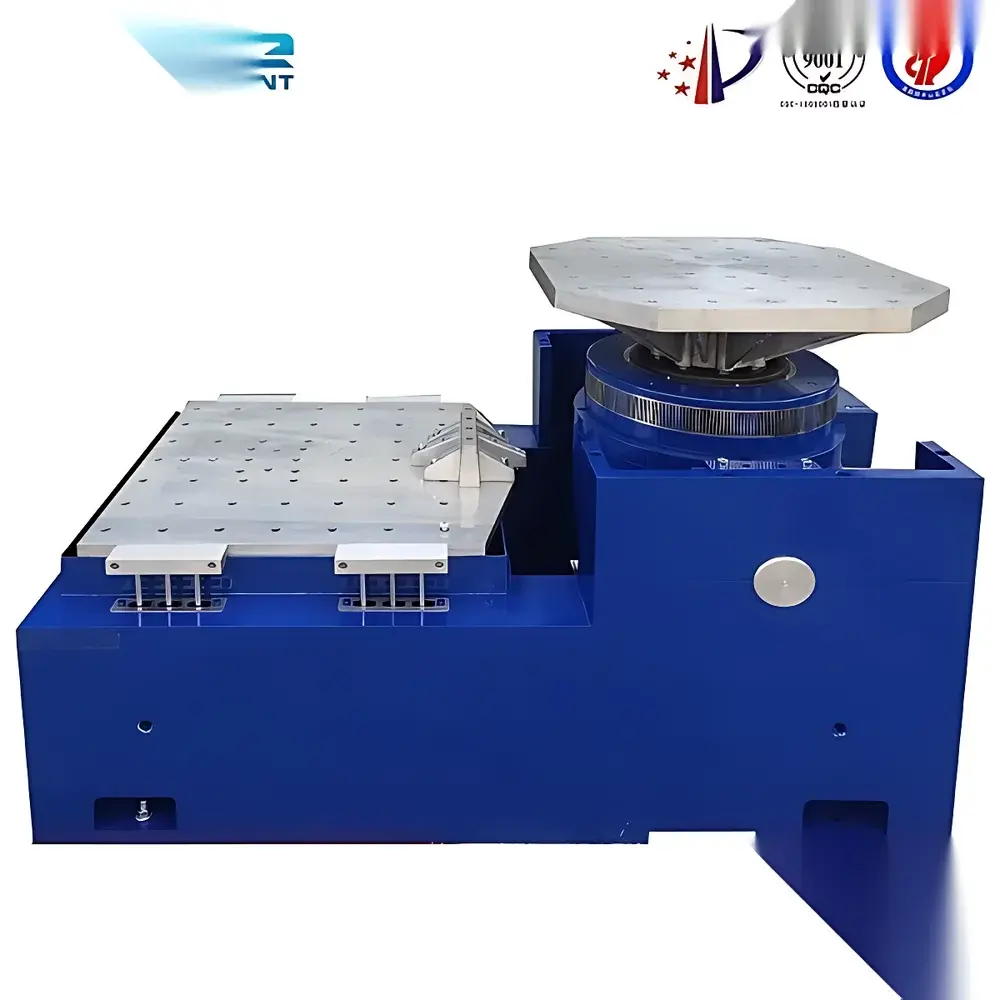
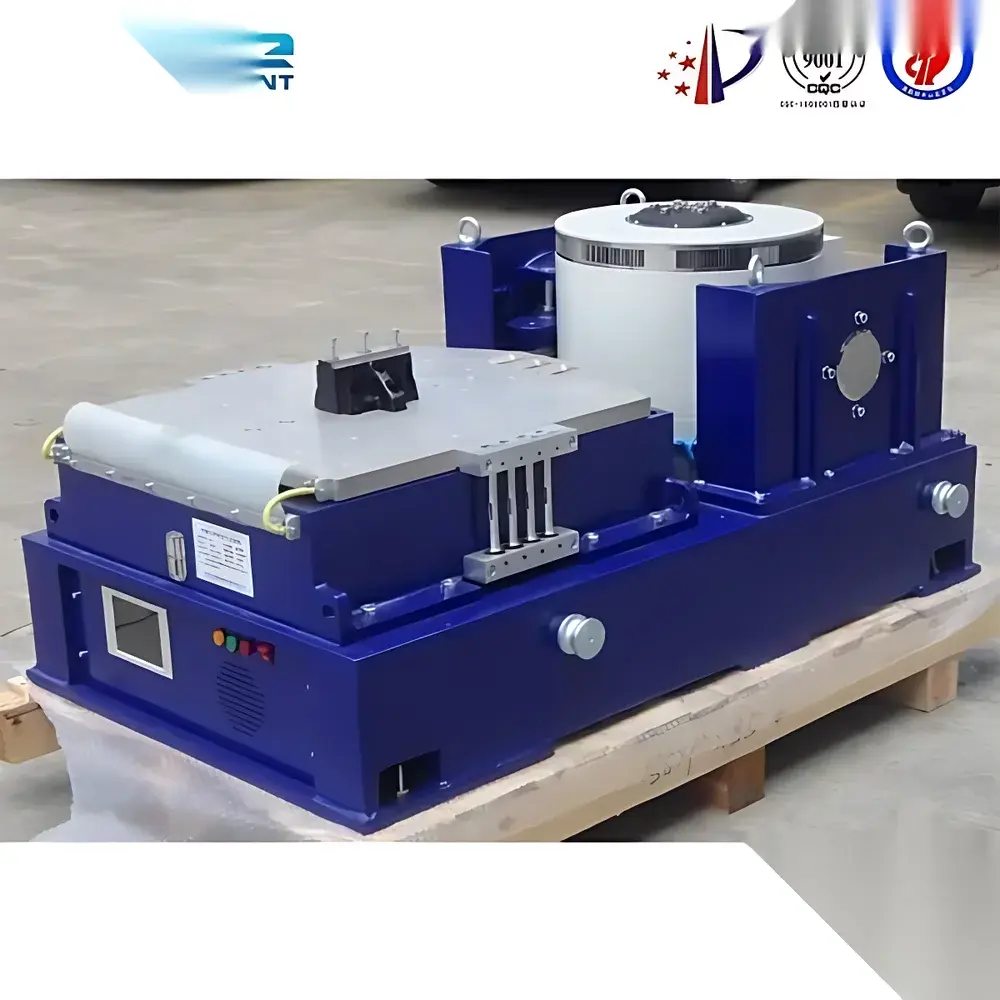
OK-ES-200 Electromagnetic Sinusoidal Vibration Shaker System
| Key Features | Frequency Range: 5–60 Hz |
|---|---|
| Frequency Resolution | 0.01 Hz |
| Frequency Accuracy | ±0.1 Hz |
| Peak-to-Peak Displacement | 0–5 mm |
| Maximum Acceleration | 20 g |
| Test Table Dimensions | 1100 × 800 mm |
| Dual-Axis Vibration | Vertical + Horizontal |
| Rated Load Capacity | 100 kg |
| Drive Power | 7.5 kW |
| Waveform | Pure Sinusoidal |
| Control Modes | Programmable (30-segment), Sweep (up/down/loop), Logarithmic, Octave |
| Time Setting Resolution | 1 s |
| Input Voltage | 380 V ±10% |
| Overall Dimensions (L×H×W) | 1100 × 800 × 60 mm |
| Compliance | IEC 60068-2-6, MIL-STD-810H, ASTM D999, JIS Z 8701, ISO 2041 |
Overview
The OK-ES-200 Electromagnetic Sinusoidal Vibration Shaker System is a dual-axis (vertical + horizontal), servo-controlled electromagnetic vibration test platform engineered for precision sinusoidal excitation across the 5–60 Hz frequency band. It operates on the principle of Lorentz-force actuation, where coil current in a magnetic field generates controlled inertial force to drive the test table. Designed for laboratory and production-line qualification testing, this system delivers high-fidelity sine wave motion with programmable amplitude, frequency, duration, and directional orientation—enabling rigorous mechanical stress evaluation of components and assemblies under standardized environmental simulation conditions. Its robust architecture supports full compliance with international vibration test standards including IEC 60068-2-6 (sinusoidal vibration), MIL-STD-810H Method 514.8, ASTM D999 (shipping container vibration), and JIS Z 8701. The system is optimized for repeatable, traceable, and auditable test execution in GLP- and GMP-aligned quality environments.
Key Features
- Dual-axis electromagnetic shaker with independent vertical and horizontal excitation capability for multi-directional mechanical stress profiling.
- High-resolution frequency control (0.01 Hz resolution, ±0.1 Hz accuracy) across 5–60 Hz range, enabling precise resonance tracking and modal analysis support.
- Programmable waveform generation: 30-segment time-frequency profiles with user-defined dwell, sweep rate, and loop count; logarithmic and octave-based sweep modes included.
- Adjustable peak-to-peak displacement (0–5 mm) and acceleration output (up to 20 g), calibrated per ISO 10816-3 and verified via traceable accelerometer calibration protocols.
- Integrated air-spring isolation system eliminates need for reinforced concrete foundation; reduces structure-borne transmission by >92% at operating frequencies.
- Self-diagnostic firmware with real-time fault logging, thermal monitoring, and interlocked safety shutdown (over-temperature, over-current, over-displacement).
- Modular controller interface compatible with industry-standard vibration controllers (e.g., Vibration Research VR9500, Data Physics Quattro, m+p VibControl) via IEEE 1451.4 TEDS-compliant analog/digital I/O.
Sample Compatibility & Compliance
The OK-ES-200 accommodates test specimens up to 100 kg on its rigid 1100 × 800 mm aluminum honeycomb table, supporting fixtures with M8 and M10 threaded mounting patterns. Its low-profile design (60 mm height) enables integration into climate chambers and EMI-shielded enclosures. All operational parameters—including acceleration profile, dwell time, sweep direction, and axis selection—are fully configurable to meet test plan requirements defined in IEC 60068-2-6, MIL-STD-810H Annex G, ASTM D4728 (random vibration equivalence), and JIS C 0040. The system’s data acquisition path complies with FDA 21 CFR Part 11 requirements when paired with validated software, supporting electronic signatures, audit trails, and secure data archiving. Calibration certificates are issued per ISO/IEC 17025-accredited procedures, with annual recalibration intervals recommended.
Software & Data Management
The system interfaces with PC-based vibration control software supporting real-time closed-loop control, spectral analysis (FFT), and waveform synthesis. Software modules include automated test sequencing, pass/fail threshold mapping against reference spectra, and export to CSV, UFF58, or MATLAB .mat formats. All test logs—including setpoints, actual measured responses, alarm events, and hardware status—retain timestamps synchronized to UTC and are stored in encrypted SQLite databases. Audit trail functionality records operator ID, parameter changes, and session start/stop times—fully compliant with GLP and ISO 17025 documentation requirements. Remote monitoring via Ethernet (TCP/IP) enables integration into centralized lab management systems (LIMS) without proprietary middleware.
Applications
- Aerospace component qualification per DO-160 Section 8 (vibration) and MIL-STD-810H Method 514.8 for avionics, sensors, and structural subassemblies.
- Automotive ECUs, infotainment modules, and battery packs subjected to road-simulation spectra per ISO 16750-3 and SAE J1211.
- Consumer electronics durability validation—including smartphones, wearables, and home appliances—against transport-induced resonance per ISTA 3A and ASTM D4169.
- Medical device packaging integrity assessment per ISO 11607-2, simulating distribution vibration profiles for sterile barrier systems.
- Research-grade modal analysis of printed circuit board (PCB) assemblies using swept-sine excitation to identify natural frequencies and damping ratios.
FAQ
What standards does the OK-ES-200 comply with for sinusoidal vibration testing?
It meets IEC 60068-2-6, MIL-STD-810H Method 514.8, ASTM D999, JIS Z 8701, and ISO 2041 for sinusoidal vibration profile generation and execution.
Can the system perform combined environmental tests (e.g., vibration + temperature)?
Yes—its compact footprint and low heat dissipation allow integration with walk-in environmental chambers via custom mounting adapters and signal feedthroughs.
Is the shaker suitable for lightweight microelectronics (<1 kg) requiring high-frequency resolution?
While optimized for 5–60 Hz, its 0.01 Hz frequency resolution and sub-micron displacement control enable precise low-amplitude resonance studies on small PCBs and MEMS devices.
How is system calibration maintained and documented?
Calibration follows ISO/IEC 17025 procedures using NIST-traceable accelerometers and laser vibrometers; certificates include uncertainty budgets and are valid for 12 months.
Does the controller support remote operation and test automation?
Yes—Ethernet-enabled control supports SCPI command sets, Python API integration, and scheduled unattended test runs with email/SNMP alerting on completion or fault.



