
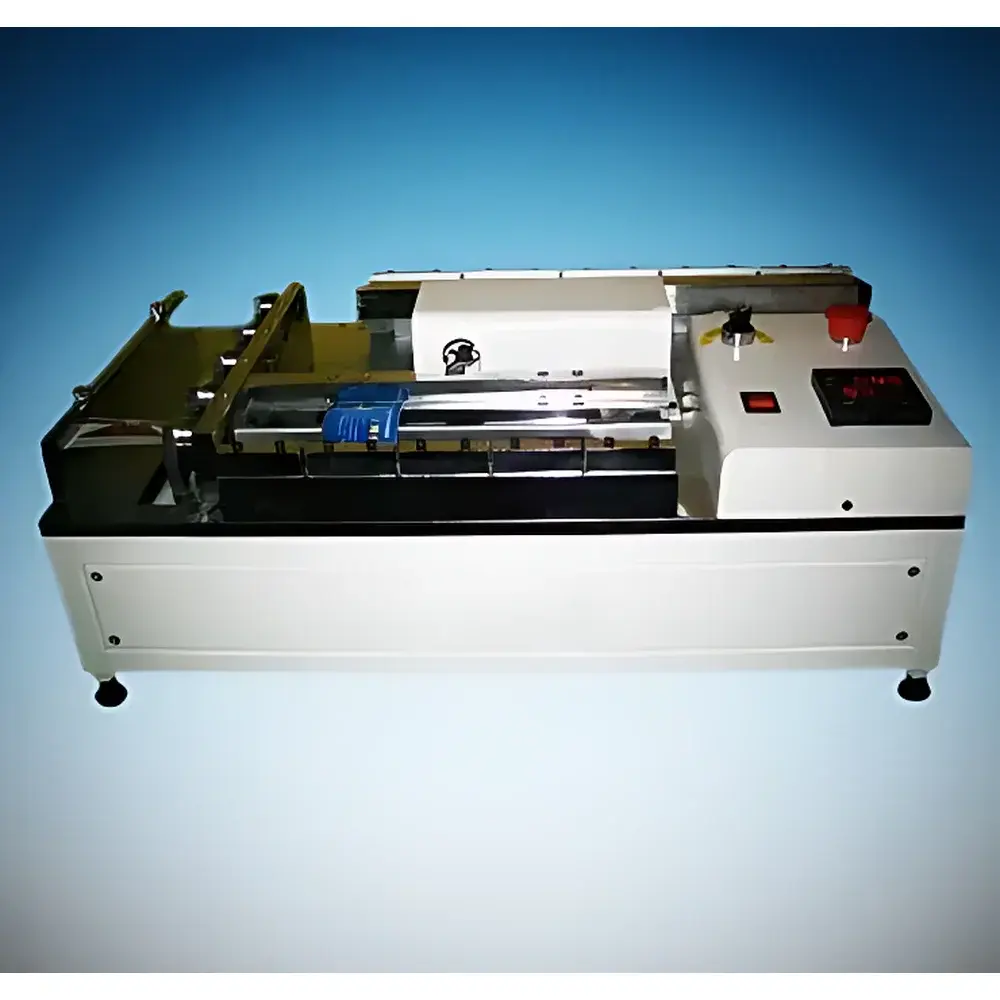
Hengyi HY(IC) Intelligent Smart Card Dynamic Dual Bending and Torsion Tester
| Brand | Hengyi / Hengyitest |
|---|---|
| Origin | Shanghai, China |
| Manufacturer Type | Direct Manufacturer |
| Country of Origin | China |
| Model | HY(IC) |
| Pricing | Upon Request |
| Dimensions (L×W×H) | 670 × 380 × 220 mm |
| Weight | 70 kg |
| Power Supply | AC 220 V ±5% |
| Power Consumption | 35 W |
| Test Speed | Bending & Torsion: 30 rpm / 0.5 Hz |
| Cycle Count Range | 1–9999 cycles |
| Torsion Angle | ±15° ±1° (bidirectional, d = 86 mm |
| total angular displacement | 30°) |
| Long-Edge Displacement | Max 20 mm (0/−1 mm), Min 2 mm ±0.50 mm |
| Short-Edge Displacement | Max 10 mm (0/−1 mm), Min 1 mm ±0.50 mm |
| Fixture Mounting | Compliant with ISO/IEC 7816-1:1998 and GB/T 16649.1 |
| Counting Method | Non-contact optical encoder (replacing mechanical switch-based counting) |
| Test Stations | 15 stations (5 long-edge bending, 5 short-edge bending, 5 torsion) |
Overview
The Hengyi HY(IC) Intelligent Smart Card Dynamic Dual Bending and Torsion Tester is an electromechanical test system engineered for precision evaluation of mechanical durability in contactless and contact smart cards under repetitive flexural and torsional stress. It operates on a deterministic kinematic principle: controlled cyclic motion is delivered via a high-fidelity AC speed-regulated motor coupled with a precision gear reduction train, enabling repeatable angular displacement and linear deflection at defined frequencies (0.5 Hz or 30 rpm). The instrument implements dual-axis mechanical stimulation—simultaneous or independent bending along card long/short edges and torsional twisting about the card’s central vertical axis—to replicate real-world handling fatigue experienced during insertion, removal, pocket friction, and transit use. Designed specifically for conformance testing against ISO/IEC 7816-1:1998, ISO/IEC 10373-1, GB/T 16649.1, and GB/T 17554.1–2006, the HY(IC) supports standardized physical reliability validation for EMV-compliant payment cards, transit fare media, e-health ID cards, and secure authentication tokens.
Key Features
- Fifteen independent test stations: five configured for long-edge bending, five for short-edge bending, and five dedicated to torsional deformation—enabling parallel multi-condition evaluation within a single test run.
- Non-contact optical encoder-based cycle counting system ensures metrological integrity and eliminates mechanical wear-related failure modes inherent in legacy switch-based counters; fault rate reduced to near-zero over extended operation.
- Programmable displacement control: long-edge bending range 2–20 mm (±0.50 mm resolution), short-edge bending 1–10 mm (±0.50 mm), and bidirectional torsion ±15° (±1° accuracy) with fixed 86 mm twist diameter.
- Stable low-power actuation architecture: 35 W nominal consumption, AC 220 V ±5% input, integrated STK motor control and high-ratio gear reduction for consistent torque delivery across 1–9999-cycle test protocols.
- Fixture geometry fully compliant with ISO/IEC 7816-1 Annex A and GB/T 16649.1 dimensional tolerances—ensuring direct comparability of results across accredited laboratories and global certification bodies.
Sample Compatibility & Compliance
The HY(IC) accommodates standard ISO/IEC 7816-form factor cards (85.6 × 53.98 × 0.76 mm) including magnetic stripe cards, contact IC cards (e.g., SIM-style chips), contactless RFID cards (13.56 MHz), and hybrid dual-interface cards. Its mechanical interface supports both rigid PVC and flexible PET substrates. All test profiles align with mandatory clauses in ISO/IEC 10373-1 (Clause 7: Mechanical Strength Tests), ISO/IEC 7816-1 (Annex A: Bending and Twisting Requirements), and Chinese national standards GB/T 16649.1 and GB/T 17554.1–2006. The system meets GLP-aligned operational traceability requirements when used with documented test protocols and calibrated fixtures—suitable for regulatory submissions requiring evidence of mechanical robustness per EN 1546-2 or EMVCo Physical Characteristics v4.3.
Software & Data Management
While the HY(IC) operates as a hardware-controlled standalone tester (no embedded OS or touchscreen), it integrates seamlessly into laboratory data workflows via external logging. Cycle count, elapsed time, and actuator status are output through TTL-level digital signals compatible with third-party DAQ systems (e.g., National Instruments USB-6009, Keysight 34972A). Optional RS-232 or USB-to-serial adapters enable connection to LIMS or custom Python/Matlab scripts for automated pass/fail reporting. All mechanical parameters—including displacement limits, torsion angle, and station-specific activation—are set manually via front-panel controls and retained across power cycles. For audit readiness, users are advised to pair the instrument with timestamped video recording and periodic calibration verification per ISO/IEC 17025 Clause 6.5.
Applications
This tester serves quality assurance labs, R&D departments, and certification bodies engaged in smart card qualification across multiple sectors: public transport authorities validating fare card longevity; medical device manufacturers verifying patient ID card integrity under hospital handling conditions; financial institutions assessing EMV chip card survivability in ATMs and POS terminals; and academic researchers studying polymer substrate fatigue mechanisms in thin-film electronics. Its 15-station architecture significantly reduces throughput time for comparative studies—e.g., evaluating thermal aging effects on PVC vs. polycarbonate card bodies—or accelerated life testing for new NFC antenna embedding processes.
FAQ
Does the HY(IC) support automated data export to CSV or Excel?
No native file export capability is built-in; however, cycle completion signals can be captured by external DAQ hardware and parsed into spreadsheet formats using standard scripting tools.
Is calibration certification included with shipment?
Factory calibration documentation (displacement and angle verification against traceable gauges) is provided; full ISO/IEC 17025 calibration requires engagement with an accredited third-party lab.
Can the instrument test non-standard card sizes?
Only ISO/IEC 7816-compliant dimensions are supported; custom fixture sets for nonstandard formats are available upon engineering consultation.
What maintenance intervals are recommended?
Gear lubrication and optical sensor cleaning every 6 months; motor and encoder performance verification annually—detailed procedures are included in the English-language operator manual.
Is the HY(IC) compliant with FDA 21 CFR Part 11 for electronic records?
As a non-networked, non-software-driven device, it does not fall under Part 11 scope; however, when integrated into validated systems with audit-trail-capable DAQ software, it may contribute to Part 11–compliant workflows.
Related Products



