
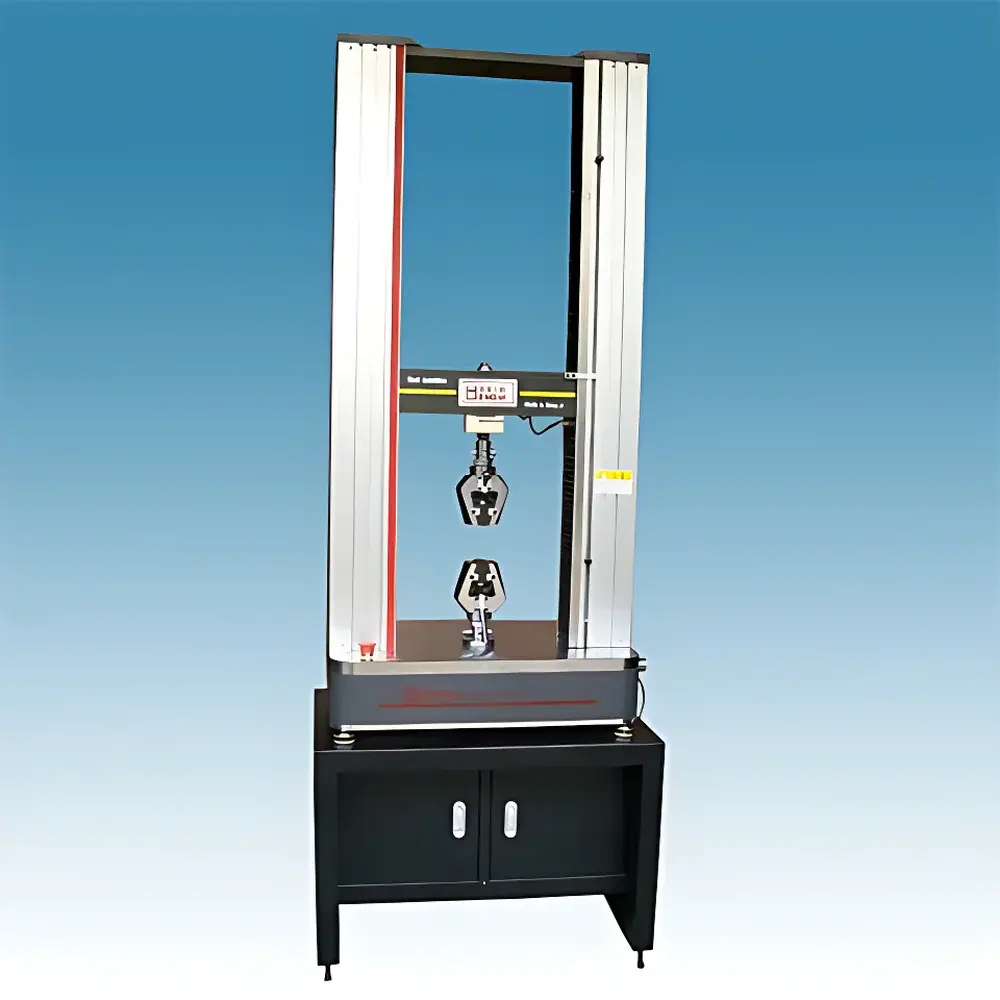
Hengyi HY-1080N Universal Testing Machine for Fiber Elastic Modulus Measurement
| Brand | Hengyi |
|---|---|
| Origin | Shanghai, China |
| Manufacturer Type | Direct Manufacturer |
| Product Category | Domestic |
| Model | HY-1080N |
| Instrument Type | Electromechanical Universal Testing Machine |
| Load Capacity Options | 1 N to 10 kN (multi-range selectable) |
| Accuracy Class | ≤0.5% |
| Effective Test Width | 380 mm (expandable) |
| Effective Stroke | 800 mm (extendable) |
| Speed Range | 0.001–500 mm/min |
| Speed Accuracy | ±0.5% of indicated value |
| Force Resolution | ±500,000 counts (full-scale, no range switching) |
| Displacement & Strain Accuracy | ±0.5% of indicated value |
| Stress/Strain Control Range | 0.002–6% FS/S |
| Power Supply | 220 V AC, 750 W |
| Host Weight | 180 kg |
| Dimensions (W×D×H) | 700 × 420 × 1510 mm |
Overview
The Hengyi HY-1080N is a high-precision electromechanical universal testing machine engineered for static mechanical characterization of low-to-medium force materials—particularly engineered fibers, filaments, thin wires, and quasi-one-dimensional biomaterials—where accurate determination of tensile elastic modulus (Young’s modulus, E) is critical. Based on the fundamental principle of uniaxial quasi-static loading under controlled displacement or force, the system applies calibrated axial tension or compression while synchronously measuring load, displacement, and optional strain via extensometry. Its dual-column rigid frame architecture ensures minimal frame compliance (<0.05% of total deformation at full scale), enabling reliable extraction of linear-elastic region slope from stress–strain curves per ASTM D3822, ISO 527-3, and USP . Designed for laboratories requiring traceable, repeatable modulus data across diverse nonmetallic specimens—including synthetic fibers (e.g., aramid, carbon, PBO), natural fibers (e.g., silk, flax, hemp), medical sutures, microfilaments, and photovoltaic interconnect ribbons—the HY-1080N delivers metrological integrity compliant with ISO/IEC 17025 requirements for mechanical testing laboratories.
Key Features
- Rigid dual-column steel frame with preloaded high-precision ground ball screws (dual-screw drive), minimizing deflection and ensuring axial alignment stability during sub-newton to kilonewton testing.
- Japan Panasonic AC servo motor and digital driver system—maintenance-free, high-torque, low-noise operation with closed-loop position and speed control.
- U.S.-sourced bidirectional load cell with automatic transducer recognition and integrated temperature compensation; rated accuracy ≤±0.5% of full scale, resolution up to 1:500,000 internal counts.
- Digital controller supporting open-loop and closed-loop modes (force, displacement, strain, stress rate, strain rate), with multi-language UI (English, German, French, Spanish, Chinese) and SI/imperial unit conversion.
- Handheld remote control for rapid jog operation, emergency stop, and real-time parameter adjustment without PC dependency.
- Integrated safety architecture: electronic travel limits, overload protection (110% FS cutoff), auto-diagnostic self-check at power-on and during test execution (monitoring drive voltage, current, sensor signal integrity).
Sample Compatibility & Compliance
The HY-1080N accommodates specimens ranging from ultra-fine monofilaments (diameter ≥10 µm) to composite laminates and biomedical devices. Standard fixtures include pneumatic fiber grips, wedge-action tensile clamps, and low-force compression platens optimized for brittle or compliant fibers. Optional accessories extend capability: video extensometers for non-contact strain measurement (ASTM E83 Class B2), clip-on mechanical extensometers (for metals per ASTM E8/E220), and custom jaw geometries for irregular cross-sections (e.g., braided cords, hollow tubes). All configurations support GLP-compliant documentation workflows. The system meets mechanical safety standards IEC 61000-6-2/6-4 and is compatible with third-party calibration services traceable to NIM (China) or NIST (USA). Optional factory-issued Shanghai Institute of Measurement & Testing calibration certificate includes uncertainty budget per ISO/IEC 17025 Annex A.
Software & Data Management
The bundled HengyiTest software (v4.2+) provides ISO 17025-aligned test method definition, real-time curve overlay, automated modulus calculation (tangent, secant, chord methods per ASTM D882), and batch report generation in PDF/Excel formats. Raw data export supports .csv and .txt formats for post-processing in MATLAB, Python (NumPy/Pandas), or Minitab. Audit trail functionality logs user actions, parameter changes, and calibration events with timestamp and operator ID—fully compliant with FDA 21 CFR Part 11 requirements when deployed with Windows domain authentication and electronic signature modules. Software supports multi-user role-based access control (administrator, technician, reviewer) and encrypted database backup.
Applications
- Quantification of axial elastic modulus and breaking tenacity of high-performance fibers (e.g., Dyneema®, Vectran®, Zylon®) for aerospace and ballistic applications.
- Quality control of textile-grade polyester, nylon, and spandex filaments per ISO 2078 and GB/T 14344.
- Mechanical screening of bioresorbable sutures (polyglycolic acid, polylactic acid) under hydrated conditions using environmental chamber integration.
- Characterization of metallized polymer ribbons (e.g., solar cell interconnects) including yield onset, plastic deformation, and creep behavior at elevated temperatures.
- Validation of ASTM D3822 procedures for single-filament tensile testing, including gauge length standardization (20 mm, 50 mm, or 250 mm) and humidity-controlled conditioning per ISO 291.
- Support for academic research in soft matter physics, where precise low-force (<100 mN) modulus gradients in electrospun nanofibers require sub-micron displacement resolution.
FAQ
What is the minimum measurable force resolution for fiber modulus testing?
The system achieves force resolution of 0.002 N at 1 N capacity (0.2% FS), scalable down to 0.02 N at 10 N range—enabling reliable modulus calculation for denier-level synthetic fibers.
Can the HY-1080N comply with ISO 527-3 for plastics testing?
Yes—when equipped with standardized dumbbell or dog-bone specimen holders, adjustable gauge length fixtures, and strain measurement via clip-on extensometer, it satisfies all mechanical and procedural requirements of ISO 527-3 for thin plastic films and sheets.
Is GLP audit support available out-of-the-box?
The base configuration includes electronic signature-ready software, full audit trail, and calibration certificate traceability; formal GLP validation package (IQ/OQ/PQ protocols, URS documentation) is available as an add-on service.
How is thermal drift compensated during long-duration modulus tests?
The load cell incorporates built-in temperature sensors and real-time zero-drift correction algorithms; ambient temperature monitoring (via optional external probe) enables time-stamped thermal compensation in post-test analysis.
Does the system support cyclic loading for fatigue modulus assessment?
Yes—software-defined waveform control (sine, triangle, trapezoidal) supports displacement- or force-controlled cycling from 0.01 Hz to 5 Hz, with hysteresis loop analysis and modulus degradation tracking over 10⁴+ cycles.



