
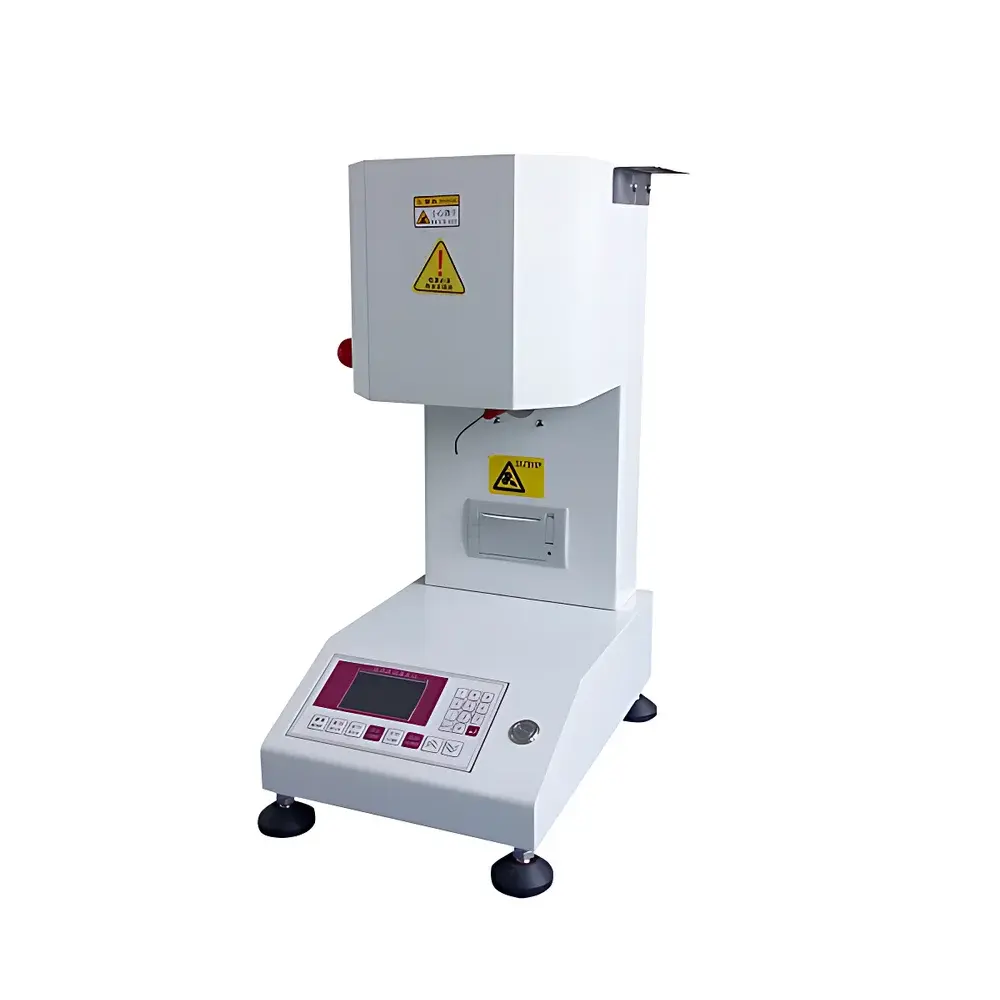
Hengyi HY(RZ)RTH Melt Flow Indexer (MFI) / Melt Flow Rate Tester
| Brand | Hengyi |
|---|---|
| Origin | Shanghai, China |
| Manufacturer Type | Direct Manufacturer |
| Region of Origin | Domestic (China) |
| Model | HY(RZ)RTH |
| Pricing | Upon Request |
| Standards Compliance | GB/T 3682–2018, JB/T 5456–2005 |
| Max Operating Temperature | ≥400 °C |
| Temperature Control Accuracy | ≤±0.2 °C |
| Temp Stabilization Time (to max temp) | ≤30 min |
| Thermal Recovery Time (post-filling) | 2–4 min |
| Timing Resolution | ≥0.1 s |
| Piston Displacement Resolution | ≥0.01 mm |
| Load Mass Options | 8-level standard weights (0.325–21.600 kg, corresponding to 3.19–211.82 N) |
| Die Dimensions | Ø2.095±0.005 mm × 8.000±0.025 mm |
| Barrel ID | Ø9.550±0.025 mm, L=152±0.1 mm |
| Piston Head | Ø9.475±0.015 mm × 6.350±0.100 mm |
| Test Methods | Mass Flow Rate (MFR) & Volume Flow Rate (MVR) |
| Control Interface | Full-color PLC touchscreen |
| Safety | Insulated high-temp components, anti-scald shielding |
| Packaging/Transport | Compliant with GB/T 13384, GB/T 191, GB/T 6388 |
Overview
The Hengyi HY(RZ)RTH Melt Flow Indexer is a precision laboratory instrument engineered for the standardized determination of melt flow rate (MFR) and melt volume rate (MVR) of thermoplastic polymers under controlled temperature and load conditions. Based on the principle of capillary rheometry—where molten polymer is extruded through a standardized die under a defined gravitational load—the system quantifies material processability, thermal stability, and molecular weight distribution proxies. Designed in strict accordance with GB/T 3682–2018 (equivalent to ISO 1133–1:2011 and ASTM D1238–22 for method A/B) and JB/T 5456–2005, the HY(RZ)RTH delivers repeatable, traceable, and auditable results essential for quality control laboratories, R&D centers, and regulatory-compliant manufacturing environments.
Key Features
- High-temperature operation up to 400 °C with ±0.2 °C digital PID temperature control, ensuring stable thermal profiles across extended test cycles.
- Dual-mode testing capability: simultaneous support for mass-based (MFR, g/10 min) and volume-based (MVR, cm³/10 min) calculations per ISO 1133–2.
- Eight-tier calibrated weight set (0.325–21.600 kg), covering all standard test loads from low-shear polyolefins to high-viscosity engineering resins—including ASTM D1238 Load Conditions 1–8.
- Full-color PLC touchscreen interface with embedded control software enabling real-time parameter configuration, auto-cut timing, temperature curve logging, and on-screen MFR/MVR result display.
- Robust mechanical architecture: hardened steel barrel (ID Ø9.550±0.025 mm, L=152±0.1 mm), precision-ground die (Ø2.095±0.005 mm × 8.000±0.025 mm), and tungsten-carbide-coated piston head (Ø9.475±0.015 mm).
- Thermal recovery optimization: <4 min return to setpoint after sample loading, minimizing cycle time without compromising thermal equilibrium.
- Integrated safety design: insulated heating zones, thermal shielding on all accessible hot surfaces, and fail-safe overtemperature cutoff.
Sample Compatibility & Compliance
The HY(RZ)RTH supports a broad spectrum of thermoplastic materials including but not limited to polyethylene (PE), polypropylene (PP), polystyrene (PS), polyoxymethylene (POM), ABS, polycarbonate (PC), nylon (PA6/PA66), and fluoropolymers (e.g., PTFE, PVDF). Its geometry and calibration meet the dimensional tolerances specified in ISO 1133–1 Annex A and ASTM D1238 Figure 1. All mechanical components conform to GB/T 3682–2018 requirements for die concentricity, barrel straightness, and piston clearance. The instrument is suitable for GLP- and GMP-aligned workflows when paired with audit-trail-enabled data export protocols and user-access-controlled software permissions.
Software & Data Management
The embedded control software provides full test lifecycle management: parameter initialization (temperature, load, cut interval), real-time temperature monitoring with graphical trend display, automatic cut-event timestamping, and dual-unit result computation (MFR and MVR). Data are stored internally with time/date stamps and can be exported via USB to CSV or PDF formats. While native software does not include 21 CFR Part 11 compliance features (e.g., electronic signatures, role-based access), the system architecture permits integration with third-party LIMS or ELN platforms via RS-232 or optional Ethernet module. Calibration logs, maintenance records, and operator entries can be manually archived to satisfy internal QA documentation requirements.
Applications
- Raw material acceptance testing for incoming polymer batches against supplier specifications.
- Process validation and in-line QC for extrusion, injection molding, and blow molding operations.
- Comparative viscosity screening during polymer formulation development (e.g., copolymer ratio optimization, additive dispersion studies).
- Thermal degradation assessment via sequential MFR measurements at fixed intervals under isothermal conditions.
- Regulatory submission support for medical-grade plastics (ISO 10993–12) and food-contact materials (FDA 21 CFR 177).
- Educational use in polymer science laboratories for teaching fundamental rheological behavior of thermoplastics.
FAQ
What international standards does the HY(RZ)RTH comply with?
It conforms to GB/T 3682–2018 (identical technical content to ISO 1133–1:2011 and ASTM D1238–22), as well as JB/T 5456–2005 for instrument performance verification.
Can the instrument perform both MFR and MVR measurements automatically?
Yes—dual-mode calculation is enabled by real-time piston displacement tracking (resolution ≥0.01 mm) combined with gravimetric collection, allowing concurrent derivation of mass and volume flow rates.
Is the die interchangeable with ISO/ASTM-standard dies from other manufacturers?
The die meets ISO 1133–1 dimensional tolerances (Ø2.095±0.005 mm, L=8.000±0.025 mm) and is fully compatible with certified reference materials and cross-laboratory intercomparisons.
What is the recommended calibration frequency?
Per GB/T 3682–2018 Clause 7.3, temperature sensors and load cells should be verified annually using NIST-traceable references; die and barrel geometry should be inspected quarterly for wear or deformation.
Does the system support automated data backup or network connectivity?
Local USB export is standard; Ethernet or Wi-Fi modules are available as optional upgrades for centralized data aggregation in multi-instrument lab environments.



