
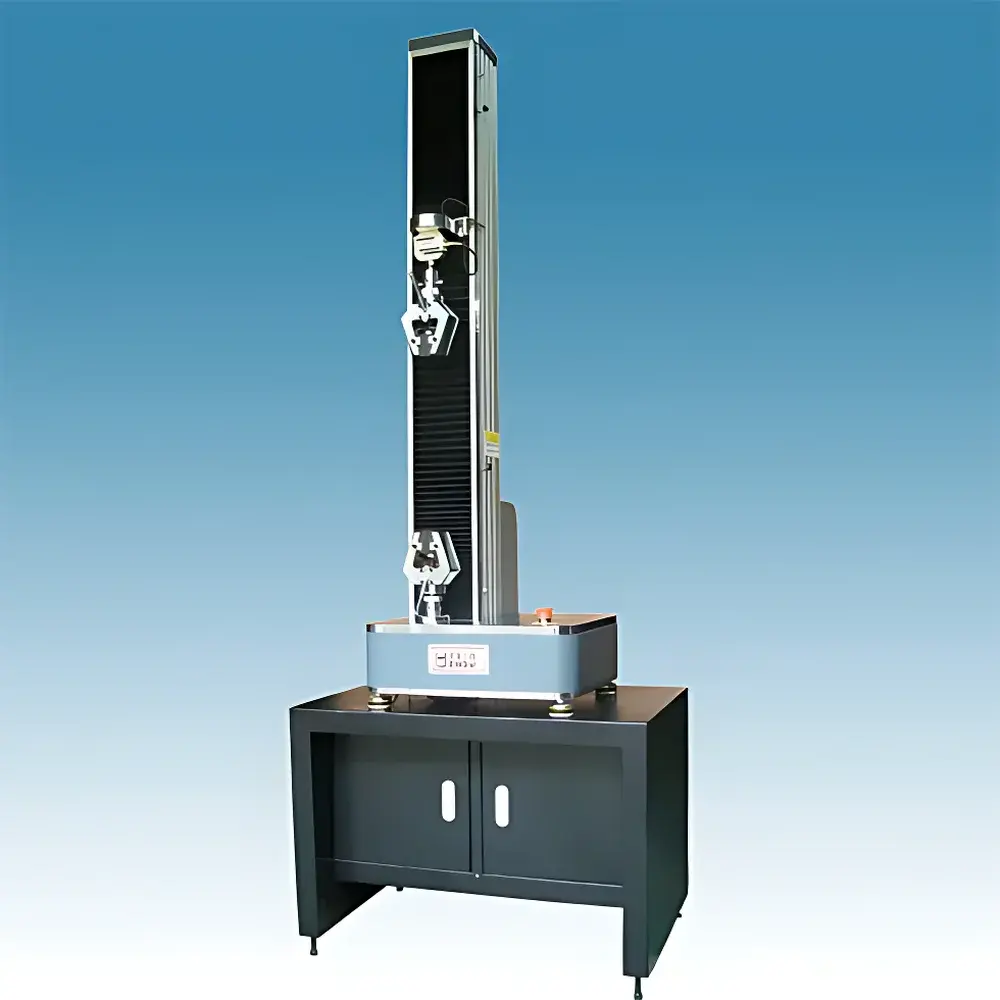
Hengyi HY-0580RTG Biomechanical Tensile Testing System for Soft Tissues
| Brand | Hengyi |
|---|---|
| Origin | Shanghai, China |
| Manufacturer Type | Direct Manufacturer |
| Country of Origin | China |
| Model | HY-0580RTG |
| Instrument Type | Electromechanical Tensile Tester |
| Max Test Load | 5 kN |
| Force Measurement Range | 0.001–100% FS |
| Force Accuracy | ±0.5% of reading |
| Travel Distance | 800 mm |
| Displacement Resolution | 0.001 mm |
| Speed Range | 0.001–500 mm/min |
| Speed Accuracy | ±0.5% of set value |
| Strain Control Range | 0.002–6% FS/s |
| Stress Control Range | 0.005–6% FS/s |
| Load Cell Options | 1 N to 5000 N (interchangeable) |
| Effective Test Width | 120 mm |
| Power Supply | 220 V AC, 50 Hz, 750 W |
| Dimensions (W×D×H) | 470 × 400 × 1510 mm |
| Weight | 95 kg |
Overview
The Hengyi HY-0580RTG Biomechanical Tensile Testing System is an electromechanical universal testing platform engineered for high-fidelity mechanical characterization of biological soft tissues and biomaterials under quasi-static and controlled-rate loading conditions. Based on a closed-loop servo-controlled load frame architecture, the system applies axial tensile, compressive, flexural, shear, and peel forces to specimens in accordance with standardized biomechanical test protocols. Its design adheres to fundamental principles of solid mechanics—namely, Hooke’s law, stress–strain constitutive modeling, and linear elastic–plastic deformation theory—enabling quantitative derivation of mechanical parameters including ultimate tensile strength (UTS), yield stress, modulus of elasticity (Young’s modulus), elongation at break, fracture toughness, and cyclic fatigue behavior. The system is calibrated to ISO 7500-1 (Class 0.5 accuracy) and supports traceable force measurement across six orders of magnitude via interchangeable precision load cells (1 N to 5 kN), ensuring consistent resolution and repeatability in heterogeneous tissue testing—from delicate vascular grafts to dense cortical bone analogs.
Key Features
- High-resolution displacement control with 0.001 mm encoder-based resolution and ±0.5% accuracy over full 800 mm travel range
- Wide dynamic speed range (0.001–500 mm/min), programmable in real time for ramp, hold, and step-load profiles
- Modular load cell architecture supporting simultaneous calibration of multiple transducers (1 N, 5 N, 10 N, 20 N, 50 N, 100 N, 200 N, 500 N, 1 kN, 2 kN, 3 kN, 5 kN)
- Dual-mode control: stress-controlled and strain-controlled loading with rate stability ≤±0.5% FS/s above 0.05% FS/s
- Integrated electronic limit switches and overload protection (110% FS cut-off) with automatic emergency stop
- Motorized crosshead with dual-speed actuation (fast jog + fine positioning) and programmable return-to-start functionality
- Real-time diagnostic monitoring of drive current, amplifier voltage, sensor signal integrity, and thermal load status
- Robust aluminum-alloy frame with vibration-damped base and rigid column alignment for sub-micron positional stability
Sample Compatibility & Compliance
The HY-0580RTG accommodates a broad spectrum of specimen geometries and material classes relevant to regulatory-grade biomedical evaluation. Standardized test configurations include ASTM D638 (tensile properties of plastics), ISO 527-2 (plastics—tensile testing), ASTM F2129 (corrosion fatigue of metallic implants), ISO 179-1 (impact resistance), and ISO 11404 (general requirements for polymeric biomaterials). It is routinely deployed for mechanical validation of FDA-submitted devices—including vascular stents, annuloplasty rings, tendon grafts, hydrogel scaffolds, decellularized tissue matrices, and orthopedic fixation components (e.g., spinal fusion cages, intramedullary nails, cortical plates). Environmental operation is certified for ambient temperatures 20–40 °C and relative humidity 20–80%, meeting ISO 17025 laboratory environmental requirements for accredited mechanical testing labs.
Software & Data Management
The system operates under Hengyi’s proprietary BioTestSuite v3.2 software—a Windows-based, audit-trail-enabled platform compliant with FDA 21 CFR Part 11 requirements for electronic records and signatures. All test sequences, calibration logs, raw sensor data (force, displacement, time), and derived metrics (stress, strain, modulus, hysteresis area) are stored in encrypted SQLite databases with timestamped user authentication. Software features include automated test method templates (ASTM/ISO preloaded), real-time curve overlay, multi-specimen statistical comparison (ANOVA-ready output), export to CSV/PDF/XLSX, and GLP-compliant report generation with digital signature fields. Calibration certificates are digitally embedded and version-controlled; all parameter changes trigger mandatory operator ID logging and reason-for-change annotation.
Applications
- Mechanical phenotyping of native and engineered soft tissues: arterial wall, myocardium, ligament, tendon, cartilage, dura mater, and corneal stroma
- Biomechanical qualification of implantable devices: synthetic vascular grafts, bioprosthetic heart valves, meniscal repair anchors, and bioresorbable screws
- Structural validation of tissue-engineered constructs: electrospun nanofibers, 3D-bioprinted scaffolds, hydrogels, and decellularized extracellular matrix sheets
- Regulatory submission support for ISO 10993-12 (sample preparation), ISO 14801 (dental implant fatigue), and ASTM F1800 (orthopedic implant wear simulation)
- Academic research in mechanobiology: stretch-activated ion channel response, collagen fiber reorientation under cyclic loading, and viscoelastic relaxation kinetics
- Quality control of medical-grade polymers: PEEK, UHMWPE, PLGA, PCL, and silicone elastomers used in Class II/III devices
FAQ
What standards does the HY-0580RTG comply with for medical device testing?
It meets ISO 7500-1 (force measurement accuracy), ISO 5893 (tensile/compression testing machines), and supports method execution per ASTM F2129, ISO 14801, and ISO 179-1.
Can the system perform cyclic fatigue tests on soft tissue specimens?
Yes—it supports programmable sinusoidal, triangular, and trapezoidal waveforms with frequency up to 5 Hz and load ratio control (R = min/max), fully compatible with ISO 14801 fatigue protocols.
Is the software validated for GxP environments?
BioTestSuite v3.2 includes 21 CFR Part 11 compliance features: electronic signatures, audit trails, role-based access control, and immutable raw data archiving.
How is force calibration maintained across different load cell ranges?
Each load cell is factory-calibrated with NIST-traceable reference standards; calibration coefficients are stored internally and auto-applied upon transducer recognition.
Does the system support third-party extensometers or video-based strain measurement?
Yes—the controller provides analog/digital I/O interfaces for integration with contactless DIC systems (e.g., Correlated Solutions VIC-2D) and LVDT/strain gauge amplifiers.



