
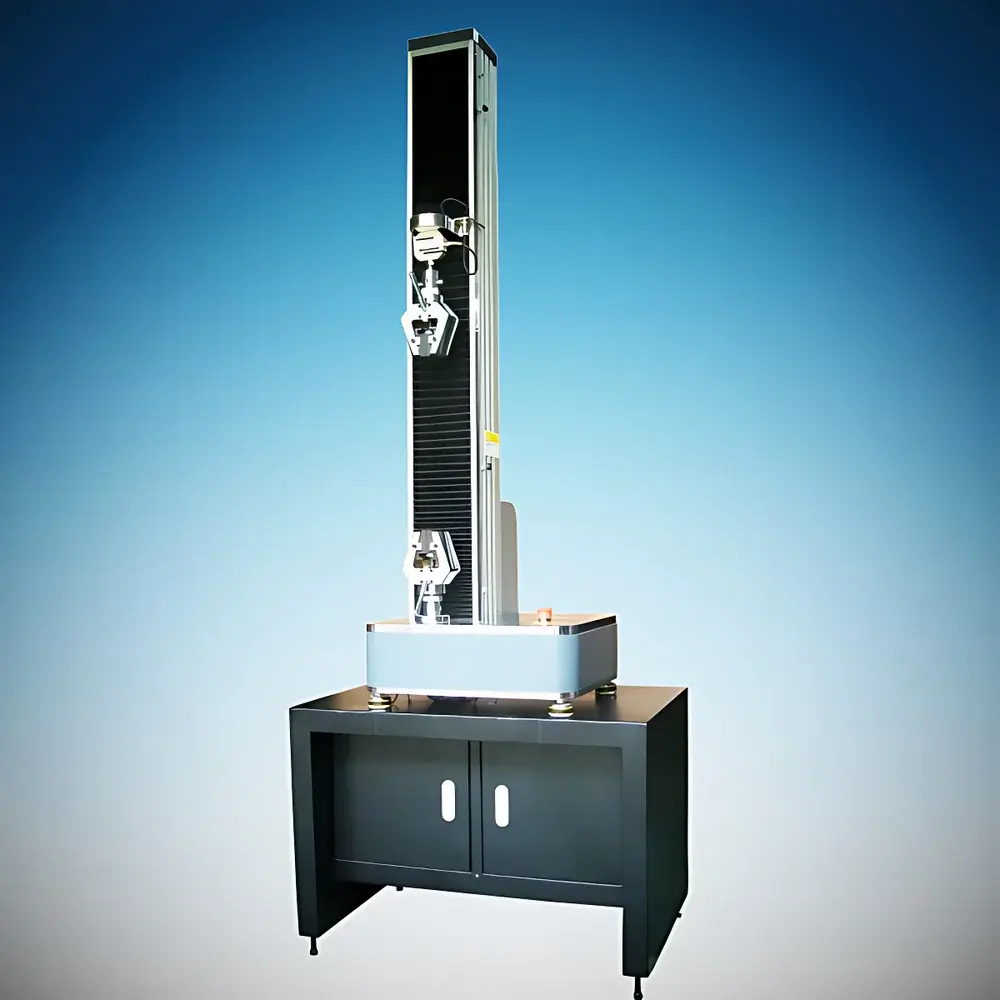
Hengyi HY-0580 Biomedical Low-Cycle Fatigue Testing Machine
| Brand | Hengyi |
|---|---|
| Origin | Shanghai, China |
| Manufacturer Type | Direct Manufacturer |
| Country of Origin | China |
| Model | HY-0580QWE |
| Instrument Type | Electromechanical Universal Testing Machine |
| Load Capacity Options | 1 N to 5000 N (interchangeable load cells) |
| Force Accuracy | ≤ ±0.5% of reading |
| Effective Test Width | 120 mm |
| Vertical Test Space | 800 mm |
| Crosshead Speed Range | 0.001–500 mm/min (programmable, ±0.5% speed accuracy) |
| Displacement & Strain Measurement Accuracy | ±0.5% of reading |
| Stress/Strain Control Resolution | 0.002–6% FS/s |
| Data Acquisition Rate | Up to 1000 Hz |
| Compliance Standards | GB/T 228.1-2010, YY/T 1504-2016, YY/T 0342-2002, YY/T 0662-2008, YY 0017-2008, GB/T 2611-2007 |
Overview
The Hengyi HY-0580 Biomedical Low-Cycle Fatigue Testing Machine is an electromechanical universal testing system engineered for high-fidelity mechanical characterization of biomaterials under static, quasi-static, and low-cycle fatigue loading conditions. Designed specifically for regulatory-compliant biomechanical evaluation in orthopedic, cardiovascular, and soft-tissue implant development, the system operates on a precision servo-controlled actuation platform with closed-loop force, displacement, and strain feedback. Its architecture supports controlled axial loading—tension, compression, bending, shear, and pull-out—across physiological and supra-physiological strain rates (0.001–500 mm/min), enabling reproducible assessment of failure initiation, hysteresis behavior, stiffness degradation, and cyclic life limits in both metallic and non-metallic implant systems. The machine adheres to fundamental metrological principles defined in ISO 7500-1 (static calibration) and ASTM E4 (force verification), ensuring traceability to national standards.
Key Features
- Modular load cell configuration supporting interchangeable sensors from 1 N to 5000 N, each certified to ≤ ±0.5% accuracy per ISO 376 Class 0.5 requirements.
- High-resolution data acquisition at up to 1000 Hz, capturing transient events during dynamic loading and unloading phases in fatigue protocols.
- Real-time closed-loop control modes: force, displacement, strain, and stress-rate, with programmable ramp-hold cycles and user-defined waveform profiles (sinusoidal, trapezoidal, block).
- Dual-speed crosshead actuation with jog functionality and electronic limit protection, ensuring operator safety and specimen integrity during setup and failure events.
- Integrated overload protection (110% full-scale), automatic emergency stop upon overtravel or system fault detection, and self-diagnostic routines for drive, sensor, and power subsystems.
- Compact footprint (470 × 400 × 1510 mm) optimized for ISO Class 7 cleanroom-adjacent lab environments; compatible with ambient temperature (20–40 °C) and relative humidity (20–80%) operational ranges.
Sample Compatibility & Compliance
The HY-0580 accommodates standardized test specimens (e.g., ASTM F2129, ISO 14801) as well as anatomically relevant constructs including cortical bone cores, cancellous bone blocks, titanium alloy screws and plates, PEEK spinal cages, hydrogel scaffolds, decellularized vascular grafts, and sutured soft-tissue interfaces. It meets essential regulatory testing requirements for preclinical submission under FDA 21 CFR Part 820, ISO 13485, and MDR Annex I (General Safety and Performance Requirements). All cited standards—including YY/T 1504-2016 (axial pull-out of bone screws), YY/T 0342-2002 (bending stiffness of osteosynthetic plates), and GB/T 228.1-2010 (tensile testing)—are implemented via validated test methods embedded in the control software. Calibration certificates are provided per ISO/IEC 17025-accredited procedures, with documented uncertainty budgets for force, displacement, and time measurements.
Software & Data Management
The system runs on Hengyi’s proprietary BioTest Suite v4.x—a Windows-based application compliant with FDA 21 CFR Part 11 for audit trail, electronic signature, and data integrity. The software supports method-driven test sequencing, real-time plotting of stress–strain, load–displacement, and hysteresis loops, and automated calculation of ASTM/ISO-defined parameters: ultimate tensile strength, yield offset (0.2%), elastic modulus, energy absorption, fatigue life (Nf), and stiffness decay rate. Raw data exports to CSV, Excel, and XML formats; all test records include metadata (operator ID, timestamp, environmental log, calibration status). Audit trails are immutable, time-stamped, and password-protected, satisfying GLP/GMP documentation requirements for device biocompatibility dossiers.
Applications
- Mechanical validation of orthopedic implants: screw pull-out resistance, plate bending fatigue, interbody cage compressive creep, and intramedullary nail torsional stability.
- Cardiovascular device testing: stent radial strength, suture retention in heart valve leaflets, and fatigue endurance of transcatheter delivery systems.
- Biomaterial qualification: tensile fracture toughness of hydrogels, viscoelastic relaxation of collagen scaffolds, and cyclic degradation kinetics of resorbable polymers (PLLA, PCL).
- Soft-tissue interface analysis: tendon-to-bone insertion strength, skin adhesion peel resistance, and vascular graft suture pull-through performance.
- Regulatory submission support: generation of ISO 14242-1 (hip joint simulator input), ISO 7206-4 (femoral stem fatigue), and ASTM F2503 (MRI safety labeling mechanical baseline data).
FAQ
Does the HY-0580 support fully automated fatigue testing with variable amplitude waveforms?
Yes. The system enables programmable multi-step fatigue sequences—including R-ratio modulation, staircase loading, and spectrum loading—with real-time cycle counting and termination triggers based on displacement drift, load drop, or preset cycle count.
Can third-party transducers (e.g., extensometers, acoustic emission sensors) be integrated?
Yes. The controller provides analog I/O ports (±10 V, 16-bit resolution) and TTL synchronization signals for external instrumentation, allowing synchronized acquisition of strain, temperature, or acoustic emission during mechanical testing.
Is the software qualified for use in FDA-submitted 510(k) or PMA dossiers?
BioTest Suite v4.x includes a vendor-provided validation package (IQ/OQ/PQ documentation) aligned with GAMP5 guidelines, supporting its use in regulated submissions when deployed within a validated laboratory environment.
What maintenance intervals are recommended for long-term calibration stability?
Annual recalibration of load cells and system-level verification per ISO 7500-1 is recommended; routine daily verification using certified reference load standards is required before critical test runs.



