
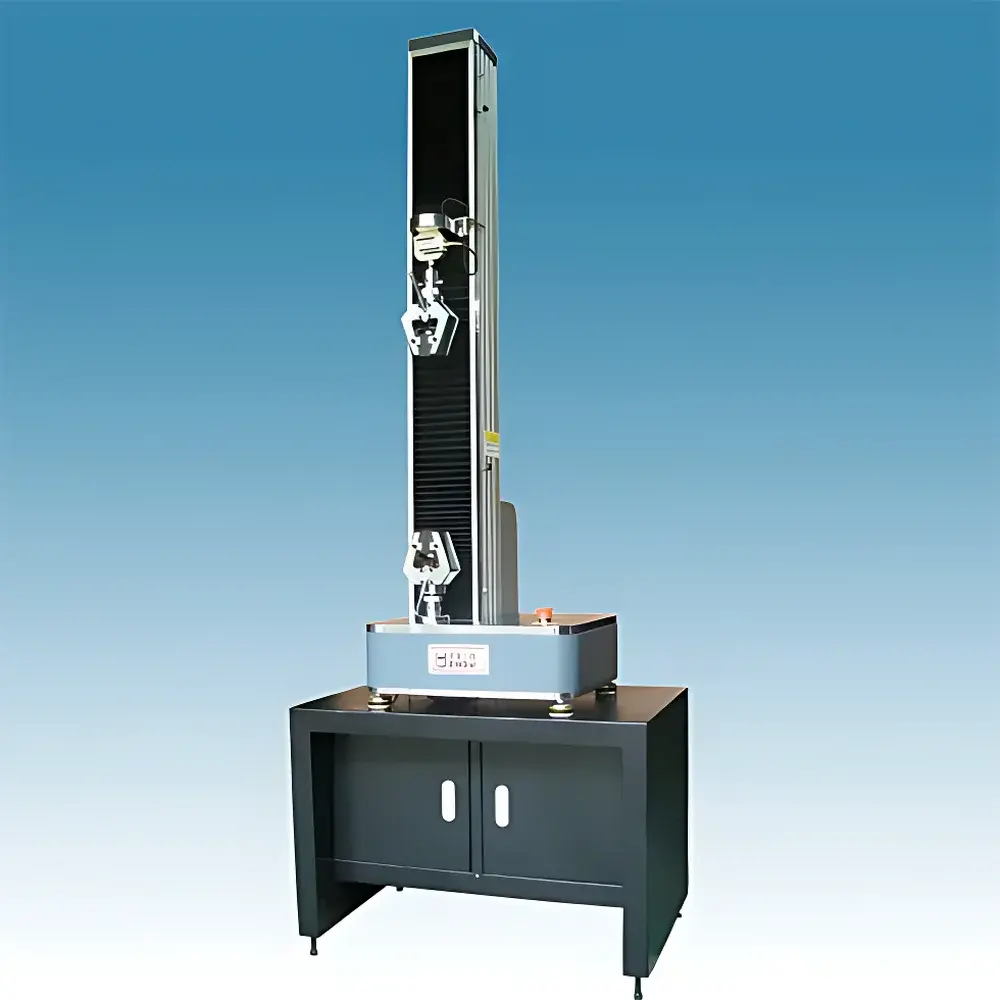
Hengyi HY-0580SWR Biological Soft Tissue Tensile Testing Machine
| Brand | Hengyi |
|---|---|
| Origin | Shanghai, China |
| Manufacturer Type | Direct Manufacturer |
| Product Category | Domestic |
| Model | HY-0580SWR |
| Instrument Type | Electromechanical Tensile Testing Machine |
| Maximum Test Load | 5 kN |
| Force Measurement Range | 0.001–100% FS |
| Force Accuracy | ±0.5% of reading |
| Test Stroke | 800 mm |
| Displacement Resolution | 0.001 mm |
| Effective Test Width | 120 mm |
| Speed Range | 0.001–500 mm/min (adjustable) |
| Speed Accuracy | ±0.5% of set value |
| Displacement Measurement Accuracy | ±0.5% of reading |
| Stress/Strain Control Rate Range | 0.002–6% FS/S |
| Load Cell Options | 1 N to 5,000 N (multi-range compatible) |
| Power Supply | 220 V AC, 50 Hz |
| Power Consumption | 750 W |
| Net Weight | 95 kg |
| Dimensions (W×D×H) | 470 × 400 × 1510 mm |
Overview
The Hengyi HY-0580SWR Biological Soft Tissue Tensile Testing Machine is a high-precision electromechanical universal testing system engineered for static and quasi-static mechanical characterization of biological soft tissues, medical devices, and biomaterials. It operates on the principle of controlled uniaxial loading—applying precisely regulated tensile, compressive, flexural, shear, or peel forces to specimens while synchronously recording load, displacement, and deformation data in real time. Designed specifically for biomechanical laboratories, regulatory R&D centers, and orthopedic device manufacturers, the HY-0580SWR meets the stringent demands of ISO 5832, ASTM F2118, ASTM F2125, ISO 14879-1 (for bone cements), and USP (mechanical testing of surgical implants). Its robust architecture supports reproducible testing under GLP-compliant workflows and provides traceable force calibration per ISO 7500-1 Class 0.5.
Key Features
- High-resolution force measurement with dual-range load cells (1 N to 5,000 N), enabling seamless transition between delicate soft tissue samples (e.g., arterial grafts, corneal strips) and rigid orthopedic constructs (e.g., spinal cages, intramedullary nails).
- Full-scale displacement resolution of 0.001 mm and closed-loop speed control (0.001–500 mm/min), ensuring accurate strain-rate-dependent response capture across viscoelastic regimes.
- Integrated electronic limit protection, overload shutdown (>110% FS), and automatic return-to-start functionality—critical for operator safety and test repeatability in high-throughput environments.
- Modular test fixture interface supporting standardized grips (pneumatic, wedge, pin-and-slot), environmental chambers (optional), and video extensometry integration for non-contact strain mapping.
- Self-diagnostic firmware that continuously monitors drive system voltage, current, thermal load, and sensor linearity—triggering alerts prior to drift or failure.
- Compliance with electromagnetic compatibility (EMC) standards IEC 61326-1 and electrical safety standard IEC 61010-1 for laboratory instrumentation.
Sample Compatibility & Compliance
The HY-0580SWR accommodates a broad spectrum of specimen geometries and material classes relevant to translational biomedical research and regulatory submission. Validated applications include tensile testing of vascular grafts (PTFE, ePTFE, decellularized scaffolds), mechanical evaluation of osteochondral explants, fatigue cycling of suture anchors, bending tests on titanium spinal rods per ASTM F2624, and compression testing of vertebral body replacements per ISO 12189. All test protocols support audit-ready metadata logging—including operator ID, calibration certificate IDs, environmental conditions (temperature/humidity), and timestamped raw data files—enabling full traceability for FDA 21 CFR Part 11 compliance when paired with validated software configurations.
Software & Data Management
Bundled Hengyi TestMaster v4.2 software delivers ISO/IEC 17025-aligned test sequence automation, real-time curve overlay, and customizable report generation (PDF, Excel, XML). The platform implements role-based user access control, electronic signatures, and immutable audit trails for all method edits, calibration events, and result exports. Raw data is stored in vendor-neutral .csv and .tdms formats, facilitating third-party analysis in MATLAB, Python (SciPy/Pandas), or commercial biomechanics toolkits such as MIMICS or ANSYS Mechanical. Optional API integration enables direct data ingestion into LIMS systems (e.g., LabVantage, Thermo Fisher SampleManager) via RESTful endpoints.
Applications
- Mechanical validation of tissue-engineered constructs under physiological strain rates (0.01–1%/s)
- Comparative strength assessment of bioresorbable fixation devices (PLLA, Mg alloys) per ISO 10993-12
- Creep and stress-relaxation profiling of hydrogel-based wound dressings
- Interfacial bond strength testing of ceramic coatings on metallic orthopedic substrates
- Dynamic fatigue life estimation of polyethylene acetabular liners (ASTM F2003)
- Standardized suture pullout testing in porcine cortical bone models (ASTM F2182)
- Multi-cycle hysteresis analysis of elastomeric cardiac patches
FAQ
Is the HY-0580SWR compliant with FDA 21 CFR Part 11 requirements?
Yes—when deployed with Hengyi TestMaster v4.2 in validated configuration (including electronic signature modules, audit trail encryption, and password policy enforcement), the system supports Part 11 compliance for electronic records and signatures.
Can the machine perform cyclic fatigue testing?
The HY-0580SWR supports programmable load/displacement waveforms (sine, triangle, trapezoidal) up to 5 Hz frequency; however, dedicated high-cycle fatigue testing (>10⁵ cycles) requires optional servo-hydraulic actuation upgrade.
What calibration standards are supported?
Force calibration adheres to ISO 7500-1 Class 0.5; displacement verification follows ISO 9513 Class 0.5. Certificate of Calibration includes NIST-traceable references and uncertainty budgets.
Does the system support ASTM/ISO test method templates?
Preloaded templates cover ASTM D638 (plastics), ASTM F1825 (sutures), ISO 527-1 (tensile properties), and ISO 1798 (foam materials); custom methods can be defined using scriptable test step logic.
Is environmental chamber integration available?
Yes—standardized mounting brackets and temperature-controlled chamber interfaces (−20°C to +60°C) are available as factory-installed options with humidity monitoring capability (20–80% RH).



