
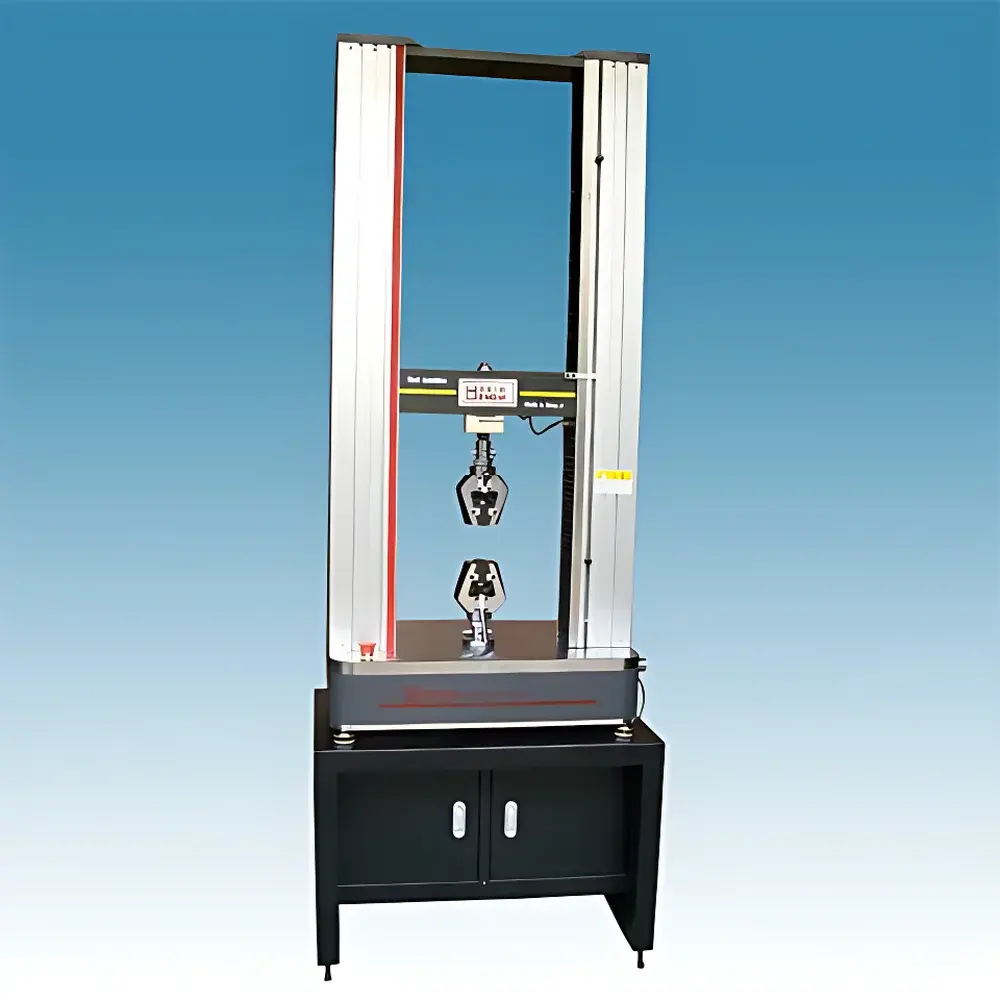
Hengyi HY-0580 (Dual-Arm) Computer-Controlled Electromechanical Fatigue Testing Machine
| Brand | Hengyi / Hengyitest |
|---|---|
| Origin | Shanghai, China |
| Manufacturer Type | Direct Manufacturer |
| Country of Origin | China |
| Model | HY-0580 (Dual-Arm) YJHMN |
| Load Capacity | 5000 N |
| Accuracy Class | 0.5 |
| Effective Test Width | 380 mm |
| Effective Test Height | 800 mm |
| Test Speed Range | 1–500 mm/min |
| Speed Accuracy | ±0.5% of indicated value |
| Displacement Measurement Accuracy | ±0.5% of indicated value |
| Strain Measurement Accuracy | ±0.5% of indicated value |
| Dynamic Frequency Range | 0.01–200 Hz |
| Maximum Dynamic Sampling Rate | 10,000 Hz |
| Waveform Options | Sine, Triangle, Square, Ramp, Trapezoidal, User-Defined |
| Control System | PC-based closed-loop electromechanical control |
| Power Supply | 220 V AC, 50 Hz, 1500 W |
| Host Weight | 180 kg |
| Overall Dimensions | 680 × 400 × 1420 mm |
| Operating Temperature | 10–35 °C (±2 °C/h fluctuation) |
| Relative Humidity | <80% RH |
| Electromagnetic Interference | Minimal environment required |
Overview
The Hengyi HY-0580 (Dual-Arm) Computer-Controlled Electromechanical Fatigue Testing Machine is a precision-engineered dynamic mechanical testing system designed for high-reproducibility fatigue and static mechanical characterization of small-scale specimens. Unlike hydraulic or servo-hydraulic systems, this instrument employs a direct-drive linear motor actuator mounted in an upper-positioned configuration within a dual-column rigid frame—eliminating the need for hydraulic fluid, lubricants, or complex sealing mechanisms. Its operation is grounded in closed-loop electromechanical force and displacement control, enabling precise waveform generation (sine, triangle, square, ramp, trapezoidal, and user-defined) across a broad frequency spectrum from 0.01 Hz to 200 Hz. The system complies with fundamental metrological and structural requirements defined in GB/T 2611–2007 (General Technical Requirements for Testing Machines) and JB 9397–2002 (Technical Specifications for Tension-Compression Fatigue Testing Machines), while also supporting test method alignment with ISO 1099, ASTM E466, ASTM E606, ISO 6892-1, and EN 10002-1 through customizable test protocols.
Key Features
- Dual-arm, dual-column structural architecture with T-slot test table—optimized for specimen stability, lateral rigidity, and accessory modularity during cyclic loading.
- Linear motor-driven actuation: zero backlash, no oil contamination, silent operation, and maintenance-free motion transmission with sub-micron positioning resolution.
- Full-range load cell (5000 N capacity, 0.5-class accuracy) featuring ±30,000-count internal resolution—no range switching required; consistent sensitivity across 0.1% to 100% of full scale.
- Real-time data acquisition at up to 10,000 Hz—sufficient to resolve harmonic content and transient responses in high-frequency fatigue regimes.
- Integrated safety architecture: electronic travel limits, overload protection (110% FS cutoff), automatic return-to-start, programmable stop conditions (time-, load-, or displacement-triggered), and self-diagnostic routines for drive, sensor, and power subsystems.
- Modular software framework supporting ISO/IEC 17025-aligned test sequence scripting, GLP-compliant audit trails, and FDA 21 CFR Part 11-ready electronic signatures (optional).
Sample Compatibility & Compliance
The HY-0580 accommodates diverse material forms—including polymeric films, elastomeric strips, textile yarns, biomedical sutures, thin metallic foils, nanocomposite ribbons, and fiber-reinforced prepreg coupons—within its 380 mm test width and 800 mm vertical stroke envelope. Specimen gripping is facilitated via pneumatic, wedge, or custom-fabricated fixtures compatible with peel (90°/180°), shear, tensile, compression, and flexural configurations. The system satisfies essential regulatory expectations for materials qualification in R&D, quality assurance, and pre-certification testing workflows. It supports traceable calibration per ISO/IEC 17025 requirements when paired with accredited external verification services. Environmental operation is specified for controlled laboratory settings (10–35 °C, <80% RH, minimal EMI), aligning with ISO 291 conditioning guidelines for polymeric and composite specimens.
Software & Data Management
Control and analysis are executed via a Windows-based application built on a deterministic real-time kernel. The interface provides synchronized visualization of force, displacement, strain, and cycle count during active testing. Post-test, users may replay raw time-series data, apply digital filtering (Butterworth, FIR), compute hysteresis loop parameters (energy dissipation, modulus degradation), generate S–N curves, and export reports in PDF, CSV, or XML formats. All data files include embedded metadata: operator ID, timestamp, calibration certificate ID, environmental log (if connected to optional sensors), and version-stamped firmware/software identifiers. Audit trail functionality records all parameter modifications, test starts/stops, and calibration events—enabling compliance with GLP, GMP, and internal QA documentation policies.
Applications
- Fatigue life assessment of medical device components (e.g., catheter shafts, suture anchors, orthopedic polymer implants).
- Cyclic mechanical endurance evaluation of elastomers, thermoplastic elastomers (TPE), and silicone rubbers under variable amplitude loading.
- Dynamic modulus and damping characterization (tan δ) of viscoelastic materials per ASTM D4065.
- Adhesion strength quantification via cyclic peel testing of pressure-sensitive adhesives and laminated packaging structures.
- High-cycle fatigue screening of micro-scale metallic alloys (e.g., NiTi shape-memory wires, stainless steel stents) under physiological or aerospace-relevant stress ratios.
- Research-grade validation of constitutive models for finite element simulation input (e.g., Mullins effect, Payne effect, ratcheting behavior).
FAQ
What standards does the HY-0580 support out-of-the-box?
Preconfigured test methods include ISO 1099 (metallic fatigue), ASTM E466 (force-controlled constant-amplitude testing), and ISO 6892-1 (tensile properties). Custom protocol development is available upon request.
Can the system perform low-cycle fatigue (LCF) and high-cycle fatigue (HCF) tests?
Yes—the 0.01–200 Hz frequency range and 10,000 Hz sampling rate enable both LCF (strain-controlled, 10⁵ cycles) regimes with appropriate extensometry and control loops.
Is third-party calibration certification included?
Factory calibration is performed using NIST-traceable reference standards; ISO/IEC 17025-accredited calibration certificates are available as an optional service.
How is data integrity ensured for regulated environments?
The software supports role-based access control, electronic signatures, immutable audit logs, and encrypted local storage—all configurable to meet 21 CFR Part 11 and EU Annex 11 requirements.
What maintenance is required for the linear motor actuator?
None—linear motors operate without contact, wear-prone components, or consumables; only periodic visual inspection and environmental cleanliness are recommended.



