
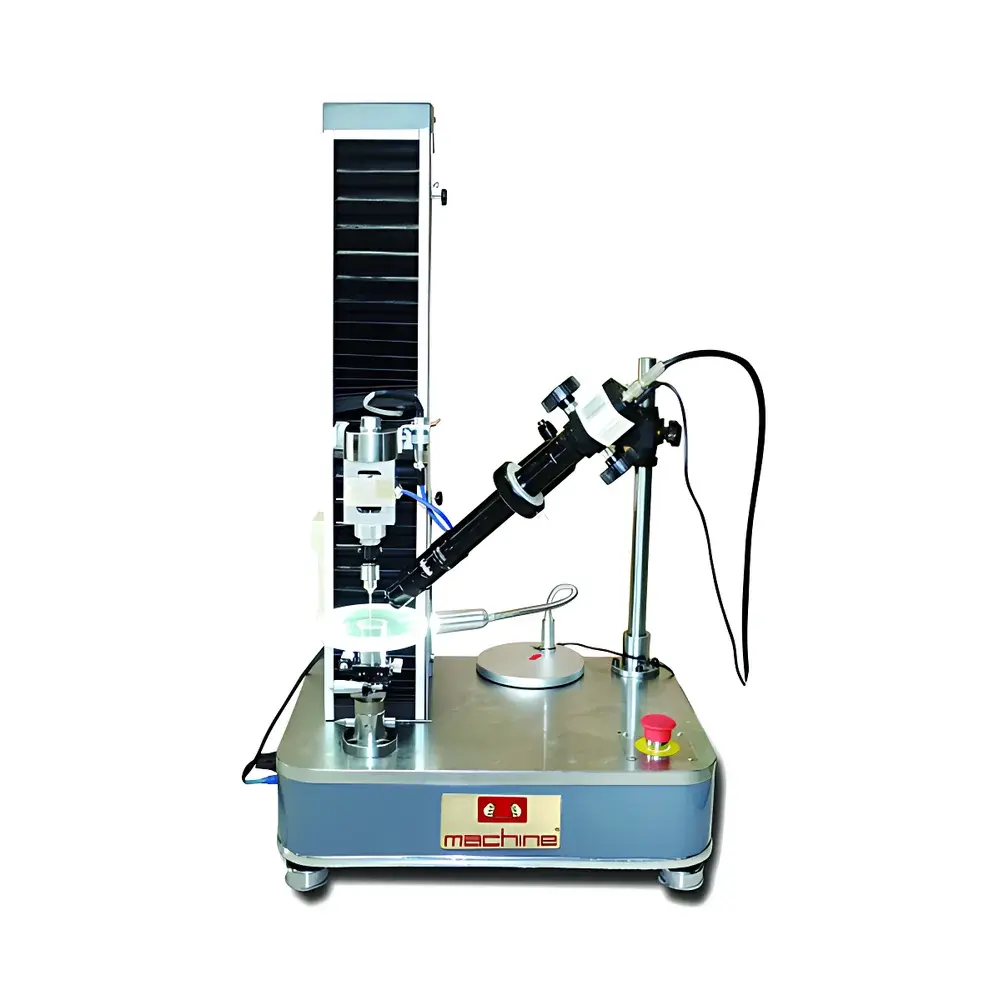
Hengyi HY-0350(SZ) Chip Pull-Off Force Tester
| Brand | Hengyi |
|---|---|
| Origin | Shanghai, China |
| Manufacturer Type | Direct Manufacturer |
| Country of Origin | China |
| Model | HY-0350(SZ) |
| Quotation | Available upon Request |
| Load Capacity | 1 N |
| Accuracy Class | 0.5 |
| Effective Force Measurement Range | 0.2%–99.999% of full scale |
| Force Resolution | ±500,000 counts (full-scale, no range switching) |
| Effective Test Width | 250 mm |
| Effective Vertical Travel | 100 mm |
| Test Speed | 0.001–300 mm/min (adjustable) |
| Speed Accuracy | ±0.5% of indicated value |
| Displacement Accuracy | ±0.5% of indicated value |
| Strain Control Rate Range | 0.002–6% FS/s |
| Stress Control Rate Range | 0.005–6% FS/s |
| Constant-Load/Displacement/Strain Measurement Range | 0.5–99.999% FS |
| Protection Features | Electronic limit switches, overload protection (110% FS), automatic fault diagnosis, emergency stop |
| Power Supply | 220 V AC, single-phase, 400 W |
| Net Weight | 95 kg |
Overview
The Hengyi HY-0350(SZ) Chip Pull-Off Force Tester is a precision electromechanical testing system engineered for quantitative mechanical evaluation of adhesive bond integrity in semiconductor packaging and microelectronic assembly processes. It operates on the principle of controlled uniaxial tensile separation—applying a vertically oriented, programmable displacement to a bonded chip-substrate interface while continuously measuring the resulting force response. The instrument integrates high-resolution load cell technology (1 N capacity, Class 0.5 accuracy per ISO 7500-1), closed-loop motion control, and real-time data acquisition to capture critical mechanical parameters including peak pull-off force, detachment onset displacement, and interfacial failure mode signatures. Designed specifically for quality assurance in wafer-level packaging, flip-chip bonding, and die-attach process validation, the system supports standardized test protocols aligned with JEDEC JESD22-B111 (Pull Test Method for Solder Ball Attachments) and IPC-TM-650 2.4.28 (Bond Strength Testing for Microelectronic Devices).
Key Features
- Precision load measurement with ±500,000-count resolution across full 1 N range—no auto-ranging or hardware scaling required, ensuring consistent sensitivity from 0.2% to 99.999% FS.
- Motorized Z-axis actuator with dual-speed control (fast jog + fine positioning), enabling rapid sample setup and sub-micron approach accuracy prior to contact detection.
- Integrated optical alignment module compatible with standard industrial CCD imaging systems (not included), allowing visual verification of probe-to-bond pad registration before test initiation.
- Programmable multi-stage test profiles: user-defined ramp rates, dwell periods, constant-force holds, and conditional termination triggers (e.g., force threshold, displacement limit, time-out).
- Real-time feedback control architecture supporting stress-rate and strain-rate modes per ASTM E2309, with dynamic compensation for system compliance and thermal drift.
- Comprehensive safety architecture including electronic end-limit switches, 110% overload cutoff, self-diagnostic power-up sequence, and hardware-enforced emergency stop.
- Modular firmware architecture compliant with IEC 61508 functional safety principles; audit trail logging available via optional software configuration.
Sample Compatibility & Compliance
The HY-0350(SZ) accommodates standard IC packages—including QFN, BGA, WLCSP, and bare die mounted on FR-4, ceramic, or silicon substrates—within its 250 mm × 100 mm active test envelope. Fixturing is configurable using interchangeable collet holders and vacuum chucks (accessories sold separately). All mechanical and electrical subsystems conform to CE marking requirements (EN 61000-6-2/6-4, EN 61010-1), and the force transducer is calibrated traceable to NIM (National Institute of Metrology, China) standards. For regulated environments, optional 21 CFR Part 11-compliant software modules provide electronic signature support, change control logs, and immutable raw data archiving—enabling use in GLP/GMP-certified laboratories conducting qualification testing per ISO/IEC 17025.
Software & Data Management
Bundled Hengyi TestMaster v4.x software provides intuitive test method definition, live curve visualization (force vs. displacement, stress vs. strain), and automated pass/fail evaluation against user-specified thresholds (e.g., ≥5 gf minimum pull strength). Raw ASCII and binary data files include full metadata (timestamp, operator ID, calibration certificate ID, environmental conditions). Export formats include CSV, XML, and PDF reports compliant with ISO 10012 requirements. Optional cloud-sync module enables centralized database aggregation across multiple instruments, supporting SPC analysis and trend monitoring of bond strength distributions over production lots. All software updates undergo regression-tested validation per IEEE 1012, with version-controlled release notes archived for audit readiness.
Applications
- Qualification and routine monitoring of die-attach adhesives (epoxy, silver sinter, conductive paste) in power electronics and automotive MCU modules.
- Process window development for thermosonic wire bonding and solder reflow profiles in advanced packaging lines.
- Comparative evaluation of underfill material performance under thermal cycling stress (pre/post-conditioning pull tests).
- Failure analysis root cause determination—distinguishing cohesive failure (within adhesive bulk) from interfacial failure (at chip/substrate boundary) via force-displacement curve morphology.
- Supplier incoming inspection for third-party packaged components, supporting AQL-based sampling plans per ISO 2859-1.
FAQ
What is the minimum detectable force resolution at full 1 N capacity?
The system achieves 20 nN effective resolution (1 N ÷ 500,000 counts), validated per ISO 376 Annex C procedures.
Can the tester be integrated into an automated production line?
Yes—RS-232, Ethernet TCP/IP, and optional digital I/O interfaces support PLC handshaking and recipe-based test execution in inline manufacturing cells.
Is calibration documentation provided with shipment?
Each unit ships with a factory calibration certificate traceable to NIM, including as-found/as-left data, uncertainty budgets, and environmental conditions during verification.
Does the system support custom test method scripting?
Advanced users may implement Python-based test logic via the exposed COM API; script templates for JEDEC and IPC methods are pre-installed.
What maintenance intervals are recommended for long-term accuracy retention?
Annual recalibration is advised; quarterly verification using certified reference loads (50 mN, 500 mN, 1 N) is recommended per ISO/IEC 17025 Clause 6.5.2.
Related Products



