
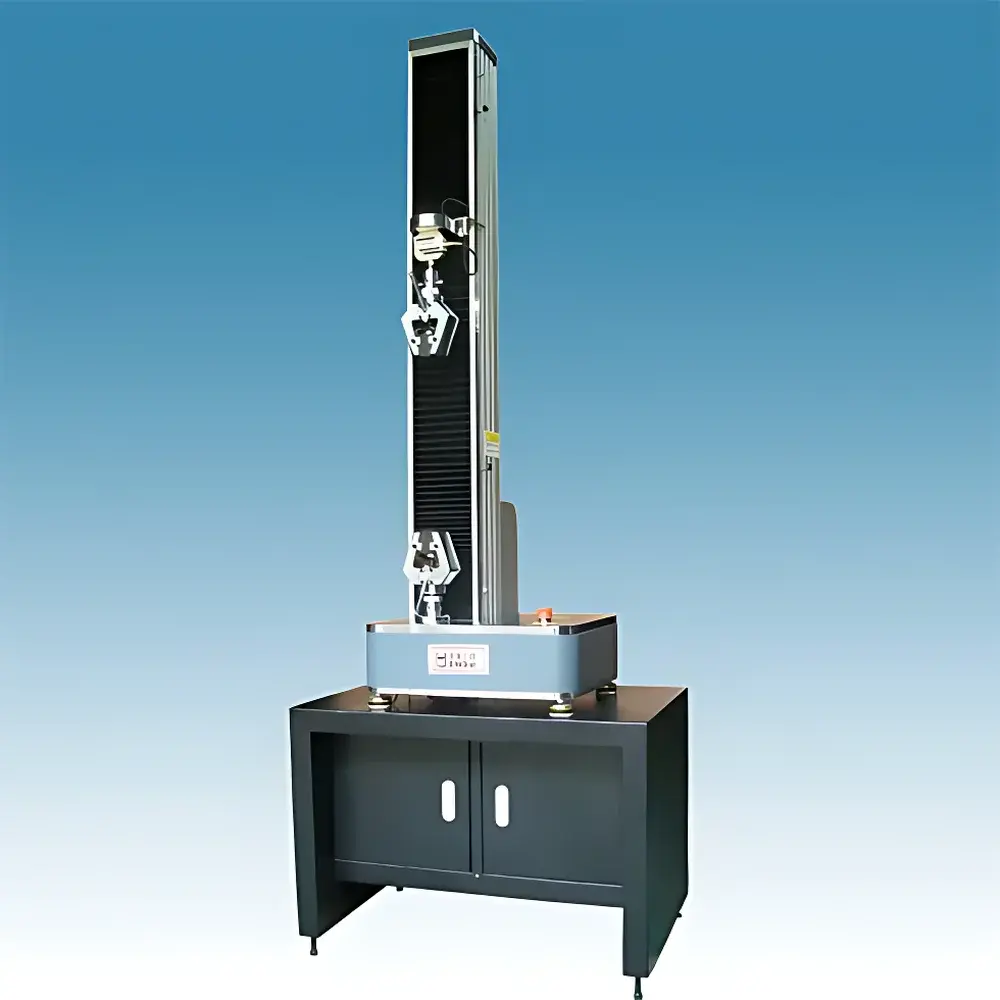
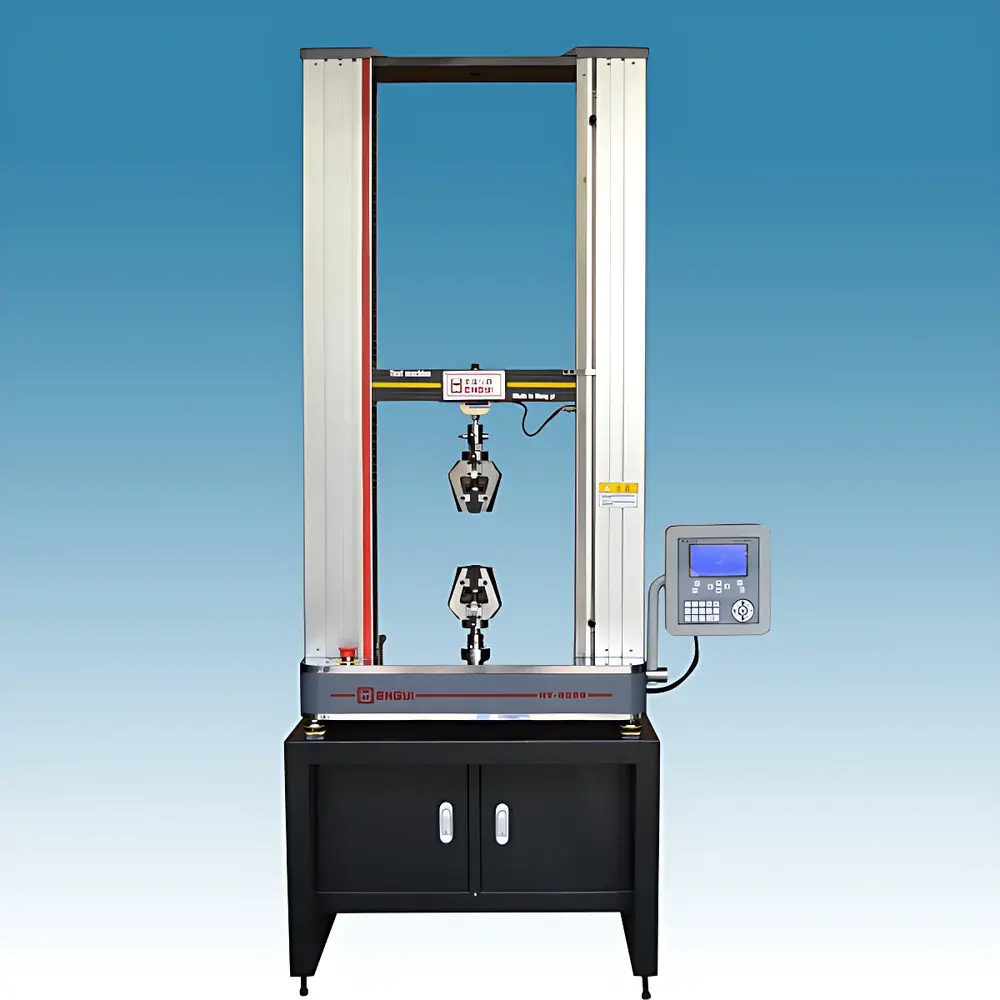
Hengyi HY-0580TYJNN Universal Testing Machine for Medical Devices
| Brand | Hengyi |
|---|---|
| Origin | Shanghai, China |
| Manufacturer Type | Direct Manufacturer |
| Product Category | Domestic |
| Model | HY-0580TYJNN |
| Price Range | USD 1,400 – 7,200 |
| Instrument Type | Electromechanical Universal Testing Machine |
| Max Load Capacity | Up to 5,000 N |
| Accuracy Class | 0.5 |
| Effective Test Width | 120 mm |
| Vertical Test Space | 800 mm |
| Speed Range | 0.001–500 mm/min |
| Speed Accuracy | ±0.5% of indicated value |
| Displacement Measurement Accuracy | ±0.5% of indicated value |
| Force Resolution | ±500,000 counts at full scale (no internal range switching) |
| Control Modes | Stress, Strain, Load, and Displacement closed-loop |
| Compliance | GB/T 16491–2008, ASTM E4, ASTM D638, ISO 527, ISO 179, ISO 6892, JIS Z2241 |
Overview
The Hengyi HY-0580TYJNN Universal Testing Machine is an electromechanical, single-column tensile and compression testing system engineered for precision mechanical characterization of medical devices, biomaterials, and pharmaceutical packaging components. Designed in strict accordance with GB/T 16491–2008 (equivalent to ISO 7500-1 Class 0.5), it delivers traceable force measurement accuracy, high reproducibility across repeated cycles, and robust architecture suitable for regulated laboratory environments. Its core principle relies on servo-controlled electromechanical actuation combined with high-resolution load cell feedback and real-time closed-loop control of stress, strain, load, or displacement—enabling compliance with dynamic and quasi-static test protocols required by ISO 10993, USP , ASTM F2193 (for suture strength), ASTM F1825 (for orthopedic implant fixation), and FDA-recommended mechanical validation practices. The machine supports both static and time-dependent mechanical assessments—including tensile strength, elongation at break, Young’s modulus, yield point, tear resistance, peel adhesion (90°/180°), puncture force, and relaxation behavior—without hardware reconfiguration.
Key Features
- Single-column modular frame constructed from high-rigidity aluminum alloy with dual-layer baked enamel finish, optimized for long-term dimensional stability and operator ergonomics.
- Full-range force resolution of ±500,000 counts at full scale (e.g., 5,000 N), with no internal range switching—ensuring consistent resolution from 0.1% to 100% FS.
- Precise speed control from 0.001 to 500 mm/min (±0.5% accuracy), enabling low-strain-rate creep and relaxation tests as well as high-speed burst evaluations.
- Integrated electronic limit protection, overload cutoff (110% FS), and self-diagnostic routines for drive system, load cell, and encoder integrity.
- Motorized crosshead with dual-speed (fast/slow) jog control and programmable return-to-start functionality post-test.
- Compliant with GLP/GMP data integrity requirements: all test parameters, calibration events, and user actions are timestamped and logged with audit-trail capability.
Sample Compatibility & Compliance
The HY-0580TYJNN accommodates a broad spectrum of specimen geometries and mechanical behaviors typical in biomedical R&D and quality assurance. It routinely evaluates soft biological tissues (tendon, ligament, skin, collagen hydrogels), synthetic polymers (PLA, PCL, PU), metallic implants (Ti-6Al-4V wires, stainless steel staples), composite scaffolds, drug-eluting stents, wound dressings, surgical meshes, catheters, syringe barrels, IV bags, blister packs, peel seals, and suture threads. Test fixtures include pneumatic grips, wedge-action clamps, peel arms, puncture probes, and three-point bending fixtures—all interchangeable without tools. All mechanical test methods align with internationally recognized standards including ASTM D882 (thin films), ASTM F88 (peel strength), ISO 11607-2 (sterile barrier systems), ISO 527-2 (tensile properties), and ISO 604 (rigid plastics compression). Data output meets FDA 21 CFR Part 11 requirements when paired with validated software.
Software & Data Management
The system operates via Hengyi’s proprietary Windows-based testing software, supporting method-driven test sequencing, real-time curve overlay (load vs. displacement, stress vs. strain), automatic parameter extraction (UTS, modulus, % elongation, yield offset), and customizable report generation (PDF/Excel). Raw data files are stored in ASCII-delimited format for third-party analysis (MATLAB, Python, Origin). Calibration certificates include uncertainty budgets per ISO/IEC 17025 guidelines. Software logs all user-initiated actions—including test start/stop, parameter edits, and calibration events—with immutable timestamps and operator ID tagging. Exported reports embed digital signatures and comply with ALCOA+ principles (Attributable, Legible, Contemporaneous, Original, Accurate, Complete, Consistent, Enduring, Available).
Applications
- Mechanical validation of resorbable sutures per ASTM D2256 and ISO 10555-1.
- Tensile and fatigue testing of cardiovascular stent struts under simulated physiological loading.
- Peel strength assessment of sterile barrier packaging per ISO 11607-2 Annex B.
- Compression modulus determination of bone graft substitutes and dental composites.
- Adhesion strength quantification of pressure-sensitive medical tapes and transdermal patches.
- Dynamic mechanical analysis (DMA-like) of hydrogel viscoelasticity using controlled-rate relaxation protocols.
- Quality control of polymer extrusion consistency via tensile property trending across production batches.
FAQ
Does the HY-0580TYJNN support ASTM F2193-compliant suture testing?
Yes—the system includes dedicated suture test modules with adjustable grip separation, programmable pre-tension, and automatic calculation of breaking load, elongation, and knot strength per ASTM F2193 and ISO 10555-1.
Can it perform cyclic fatigue testing on orthopedic implants?
While primarily designed for static and quasi-static tests, optional add-on modules enable low-frequency sinusoidal loading (up to 5 Hz) for preliminary fatigue screening; full high-cycle fatigue requires dedicated servo-hydraulic systems.
Is calibration traceable to national metrology institutes?
All factory calibrations are performed using NIST-traceable deadweight standards and documented in accordance with ISO/IEC 17025; on-site recalibration services include certificate of conformance with measurement uncertainty.
What is the minimum measurable force at 5,000 N capacity?
With ±500,000-count resolution and 0.1% FS lower limit, the system resolves down to 5 N (0.1% of 5,000 N) with ±0.5% linearity error—suitable for micro-scale tissue samples and thin-film peel testing.
How is data integrity ensured during regulatory audits?
The software enforces role-based access control, auto-generates electronic records with digital signatures, prevents manual data alteration, and retains full audit trails—including failed login attempts, calibration history, and test parameter revisions—for ≥30 years per GxP retention policies.



