
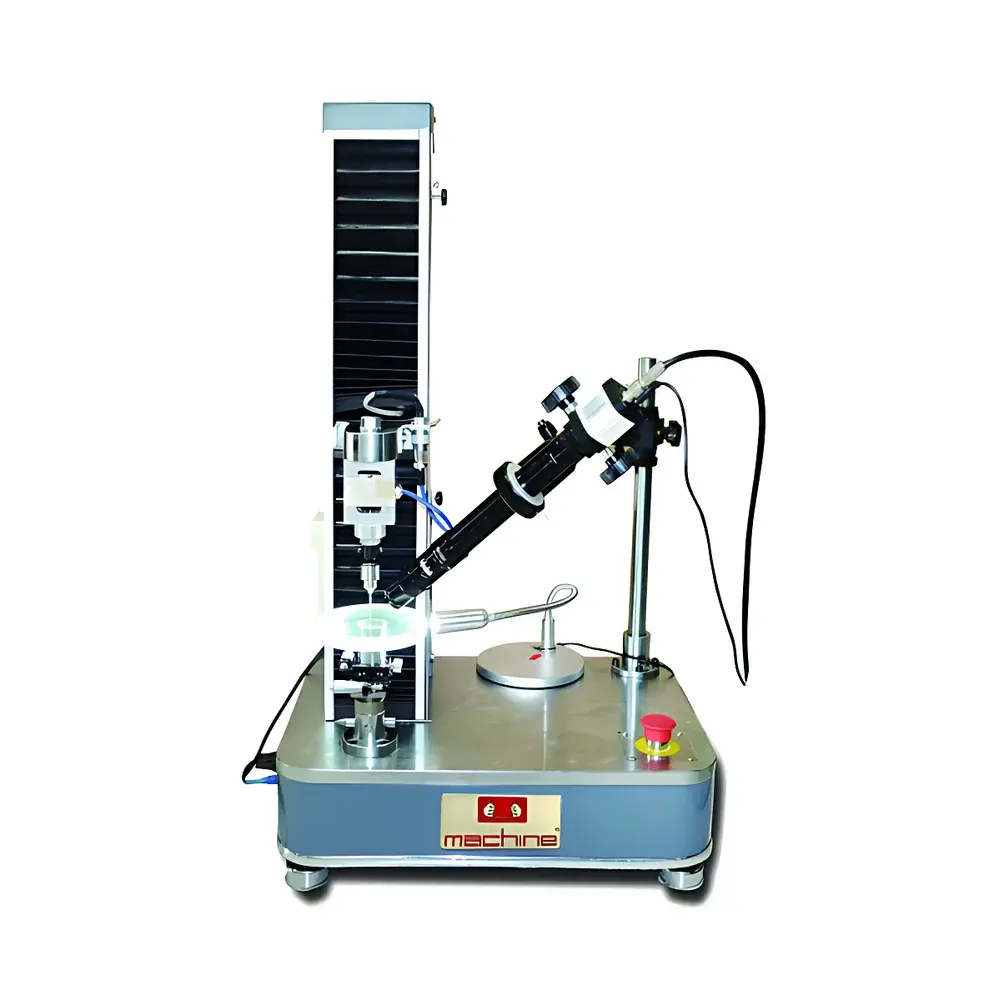
Hengyi HY-0350(SZ) Computer-Controlled XY Biaxial Force Testing System
| Brand | Hengyi |
|---|---|
| Origin | Shanghai, China |
| Manufacturer Type | Direct Manufacturer |
| Country of Origin | China |
| Model | HY-0350(SZ) |
| Price | Upon Request |
| Load Capacity | 1 N |
| Accuracy Class | 0.5 |
| Effective Force Range | 0.2%–99.999% of full scale |
| Force Resolution | ±500,000 counts (full-scale, no range switching) |
| Effective Test Width | 250 mm |
| Effective Vertical Travel | 100 mm |
| Test Speed | 0.001–300 mm/min (adjustable) |
| Speed Accuracy | ±0.5% of indicated value |
| Displacement Measurement Accuracy | ±0.5% of indicated value |
| Strain Control Rate Range | 0.002–6% FS/S |
| Stress Control Rate Range | 0.005–6% FS/S |
| Constant-Load/Displacement/Strain Accuracy | ±1% (if setpoint <10% FS), ±0.1% (if ≥10% FS) |
| Overload Protection | Activates at >110% of full scale |
| Power Supply | 220 V AC, single-phase |
| Rated Power | 400 W |
| Net Weight | 95 kg |
Overview
The Hengyi HY-0350(SZ) Computer-Controlled XY Biaxial Force Testing System is a precision mechanical characterization instrument engineered for micro-force evaluation in semiconductor packaging and microelectronics assembly validation. It implements a dual-axis (X–Y) motorized stage combined with high-resolution Z-axis force actuation to perform controlled, repeatable pull-off and shear tests on miniature bonded interfaces—particularly chip-to-substrate adhesive joints. The system operates on the principle of quasi-static tensile or lateral displacement under closed-loop load control, with real-time force–displacement data acquisition synchronized to optical positioning feedback from an integrated CCD imaging module. Designed to meet the metrological requirements of micro-scale interfacial strength assessment, it supports pass/fail verification against predefined force thresholds—such as the industry-typical 5 g (≈49 mN) pull strength criterion for die-attach integrity—while maintaining traceable calibration per ISO 7500-1 (Class 0.5 accuracy) and compliant with general principles of GLP-aligned test documentation.
Key Features
- Motorized XY translation stage with sub-micron repeatability, enabling precise alignment of probe tip relative to bond pad coordinates prior to force application.
- High-sensitivity 1 N load cell with ±500,000 internal resolution, offering stable force measurement across the entire dynamic range (0.2%–99.999% FS) without auto-ranging artifacts.
- Programmable Z-axis motion from 0.001 to 300 mm/min, supporting both slow quasi-static ramping and rapid positioning—critical for minimizing inertial loading effects during micro-bond detachment.
- Integrated CCD camera system with adjustable magnification and real-time overlay of crosshair markers, allowing visual confirmation of initial contact point and deformation onset before force initiation.
- Dual-mode control architecture: stress-controlled (MPa/s) and strain-controlled (%/s) testing protocols, configurable via software-defined profiles to replicate thermal-mechanical loading histories.
- Comprehensive hardware safety suite including electronic travel limits, overload cutoff (>110% FS), automatic return-to-home, and real-time diagnostics for drive voltage, current, and sensor signal integrity.
Sample Compatibility & Compliance
The HY-0350(SZ) accommodates standard wafer-level test substrates, leadframes, PCB-mounted dies, and wire-bonded assemblies up to 250 mm wide and 100 mm vertical clearance. Its low-force capability (down to 0.2% of 1 N ≈ 2 mN) ensures suitability for fragile microstructures—including thin-film adhesives, anisotropic conductive films (ACF), and underfill materials—without inducing parasitic bending or substrate fracture. The system conforms to fundamental mechanical testing standards including ISO 11359-2 (dynamic mechanical analysis principles), ASTM F467M (standard guide for microelectronic package mechanical testing), and supports audit-ready data logging aligned with FDA 21 CFR Part 11 requirements when paired with validated software configurations.
Software & Data Management
Control and analysis are executed via proprietary Windows-based software featuring intuitive workflow sequencing, multi-step test scripting (e.g., dwell → ramp → hold → retract), and synchronized video capture timestamping. All raw force–displacement curves are stored in IEEE-compliant binary format with embedded metadata (operator ID, sample ID, calibration certificate ID, environmental conditions). Export options include CSV, Excel, and PDF reports with customizable templates compliant with internal QA documentation standards. Audit trails record every parameter change, test execution event, and calibration action—including user login timestamps and digital signatures where enabled.
Applications
- Determining die shear strength and pull-off force of flip-chip solder bumps and epoxy-adhered IC packages.
- Evaluating bond line integrity in MEMS encapsulation processes under thermal cycling preconditioning.
- Quantifying interfacial adhesion energy of polymer-based underfills using controlled delamination rate protocols.
- Validating rework process impact on solder joint reliability through comparative pre- and post-reflow pull testing.
- Supporting failure mode analysis (FMA) by correlating peak force values with optical post-test fracture surface inspection.
FAQ
What is the minimum resolvable force increment on the HY-0350(SZ)?
The system achieves a theoretical force resolution of approximately 0.002 mN (2 µN) at full scale (1 N), based on its ±500,000-count A/D conversion and linear transduction characteristics.
Does the system support automated batch testing with barcode-triggered test sequences?
Yes—when integrated with optional USB barcode readers and configured with custom script logic, the software can initiate predefined test routines upon scan of sample-specific identifiers.
Is third-party calibration certification available?
Hengyi provides factory calibration certificates traceable to CNAS-accredited national metrology institutes; users may also engage ISO/IEC 17025-certified external labs for periodic verification.
Can the XY stage be used independently of force application for alignment-only tasks?
Yes—the stage supports manual jog, absolute coordinate positioning, and programmable movement sequences without engaging the Z-axis actuator or load cell.
What environmental conditions are recommended for optimal performance?
Operation is specified for ambient temperatures of 15–30 °C, relative humidity ≤80% non-condensing, and vibration-isolated benchtop mounting to maintain sub-micron positional fidelity.



