
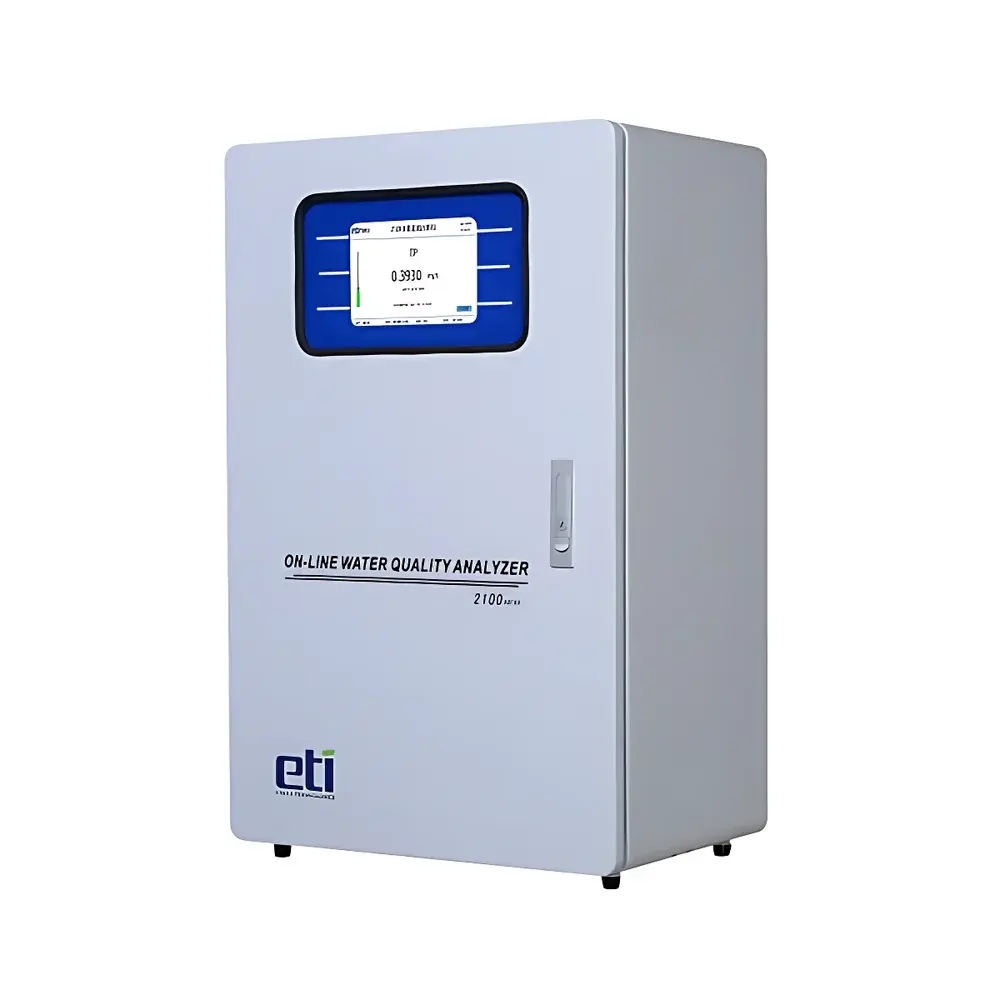
ETI 2100Plus Online Total Nitrogen Analyzer
| Brand | ETI |
|---|---|
| Origin | Guangdong, China |
| Manufacturer Type | Authorized Distributor |
| Country of Origin | China |
| Model | 2100Plus Total Nitrogen |
| Instrument Type | Online Analyzer |
| Detection Principle | Alkaline Potassium Persulfate Digestion – UV-Vis Spectrophotometry |
| Analysis Time | < 10 min |
| Accuracy/Precision | ≤ ±5% FS |
| Resolution | 0.001 mg/L |
| Measurement Ranges | 0–5 / 0–10 / 0–50 mg/L (customizable extended ranges available) |
| Operating Modes | Cyclic, Trigger-Controlled, Point-Interval, Continuous, Manual |
| QC Modes | Remote Verification, Manual Check, Automatic Verification (time-based or alarm-triggered) |
| Analog Output | 4–20 mA |
| Digital Interfaces | RS232 / RS485 |
| Power Supply | 220 ± 22 VAC, 50 ± 0.5 Hz |
| Enclosure Dimensions | 520 mm (W) × 380 mm (D) × 800 mm (H) |
| Net Weight | ~45 kg (excluding reagents) |
Overview
The ETI 2100Plus Online Total Nitrogen Analyzer is an industrial-grade, fully automated water quality monitoring system engineered for continuous, unattended measurement of total nitrogen (TN) in diverse aqueous matrices. It implements a standardized two-stage analytical protocol compliant with ISO 11908:2017 and HJ 636–2012: alkaline potassium persulfate digestion followed by ultraviolet–visible (UV-Vis) spectrophotometric quantification of nitrate. During digestion, all nitrogen species—including organic nitrogen, ammonia, and nitrite—are oxidized to nitrate under high-pH, high-temperature conditions. The resulting nitrate reacts with a proprietary chromogenic reagent under controlled pH and temperature, generating a stable colored complex measurable at a defined wavelength (typically 220 nm and optionally 275 nm for turbidity correction). This dual-wavelength absorbance ratio method minimizes interferences from dissolved organic matter and suspended solids, ensuring robustness in real-world effluent and surface water applications.
Key Features
- Modular architecture with tool-free access to fluidic, optical, and electronic subassemblies—enabling rapid maintenance and component-level replacement without system recalibration.
- Patented intelligent dilution module with automatic range switching: dynamically selects optimal dilution factor based on real-time absorbance feedback, extending linear dynamic range while preserving detection sensitivity down to 0.001 mg/L.
- High-precision syringe-driven fluid handling system with volumetric accuracy better than ±0.5% across full stroke, calibrated traceably to NIST-traceable standards.
- Integrated power-loss recovery logic: retains calibration coefficients, method parameters, and recent measurement history during outages; resumes operation automatically upon power restoration without manual intervention.
- Configurable operational modes—including cyclic (user-defined interval), trigger-controlled (external signal or alarm-initiated), point-interval (single-shot on demand), continuous (real-time streaming), and manual (service mode)—supporting both regulatory compliance and process optimization workflows.
- Onboard QC capability: supports scheduled or event-driven standard solution verification, spike recovery tests, and blank checks—all with full audit trail generation per GLP/GMP requirements.
Sample Compatibility & Compliance
The 2100Plus is validated for direct analysis of raw and pretreated water samples within pH 4–10 and turbidity ≤ 100 NTU. It accommodates inlet pressures from 0.1 to 0.6 bar and tolerates particulate loadings up to 50 mg/L total suspended solids (TSS) when paired with optional inline filtration (e.g., 40 µm stainless-steel mesh prefilter). All wetted materials—including PTFE, PFA, borosilicate glass, and 316L stainless steel—are chemically inert to common oxidants and acidic/alkaline reagents. The analyzer meets IEC 61326-1 (EMC) and IEC 61000-6-2/6-3 emission immunity standards. Its firmware supports 21 CFR Part 11-compliant user authentication, electronic signatures, and immutable audit logs for regulated environments including municipal wastewater treatment plants and industrial discharge monitoring stations.
Software & Data Management
The embedded Linux-based controller runs ETI’s AquaControl™ v4.x firmware, featuring a web-accessible interface (HTTPS/TLS 1.2) for remote configuration, diagnostics, and data export. Measurement data—including raw absorbance values, calculated TN concentration, QC status flags, and instrument health metrics—are timestamped with UTC synchronization and stored locally for ≥90 days. Data export formats include CSV, XML, and Modbus TCP for seamless integration into SCADA, DCS, or LIMS platforms. Firmware updates are delivered via signed package files with SHA-256 verification; rollback capability ensures system stability during field deployments. Role-based access control (RBAC) enforces separation of operator, technician, and administrator privileges.
Applications
- Real-time TN monitoring at drinking water intake points and reservoirs to assess eutrophication risk and support early-warning systems.
- Compliance tracking for municipal wastewater treatment plants discharging to sensitive receiving waters, aligned with EU Urban Wastewater Treatment Directive (91/271/EEC) and US EPA NPDES permit limits.
- Process control in industrial facilities—including chemical manufacturing, food & beverage processing, and semiconductor fabrication—where nitrogen loading must be minimized prior to biological treatment or reuse.
- Long-term trend analysis in river basin management programs, supporting national reporting under the Water Framework Directive (WFD) and China’s “Blue Sky & Clear Water” initiative.
- Validation of denitrification efficiency in tertiary treatment units and constructed wetlands through synchronized TN and nitrate/nitrite profiling.
FAQ
What digestion method does the 2100Plus use, and how does it ensure complete nitrogen conversion?
It employs high-efficiency alkaline potassium persulfate digestion at elevated temperature (≥120 °C) and pressure, achieving >99.5% oxidation of organic nitrogen, ammonia, and reduced nitrogen species to nitrate—validated against certified reference materials (CRMs) per ISO Guide 35 protocols.
Can the analyzer operate without on-site technical staff?
Yes. Its self-diagnostic routines monitor pump performance, optical path cleanliness, reagent depletion, and temperature stability; alerts are transmitted via email/SMS or Modbus register flags, enabling predictive maintenance scheduling.
Is remote calibration and validation supported?
Fully supported. Users can initiate standard addition, blank verification, or multi-point calibration remotely via secure web interface or Modbus command—each action logged with user ID, timestamp, and result metadata.
How is interference from chloride or bromide addressed?
Chloride concentrations up to 2,000 mg/L and bromide up to 50 mg/L have been experimentally verified to introduce <±1.2% bias in TN readings; higher halide loads require optional post-digestion silver nitrate precipitation or ion chromatography pre-separation.
What reagent shelf life and storage conditions are required?
Potassium persulfate and chromogenic reagents are supplied in stabilized liquid form with 12-month ambient storage stability (15–30 °C); refrigerated storage extends viability to 18 months. Reagent consumption averages 1.8 mL per analysis cycle.
Related Products







