
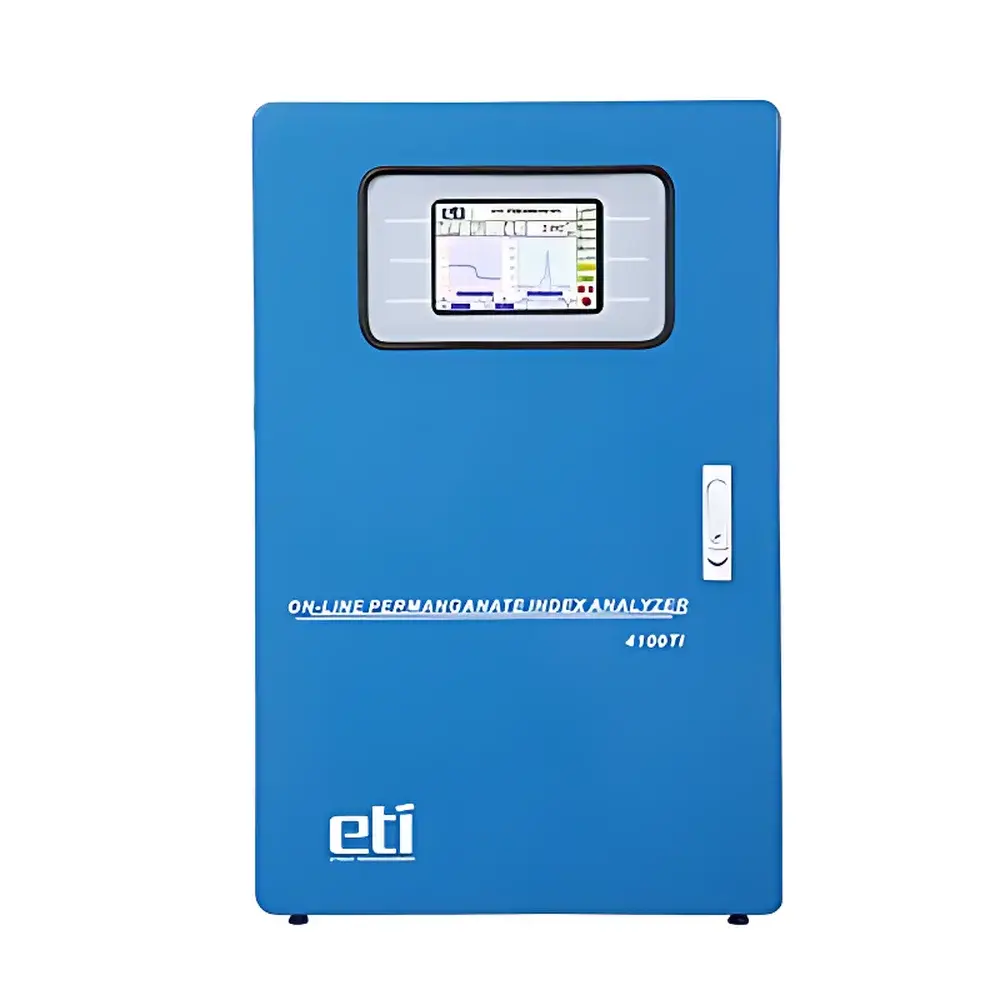
ETI 4100TI Online Permanganate Index Analyzer
| Brand | ETI |
|---|---|
| Origin | Guangdong, China |
| Manufacturer Type | Authorized Distributor |
| Country of Origin | China |
| Model | 4100TI |
| Price | Upon Request |
| Detection Principle | Potassium Permanganate Digestion – Redox Potential Titration |
| Measurement Range | 0–20 mg/L O₂ (expandable to higher ranges) |
| Measurement Modes | Cyclic, Controlled, Point, Continuous, Manual |
| Verification Modes | Remote, Manual, Automatic (time-triggered or limit-exceeded triggered) |
| Signal Output | 4–20 mA, RS232 / RS485 |
| Power Supply | 220 ± 22 VAC, 50 ± 0.5 Hz |
| Enclosure Dimensions | 520 mm (W) × 380 mm (D) × 800 mm (H) |
| Instrument Weight | ~45 kg (excluding reagents) |
Overview
The ETI 4100TI Online Permanganate Index Analyzer is an industrial-grade, fully automated water quality monitoring system engineered for continuous, unattended determination of the permanganate index (CODMn) in natural and potable water sources. It implements the standardized chemical oxidation method defined in ISO 8467:1993 and equivalent national standards (e.g., GB/T 5750.7–2006), wherein potassium permanganate serves as the oxidant under acidic, thermally controlled conditions. The instrument performs a precise redox titration sequence—initial digestion with KMnO₄ in sulfuric acid medium at elevated temperature, followed by back-titration with sodium oxalate and final potentiometric titration with standardized KMnO₄—measuring endpoint via real-time redox potential (ORP) monitoring. This electrochemical endpoint detection eliminates interference from sample color, turbidity, or suspended solids, ensuring high reproducibility in complex matrices such as surface water, raw drinking water intakes, and reservoir influents. Designed for deployment in fixed-site environmental monitoring stations, water treatment plants, and source protection zones, the 4100TI delivers traceable, auditable data compliant with routine regulatory reporting requirements.
Key Features
- Robust potentiometric endpoint detection using platinum/redox reference electrode pair—no optical components, zero drift from chromaticity or turbidity
- Integrated oil-bath heating system enabling rapid, uniform temperature control (typically 100 °C ± 0.5 °C) and fast thermal cycling via cold-oil replacement
- High-precision syringe pump with sub-μL volumetric accuracy for reagent delivery and titrant dispensing, minimizing carryover and improving long-term calibration stability
- Modular fluidic architecture with minimal dead volume and chemically resistant PTFE/PFA tubing—designed for low-maintenance operation over extended duty cycles
- Five operational modes (Cyclic, Controlled, Point, Continuous, Manual) supporting flexible integration into SCADA or PLC-based supervisory systems
- Triple-layer verification protocol: remote-initiated validation, operator-triggered check, and autonomous auto-verification triggered either on scheduled intervals or upon out-of-specification measurement alerts
Sample Compatibility & Compliance
The 4100TI accepts untreated or filtered raw water samples with turbidity ≤ 500 NTU and total suspended solids ≤ 100 mg/L. It is validated for use with surface water, groundwater, reservoir water, and finished drinking water (post-chlorination). All wetted materials comply with USP Class VI and FDA 21 CFR §177.2600 for food-contact safety. The analyzer supports GLP/GMP-aligned audit trails—including timestamped method execution logs, reagent lot tracking, operator ID association, and electronic signature-capable event records—ensuring full traceability for regulatory submissions. Its measurement methodology aligns with ISO 8467, ASTM D1253, and China’s HJ/T 100–2003 standard methods for permanganate index determination.
Software & Data Management
Embedded firmware provides local configuration via intuitive web interface (HTTPS-enabled) accessible through standard Ethernet (RJ45). Data output includes primary CODMn values (mg O₂/L), titration curve metadata (E/mV vs. volume), digestion temperature profile, and diagnostic flags (e.g., electrode response slope, pump priming status). All measurements are time-stamped with NTP-synchronized UTC clock and exported via Modbus RTU/TCP or ASCII over RS485/RS232. The 4–20 mA analog output is linearly scaled and independently configurable per range segment. Optional cloud connectivity enables secure MQTT-based telemetry to central data platforms, with built-in TLS 1.2 encryption and configurable data retention policies meeting ISO/IEC 27001-aligned cybersecurity baselines.
Applications
- Real-time monitoring of organic load in river intake points and reservoirs for early warning of algal bloom or pollution events
- Performance verification of pre-oxidation and coagulation-flocculation stages in municipal water treatment facilities
- Compliance reporting for national surface water quality classification (e.g., China’s GB 3838–2002 Class I–III waters)
- Long-term trend analysis of seasonal organic matter variation in protected watershed areas
- Integration into automated water safety plans (WSPs) per WHO guidelines, providing objective input for risk-based decision logic
FAQ
What is the typical maintenance interval for the 4100TI?
Routine maintenance—including reagent replacement, tubing inspection, and electrode cleaning—is recommended every 30 days under continuous operation; full system calibration verification is advised every 90 days.
Can the 4100TI be integrated with existing SCADA systems?
Yes—via native Modbus RTU/TCP or ASCII serial protocols over RS485/RS232, with configurable polling intervals and alarm thresholds.
Does the analyzer require daily manual intervention?
No—fully autonomous operation is supported across all five measurement modes; only periodic reagent replenishment and quarterly preventive maintenance are required.
Is the 4100TI suitable for wastewater applications?
It is optimized for low-to-moderate organic loading (0–20 mg/L O₂); for wastewater with higher CODMn, optional extended-range configurations (e.g., 0–50 mg/L) are available upon request.
How does the system ensure data integrity during power interruptions?
Non-volatile memory retains method parameters, calibration coefficients, and recent measurement history; upon restart, the unit resumes operation from last valid state without data loss.
Related Products







